Czech Surnames: The 10 Most Common, Meanings and Female Forms
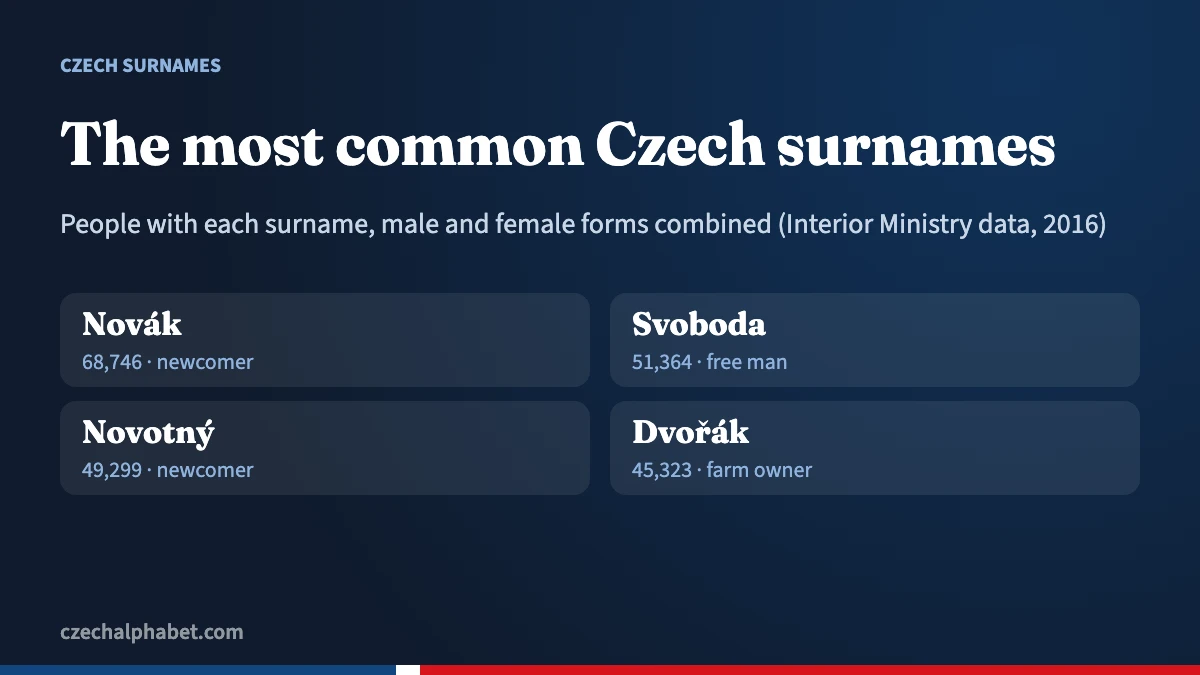
The most common Czech surname is Novák (“newcomer”), carried by about 68,700 people when you count both Novák and Nováková. Next come Svoboda, Novotný, Dvořák and Černý. Most Czech surnames come from jobs, nicknames, places or first names, and women’s forms usually end in -ová or -á.
The 10 most common Czech surnames
Counts below are the Interior Ministry’s register figures as published in 2016, adding the male and female forms together. The ministry stopped releasing name statistics after 2016, citing data protection, so these remain the most recent official totals.
| # | Surname (male / female) | People | Meaning |
|---|---|---|---|
| 1 | Novák / Nováková | 68,746 | A newcomer to a village |
| 2 | Svoboda / Svobodová | 51,364 | “Freedom”: a free man, not a serf |
| 3 | Novotný / Novotná | 49,299 | From nový, new: also a newcomer |
| 4 | Dvořák / Dvořáková | 45,323 | From dvůr, farmstead: a farmer with his own farm |
| 5 | Černý / Černá | 36,125 | “Black”: dark hair or complexion |
| 6 | Procházka / Procházková | 32,312 | “A walk”: a wanderer, like English Walker |
| 7 | Kučera / Kučerová | 30,829 | “A curl”: someone with curly hair |
| 8 | Veselý / Veselá | 26,397 | “Cheerful” |
| 9 | Horák / Horáková | 24,691 | A highlander, or someone from the Horácko region |
| 10 | Němec / Němcová | 22,639 | “German”, from an old word for someone who could not speak Slavic |
Novák is so common that in 2017 register data the female form Nováková (34,759 people) had overtaken the male Novák (33,870). Czech first names have their own page.
Where Czech surnames come from
- Jobs: Kovář (smith), Krejčí (tailor), Mlynář (miller), Sedlák (farmer), Kolář (wheelwright), Řezník (butcher).
- Looks and character: Černý (black), Bílý (white), Malý (small), Veselý (cheerful), Kučera (curly), Hrubý (coarse).
- Places and origins: Horák (highlander), Moravec (from Moravia), Slezák (from Silesia), Němec (German), Pražák (from Prague).
- First names: Janků, Pavlů and Martinů mean “Jan’s”, “Pavel’s”, “Martin’s” family. Havel, Beneš (from Benedikt) and Šimek (from Šimon) work the same way.
- Newcomers and status: Novák, Novotný (new arrival), Svoboda (free man), Dvořák (farm owner).
Female surnames: -ová and -á
Czech traditionally adds a feminine ending to a woman’s surname. There are three main patterns, and a few names don’t change at all.
Follows the standard patterns. Unusual or foreign names can differ, so check with the person.
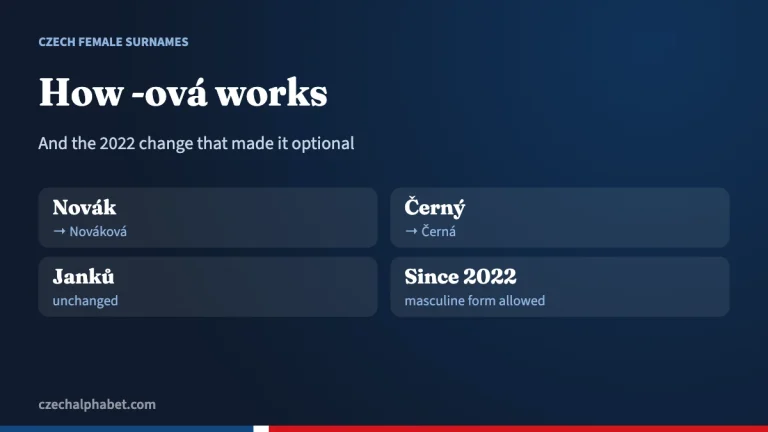
- Noun surnames add -ová: Novák → Nováková, Svoboda → Svobodová, Hájek → Hájková.
- Adjective surnames swap -ý for -á: Černý → Černá, Novotný → Novotná.
- Some never change: names ending in -ů (Janků) or -í (Krejčí).
Since 1 January 2022, an amendment to the Registry Act lets any woman have her surname recorded in the masculine form without giving a reason, so you will now meet women called, for example, Jana Novák. Parents can also choose the unfeminised form for a daughter at birth. More detail is on Czech female surnames.
How to pronounce common surnames
| Surname | Say it | Tip |
|---|---|---|
| Dvořák | DVOH-rzhahk | ř is one sound: a trilled r with a buzz. See Ř. |
| Černý | CHEHR-nee | č = ch in church |
| Procházka | PROH-khahs-kah | ch = Scottish loch |
| Kučera | KOO-cheh-rah | Stress on the first syllable, always |
| Němec | NYEH-mets | ě softens n to “ny”; c = ts |
| Veselý | VEH-seh-lee | Final ý is a long “ee” |
Finding Czech ancestors: spelling changes to expect
Emigrants’ names were often respelled by clerks who didn’t know Czech accents. When you search records, try these variants:
- Accents dropped: Dvořák → Dvorak, Černý → Cerny, Kučera → Kucera.
- German-style spellings (common in records before 1918): Č → Cz or Tsch (Černý → Czerny), Š → Sch, V → W (Svoboda → Swoboda).
- Polish-looking spellings: Novák → Nowak, Dvořák → Dworak.
- Female forms in records: a mother listed as Marie Nováková is the wife of Jan Novák, not a different family.
Frequently asked questions
What is the most common surname in the Czech Republic?
Novák, with Nováková the most common female surname. Together they cover about 68,700 people.
Why do Czech women’s surnames end in -ová?
Czech is a gendered language, and surnames traditionally take a feminine form. Since 2022 women can choose the masculine form instead.
What does Dvořák mean?
It comes from dvůr, a farmstead or manor: a farmer who held his own farm.
Do Czech surnames change in sentences?
Yes. Surnames decline like other words: “Mr Novák!” is pane Nováku!, and “with the Nováks” is s Novákovými.
Keep going
- Czech first names and the most popular baby names
- Czech female surnames and the 2022 law
- How to pronounce Czech names
- Czech name days
Sources
- Eurozprávy, Interior Ministry surname counts, 11 Jun 2016: eurozpravy.cz
- Novinky.cz, 2017 register data (Česko v datech): novinky.cz
- CNN Prima News, on the ministry withholding name statistics since 2016 (2023): cnn.iprima.cz
- Dictionary of Family Names in the Visegrad Countries (ELTE): Novák, Kučera, Horák
- Radio Prague International, on Svoboda and Dvořák: english.radio.cz
- Interior Ministry announcement on unfeminised surnames from 2022, via Právní prostor: pravniprostor.cz