Thank You in Czech: Děkuji, Děkuju, Díky and How to Reply
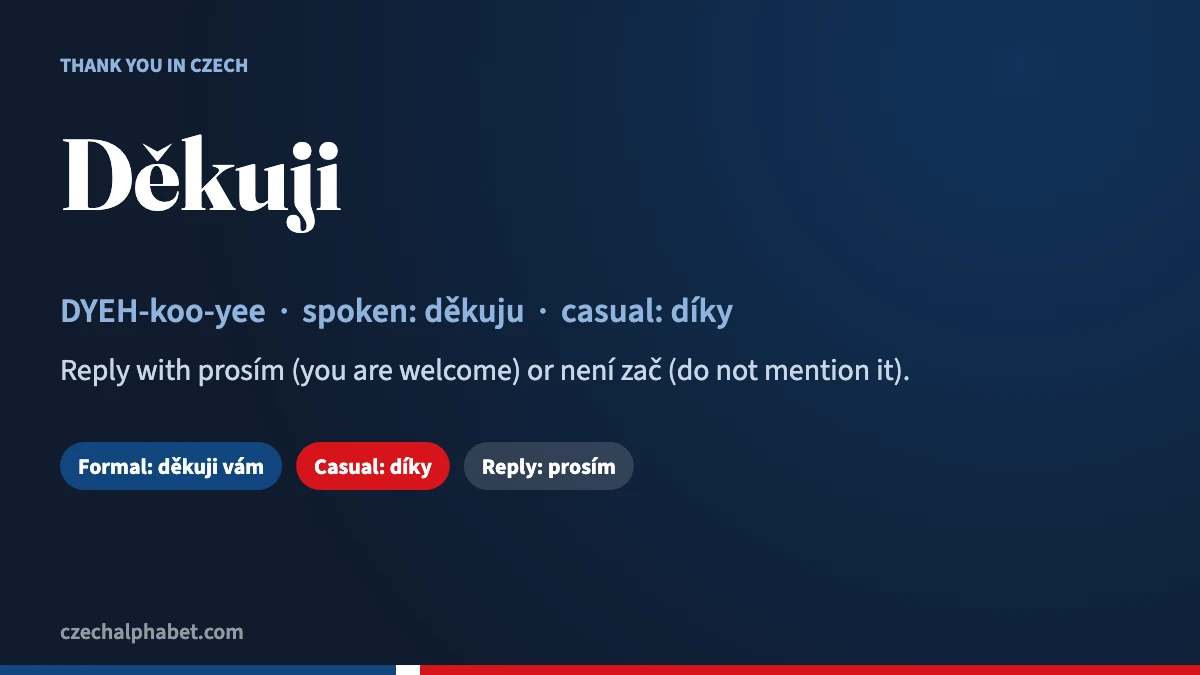
Thank you in Czech is děkuji (DYEH-koo-yee). In everyday speech most people say děkuju (DYEH-koo-yoo), and friends say díky (DEE-kee, “thanks”). The usual reply is prosím (“you’re welcome”, the same word as “please”).
Děkuji or děkuju: which is correct?
Both. Děkuji is the traditional written form and still the safer choice in emails, speeches and anything formal. Děkuju is what you will hear in shops, on trams and at home. When the Czech Language Institute’s new explanatory dictionary came out in 2016, ČT24 reported that děkuju is now accepted as standard Czech too; the institute’s Kamila Smejkalová described the shift as natural development of the language.
So the practical rule is simple: write děkuji, say whichever feels natural. Nobody will correct you for either.
Every way to say thanks, from casual to very formal
| Czech | Say it | Register | Use it for |
|---|---|---|---|
| Dík | deek | Very casual | A friend passing you the salt |
| Díky | DEE-kee | Casual | Friends, family, colleagues on first names |
| Děkuju | DYEH-koo-yoo | Neutral, spoken | Almost anywhere in conversation |
| Děkuji | DYEH-koo-yee | Neutral, careful | Writing, service situations, older people |
| Děkuji vám | DYEH-koo-yee vahm | Polite | Thanking someone you address as vy |
| Mockrát děkuji | MOTS-kraht | Warm | “Thanks a lot” |
| Děkuji vám mnohokrát | MNO-ho-kraht | Very formal | Speeches, letters, real gratitude |
To say what you are thankful for, add za and the thing: děkuji za pomoc (thanks for the help), díky za všechno (thanks for everything), děkuji za pozvání (thank you for the invitation).
How Czechs reply to thank you
This catches learners out, because the most common answer is a word they already know as “please”.
- prosím : you’re welcome. Radio Prague’s language series calls it the most standard reply to děkuji.
- Není zač: don’t mention it (literally “there is nothing for”).
- Nemáte zač / Nemáš zač: the same, formal and informal.
- Rádo se stalo: my pleasure (literally “it happened gladly”). Warm and slightly formal.
- V pohodě: no problem. Casual, younger speakers.
Three short exchanges
In a café
— Tady je vaše káva. Here is your coffee.
— Děkuju.
— Prosím.
A friend helps you move
— Díky moc, fakt! Thanks a lot, really!
— V pohodě.
A formal email
Děkuji vám za rychlou odpověď. Thank you for the quick reply.
S pozdravem Kind regards
Pronunciation: the ě in děkuji
The háček on ě softens the d before it, so dě sounds like “dyeh”, not “deh”. Keep the stress on the first syllable: DYE-ku-ji. The j is an English “y”. For the full rule, see the letter Ě.
Common mistakes
- Saying “deh-KOO-yee”. Stress goes on the first syllable, and dě is “dyeh”.
- Answering děkuji with děkuji. The reply is prosím or není zač.
- Using díky with a customs officer. It is not offensive, just too casual; děkuji fits better.
- Writing “dekuji”. Without the háček it reads like a typo. See how to type Czech characters.
Frequently asked questions
How do you say thank you very much in Czech?
Mockrát děkuji, or děkuji moc in speech. The most formal is děkuji vám mnohokrát.
Is děkuju informal?
It is spoken and relaxed, but not rude or slangy. It is fine with strangers in speech.
What does prosím mean after thank you?
“You’re welcome.” The same word also means “please” and “pardon?”.
How do you say no, thank you in Czech?
Ne, děkuji. It is the polite way to refuse an offer, for example more food or a shop bag.
Keep going
- Please in Czech: the many jobs of prosím
- Hello in Czech: dobrý den vs ahoj
- Essential Czech phrases
Sources
- ČT24, “Děkuju, nebo děkuji? Odpoví nový výkladový slovník češtiny”, 3 Dec 2016: ct24.ceskatelevize.cz
- Radio Prague International, Czech politeness phrases: english.radio.cz
- Omniglot, useful Czech phrases: omniglot.com