Czech Language: History, Alphabet, Grammar and Dialects
| Fact | Czech language |
|---|---|
| Native name | čeština (český jazyk) |
| Family | Indo-European, Slavic, West Slavic |
| Speakers | About 10 million native, over 12 million in total |
| Official in | Czech Republic; an official EU language since 2004 |
| Script | Latin alphabet with diacritics (42 letters on this site’s count) |
| Stress | Always on the first syllable |
| Closest relative | Slovak (largely mutually intelligible) |
The Czech language (čeština) is a West Slavic language spoken by about 10 million people, mainly in the Czech Republic, where it is the official language. It uses the Latin alphabet with diacritics such as the háček and čárka, has seven grammatical cases, and stresses the first syllable of every word. Slovak is its closest relative.
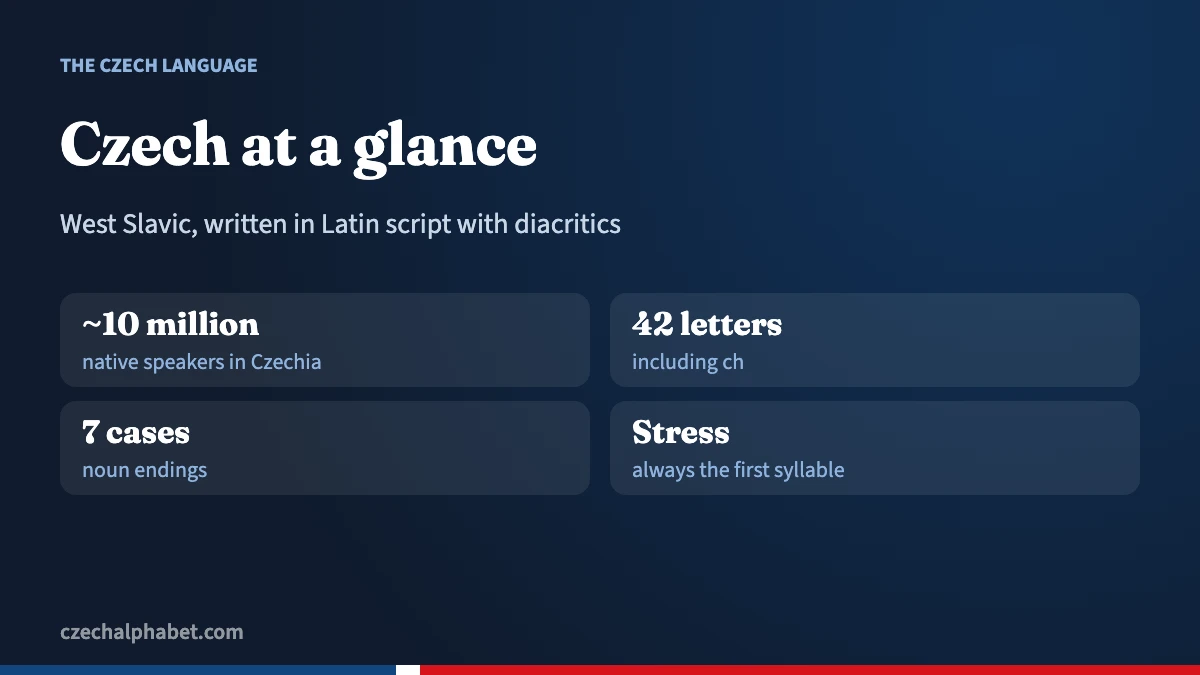
The Czech language (čeština) is a West Slavic language spoken by about 10 million people in the Czech Republic and by communities abroad. It is written in the Latin alphabet with a set of accent marks, has seven grammatical cases, and always stresses the first syllable of a word. If you are heading to Prague, marrying into a Czech family, or trying to read a great-grandparent’s documents, this page gives you the big picture.
Where the Czech language fits among world languages
Czech belongs to the Slavic branch of the Indo-European family. Within Slavic, it sits in the western group together with Slovak, Polish, and the two Sorbian languages of eastern Germany. Russian, Ukrainian, Serbian, and Bulgarian are more distant cousins in the eastern and southern groups.
Czech is the official language of the Czech Republic. Since the country joined the European Union in 2004, it has also been one of the EU’s official languages, so EU laws are published in Czech. Slovakia recognizes it as a minority language.
Speaker numbers are usually given as about 10 million native speakers and over 12 million when second-language speakers are included. A 2012 Eurobarometer survey found that Czech was the first language of 98% of Czech citizens, which makes the country one of the most linguistically uniform in Europe.
The Czech alphabet and its accent marks
Czech uses Latin letters, but it adds two kinds of diacritics to make the spelling match the sound almost one to one. The čárka (acute accent, as in á) marks a long vowel. The háček (a small v, as in č or ř) changes a consonant’s sound. A third mark, the kroužek (ring), appears only on ů.
Counting every distinct letter, including ch, which Czechs treat as a single letter after H, gives 42 letters. Some textbooks count only 26 base letters plus marks, so you will see different totals. Our guide to Czech letters walks through each one, and the Czech alphabet pronunciation page shows how they sound.
Because spelling is so regular, you can read a Czech word aloud once you know the letters. The hard part is producing a few sounds English lacks, above all ř, which has its own page on how to pronounce the Czech ř.
A Czech word is stressed on its first syllable, every time. Accent marks never show stress; the čárka only makes a vowel longer. Dobrý is said DOH-bree, not doh-BREE.
A short history of the Czech language
The first Czech words written in Latin script appear as glosses and short notes in Latin manuscripts of the 12th and 13th centuries. Full literary works follow in the late 13th and early 14th centuries.
The spelling system owes a great deal to a treatise known as De orthographia bohemica, usually attributed to the reformer Jan Hus in the early 15th century. As Radio Prague International explains, it replaced the clumsy letter clusters scribes had used with marks above single letters, aiming at one letter for one sound. The ring over ů came about 150 years later.
The Bible of Kralice, printed by the Unity of the Brethren between 1579 and 1593, became a model of literary Czech for centuries. After the Thirty Years’ War, German dominated public life, and Czech was pushed toward the countryside.
The Czech National Revival, starting in the late 18th century, reversed that. Josef Dobrovský published a detailed grammar in 1809, and Josef Jungmann’s five-volume Czech-German dictionary appeared between 1834 and 1839. The modern standard language grew out of their work. Today the Czech Language Institute of the Academy of Sciences (Ústav pro jazyk český) codifies the standard.
Standard Czech, Common Czech and dialects
Written Czech and everyday spoken Czech differ more than learners expect. The written standard is called spisovná čeština. Much of the country, especially Bohemia, speaks obecná čeština (Common Czech), an interdialect rooted in Prague speech.
The differences are regular. Common Czech often turns long ý into ej and adds a v before initial o:
| Standard | Common Czech | English | Hear |
|---|---|---|---|
| dobrý | dobrej | good | |
| okno | vokno | window | |
| mléko | mlíko | milk | |
| děkuji | děkuju | thank you |
Traditional dialect groups include the Bohemian dialects, the Central and Eastern Moravian dialects, and the Silesian dialects near the Polish border. Moravian speech tends to keep features that Prague has dropped, so you may hear dobrý rather than dobrej in Brno.
Czech grammar in brief
Czech grammar is what gives the language its reputation. Nouns, adjectives, and pronouns change their endings across seven Czech cases, so “Prague” can be Praha, do Prahy (to Prague), or v Praze (in Prague). Nouns have three genders, and verbs come in pairs that show whether an action is finished.
The payoff is flexible word order. Because endings show who did what, Czech can move words around for emphasis. Czech also has no articles, so there is no word for “the” or “a”.
Another hallmark is consonant clusters. The tongue twister Strč prst skrz krk (“stick a finger through the throat”) contains no vowels at all, because r and l can act as the core of a syllable. If you are wondering how much work all this takes, see is Czech hard to learn.
The Czech language and its neighbors
Czech and Slovak are close enough that speakers usually understand each other without study. During Czechoslovakia, both languages were heard daily on television. Research shows the mutual understanding has weakened somewhat among young people born after the 1993 split. Our page on Czech vs Slovak compares spelling and vocabulary side by side.
Polish is related but harder for Czechs to follow, partly because its spelling uses different conventions. German has left many loanwords in Czech, such as taška (bag), while Czech gave English at least one famous word: robot, which reached the world through Karel Čapek’s 1920 play R.U.R., from the Czech idea of forced labor (robota).
Where to start learning Czech
A practical order for beginners:
- Learn the alphabet and its sounds first. Czech spelling is reliable, so this pays off immediately.
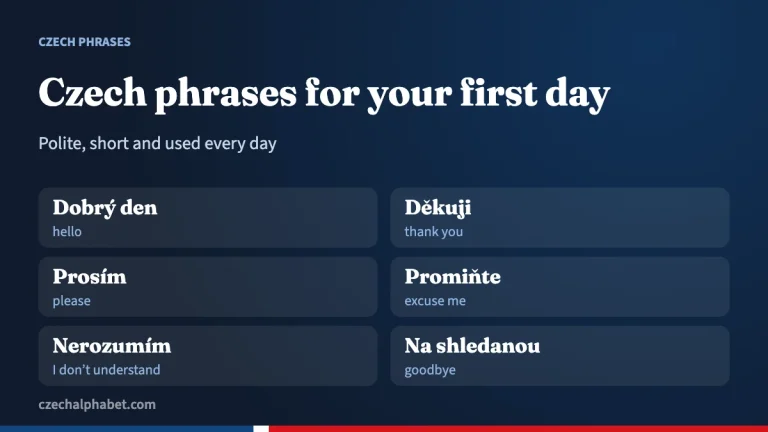
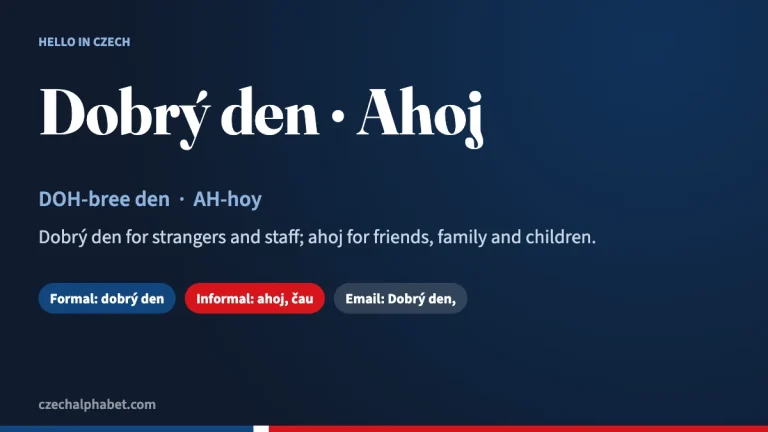
- Learn a handful of polite words: hello (dobrý den), thank you (děkuji), please (prosím), and goodbye (na shledanou).
- Learn the difference between formal vy and informal ty (both mean “you”). Strangers and older people get vy.
- Add the cases slowly, starting with the accusative, which you need for ordering food and drink.
Our collection of Czech phrases is a good next stop once the sounds feel familiar.
Common mistakes about Czech
- Calling it “Czechoslovakian”. There was never a Czechoslovak language in daily use; Czech and Slovak are separate languages.
- Reading accents as stress. The čárka lengthens a vowel. Stress stays on the first syllable.
- Dropping the diacritics. Byt (apartment) and být (to be) are different words. Always type the accents; they are part of the spelling.
- Assuming Russian will carry you. Some roots overlap, but grammar, spelling, and much everyday vocabulary differ.
- Treating ch as c + h. Ch is one letter with one sound, like the end of Scottish “loch”.
Frequently asked questions
How many people speak the Czech language?
About 10 million people speak Czech as their first language, almost all in the Czech Republic. Including second-language speakers, the total is usually put at over 12 million.
Is Czech the same as Slovak?
No. They are separate languages, but they are close enough that Czechs and Slovaks usually understand each other without lessons.
Is Czech related to Russian?
Yes, both are Slavic languages, but Czech is West Slavic and Russian is East Slavic. Czech uses the Latin alphabet, while Russian uses Cyrillic.
How many cases does Czech have?
Czech has seven cases: nominative, genitive, dative, accusative, vocative, locative and instrumental.
Who regulates the Czech language?
The Czech Language Institute of the Czech Academy of Sciences (Ústav pro jazyk český) codifies standard Czech and runs a public language handbook and advice line.
Sources
- Wikipedia: Czech language
- Radio Prague International: What does Jan Hus have to do with Czech spelling?
- Britannica: R.U.R. (origin of the word robot)