Háček: The Czech Hook Accent, Its 8 Letters and Where It Came From
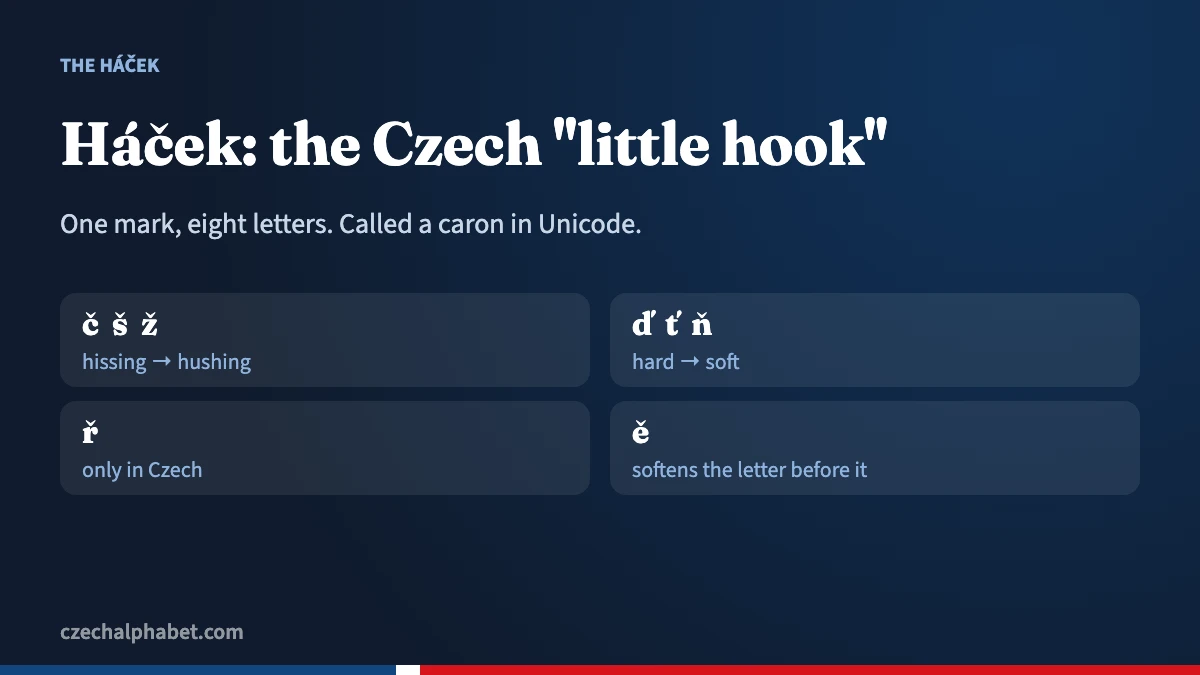
A háček (ˇ, HAH-chek, “little hook”) is the small v-shaped mark Czech puts on letters to change their sound: č š ž ř ď ť ň ě (and capital Ď Ť, where it often looks like an apostrophe: ď ť). In Unicode and typography it’s called a caron. The system goes back to an early 15th-century spelling reform traditionally credited to Jan Hus.
All the letters with a háček
| Letter | Sounds like | Example |
|---|---|---|
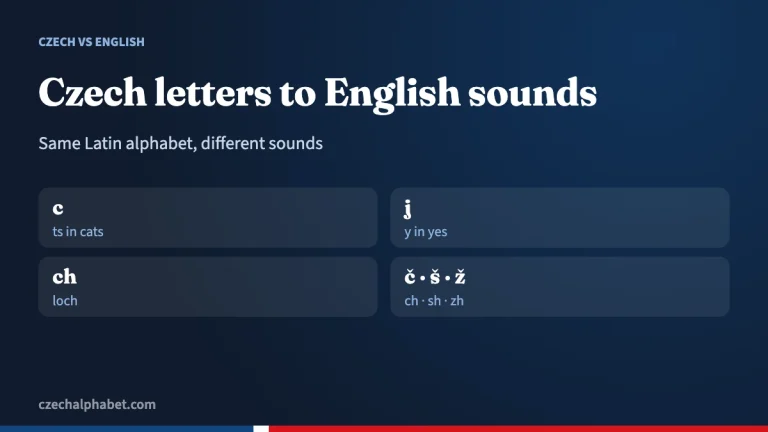
| Č č | ch in “church” | čaj tea |
| Š š | sh in “shop” | šest six |
| Ž ž | s in “pleasure” | žena woman |
| Ř ř | trilled r + buzz (unique to Czech) | řeka river |
| Ď ď | soft d, like “dy” in “due” (British) | ďábel devil |
| Ť ť | soft t, like “ty” in “tune” (British) | ťukat to tap |
| Ň ň | ny in “canyon” | kůň horse |
| Ě ě | softens the letter before it | děti children |
What the háček actually does
Think of the háček as an instruction: “make this sound softer and further back”. Three patterns cover nearly everything:
- Hissing to hushing: s → š, z → ž, c → č. The “s”-type sound turns into a “sh”-type sound.
- Hard to soft: d → ď, t → ť, n → ň. The tongue’s flat middle presses the palate, adding a “y” colour.
- Special cases: r → ř (a sound only Czech has), and e → ě (which softens the consonant before it).
Why ď and ť look like an apostrophe
On tall lowercase letters there’s no room above, so the háček shrinks into a small stroke beside the letter: ď, ť (and Slovak ľ). It is still a háček, not an apostrophe. Capitals take the full v-shape: Ď, Ť. When you type them, use the real characters, not d’ or t’.
Where the háček came from
The treatise De orthographia Bohemica, written in the early 15th century and traditionally attributed to Jan Hus, proposed marking soft and hushing sounds with a mark above the letter instead of clumsy letter combinations like “cz” and “rz”. In that text the mark was closer to a dot. Over the next century and a half it took the hook shape Czech uses today. Radio Prague quotes linguist Karel Oliva rating the Hus attribution as about 99% certain, though the original manuscript is lost and the surviving copy dates from around 1450–60.
Polish kept the older digraph approach (cz, sz, rz), which is why Czech čas (time) and Polish czas mean the same thing but look so different.
Who else uses the háček
Czech exported the idea. Slovak, Slovene, Croatian, Serbian in Latin script, Upper and Lower Sorbian, Latvian and Lithuanian all use letters like š, ž and č, and the mark is standard in the scientific transliteration of Cyrillic.
Háček vs čárka vs kroužek
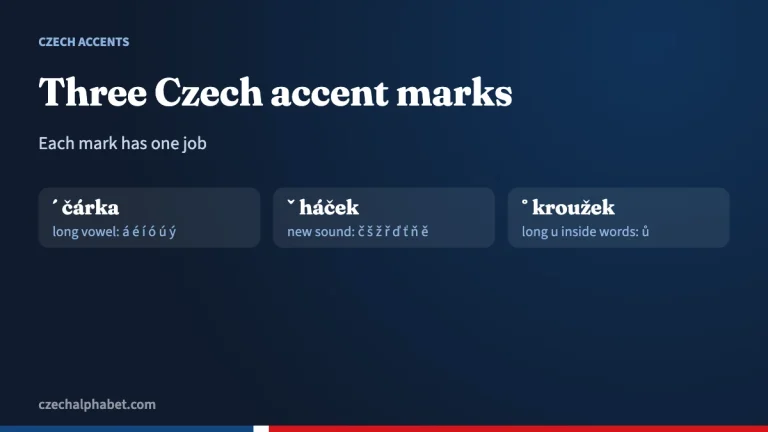
| Mark | Name | Job | Letters |
|---|---|---|---|
| ˇ | háček | Changes the sound | č š ž ř ď ť ň ě |
| ´ | čárka | Makes a vowel long | á é í ó ú ý |
| ˚ | kroužek | Long u inside words | ů |
More on the other two in Czech accents.
Typing a háček
- Czech keyboard: ě š č ř ž sit on the number row (2–6). For ď, ť and ň, press Shift + the ´ key (just left of Backspace) to get the háček dead key, then the letter.
- Mac: hold the letter and pick the háček version.
- Phone: long-press the letter.
- HTML: š (š), Š (Š), č (č), ř (ř), ž (ž).
Frequently asked questions
What does háček mean?
“Little hook”. It’s the diminutive of hák, hook.
Is a háček the same as a caron?
Yes. Caron is the name used in Unicode and English typography; háček is the Czech name.
How do you pronounce háček?
HAH-chek, with a long á and č as in “church”.
Which letters have a háček in Czech?
Č, Š, Ž, Ř, Ď, Ť, Ň and Ě.
Keep going
- Czech accents: čárka and kroužek
- How to type Czech characters
- Czech alphabet chart
Sources
- Radio Prague International, “What does Jan Hus have to do with Czech spelling?”: english.radio.cz
- Wikipedia, “Caron” (Unicode naming and languages): en.wikipedia.org
- Wikipedia, “Czech orthography”: en.wikipedia.org