Czech Accents: Čárka, Háček and Kroužek Explained
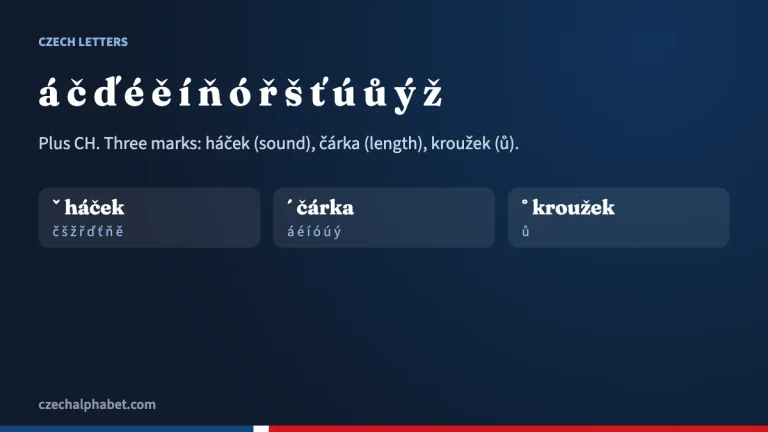
Czech accents are three diacritic marks that create extra letters: the čárka (acute, ´) lengthens a vowel, as in á; the háček (caron, ˇ) changes a sound, as in č, š, ř; and the kroužek (ring, ˚) appears only on ů. Together they produce 15 of the 42 Czech letters.

Czech accents are three small marks written above letters: the čárka, the háček and the kroužek. They are not optional decoration. Each accented letter counts as its own letter, with its own sound or length, and leaving the mark off can turn one word into another.
The click-to-copy grid above gives you every accented Czech letter with its Unicode code point and the key it sits on in the Czech keyboard layout. The rest of this page explains what each mark does.
The three Czech accents at a glance
| Mark | Czech name | English name | What it does | Letters |
|---|---|---|---|---|
| ´ | čárka | acute accent | Makes a vowel long | á é í ó ú ý |
| ˇ | háček | caron | Creates a new sound | č ď ě ň ř š ť ž |
| ˚ | kroužek | ring above | Marks a long u from an old o | ů |
That is 6 + 8 + 1 = 15 accented letters. With the 26 Latin letters and ch they make up the 42-letter alphabet listed in the ČÚZK toponymic guidelines.
Čárka: the Czech accent for long vowels
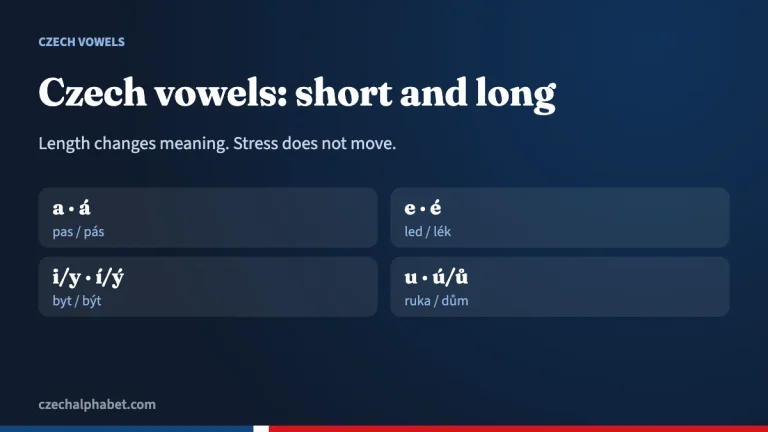
The čárka is the acute accent. The word also means “comma” and “dash” in everyday Czech, because it describes a short stroke. On vowels it means one thing only: hold the vowel longer. The quality of the vowel stays almost the same.
| Short | Meaning | Long | Meaning | Hear |
|---|---|---|---|---|
| byt | apartment | být | to be | |
| pas | passport | pás | belt, strip | |
| rada | advice, council | ráda | glad (feminine) |
Unlike in Spanish or Italian, the Czech acute has nothing to do with stress. Czech stress is always on the first syllable, wherever the čárka sits. A long vowel in the last syllable is long, not loud. See Czech vowels for the full system.
One detail surprises people: í has no dot. The čárka replaces it, both in print and in handwriting.
Háček: the Czech accent that changes sounds
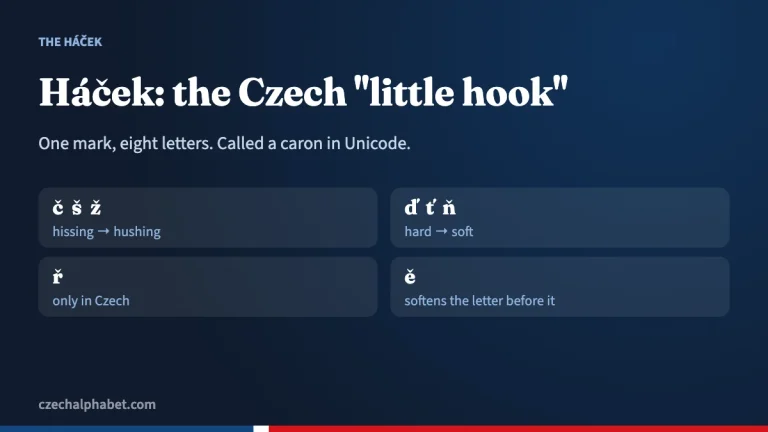
The háček (“little hook”) is the most recognizable Czech accent and the one most often borrowed by other languages. It turns a letter into a different consonant, usually a “softer” or hushing one.
- c [ts] to č [tʃ], “ch” in “church”: čaj (tea)
- s to š [ʃ], “sh”: škola (school)
- z to ž [ʒ], “s” in “measure”: žena (woman)
- r to ř [r̝], a sound unique to Czech: řeka (river)
- d, t, n to ď, ť, ň [ɟ c ɲ], soft palatal sounds: kůň (horse)
- e to ě, which softens the consonant before it: pět (five)
On lowercase ď and ť the háček is printed as a small stroke beside the letter, so it looks like an apostrophe. It is still a háček. The Unicode chart for these letters even notes that “the form using apostrophe is preferred in typesetting”.
Kroužek: the ring on ů
The kroužek (“little circle”) appears on a single letter, ů, and sounds exactly like ú, a long “oo”. The ring is a piece of history. Old Czech long ó became the diphthong uo, and the small o written above the u later shrank to a ring, as Wikipedia’s Czech orthography article explains: kóň became kuoň and then kůň.
That history explains a modern spelling habit. Ů often alternates with o in related forms: dům (house) but domu (of the house), kůň but koně (horses). Ů never starts a word.
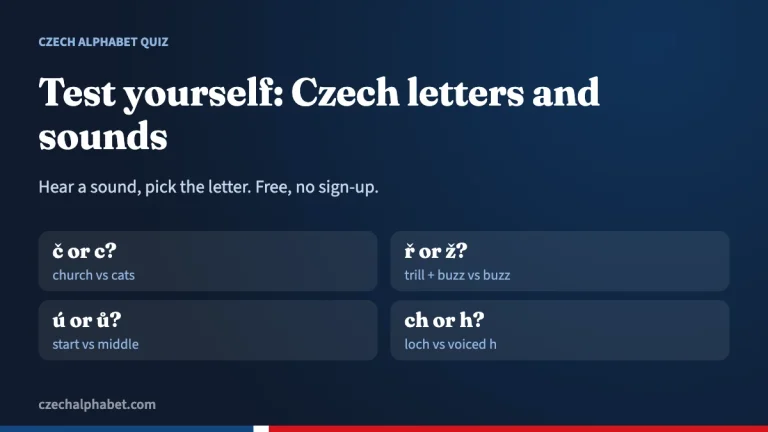
Ú or ů?
Both spell the same sound, so how do you choose? The school rule is simple, with exceptions:
- Ú at the start of a word: úterý (Tuesday), and after a prefix: neúspěch (failure).
- Ů in the middle or at the end: dům, domů (home, homeward).
- Exceptions include loanwords and sound words such as túra (hike) and múza (muse).
Typing and copying Czech accents
On a Czech keyboard, the number row holds the most common accented letters, and dead keys add a čárka or háček to any letter. On other keyboards you have options:
- Use the copy grid at the top of this page.
- On phones, long-press a letter to see accented versions.
- On Windows, add the Czech keyboard in language settings; on a Mac, add the Czech input source.
Step-by-step instructions are on how to type Czech characters and the Czech keyboard.
Czech accents in names and addresses
Czech accents matter most where precision matters: names, addresses and official forms. A Czech reader sees Novák and Novak as the same person written carelessly, but in a database they are two different strings. Searches, bookings and deliveries can fail when the marks are dropped on one side and kept on the other.
Place names show the same issue. Plzeň, Český Krumlov and Karlovy Vary all appear without marks on many English maps, but Czech signs, timetables and addresses use the full spelling. If you are sending mail or typing an address into a Czech website, keep every mark.
When a system cannot handle diacritics, the usual fallback is to drop the mark and keep the base letter: č becomes c, ř becomes r, ů becomes u. The text box in the copy grid above does this for you. See Czech alphabet to English for more on writing Czech in English texts.
Common mistakes with Czech accents
- Treating the čárka as stress. It marks length only.
- Typing an apostrophe for ď or ť. d’ is two characters; ď is one letter (U+010F).
- Confusing the háček with a circumflex. Czech uses ˇ (pointing down), not ^ (pointing up).
- Putting a ring on ú at the start of a word. Ů never begins a word.
- Dropping marks in names. Dvořák without its marks is a different-looking word to a Czech reader.
Frequently asked questions
What are the accents in Czech called?
The čárka (acute accent) for long vowels, the háček (caron) for changed sounds, and the kroužek (ring) used only on ů.
Do Czech accents show stress?
No. Czech stress is always on the first syllable. The čárka only makes a vowel long.
Which Czech letters have a háček?
Č, Ď, Ě, Ň, Ř, Š, Ť and Ž. On lowercase ď and ť it looks like an apostrophe.
Is there a difference between ú and ů?
They sound the same, a long oo. Ú is used at the start of a word or after a prefix, and ů in the middle or at the end, with a few exceptions.
How many accented letters does Czech have?
Fifteen: á, é, í, ó, ú, ý with a čárka, č, ď, ě, ň, ř, š, ť, ž with a háček, and ů with a ring.
Sources
- Wikipedia: Czech orthography
- Unicode Consortium: Latin Extended-A code chart (U+0100–U+017F)
- ČÚZK: Toponymic Guidelines of the Czech Republic, 4th ed. (2024), UNGEGN
- Wikipedia: Caron