Czech Alphabet Chart: All 42 Letters With Sounds and Audio
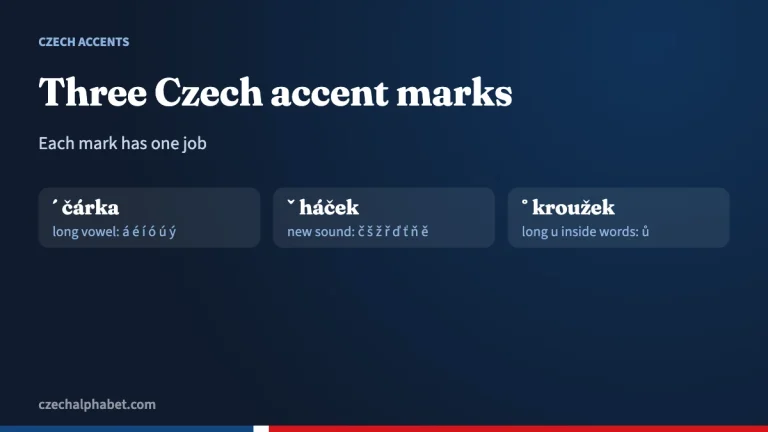
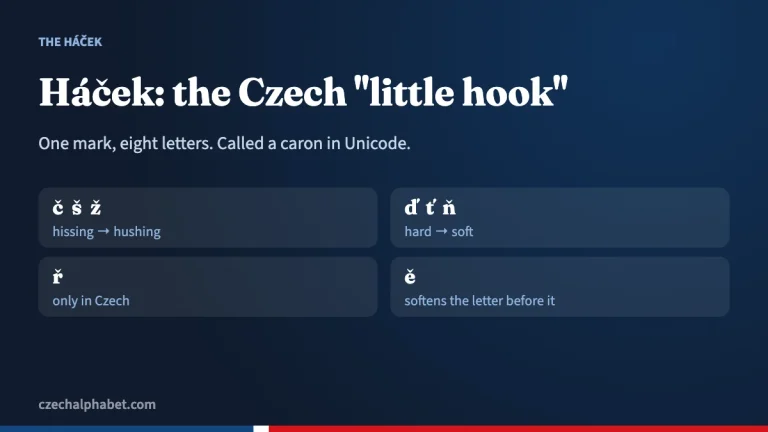
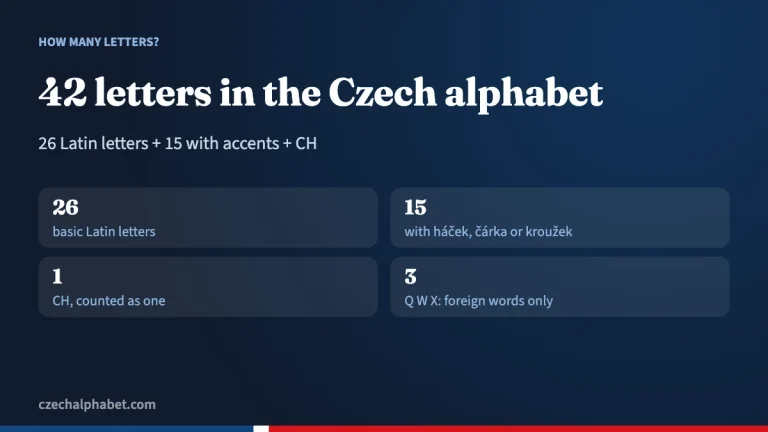
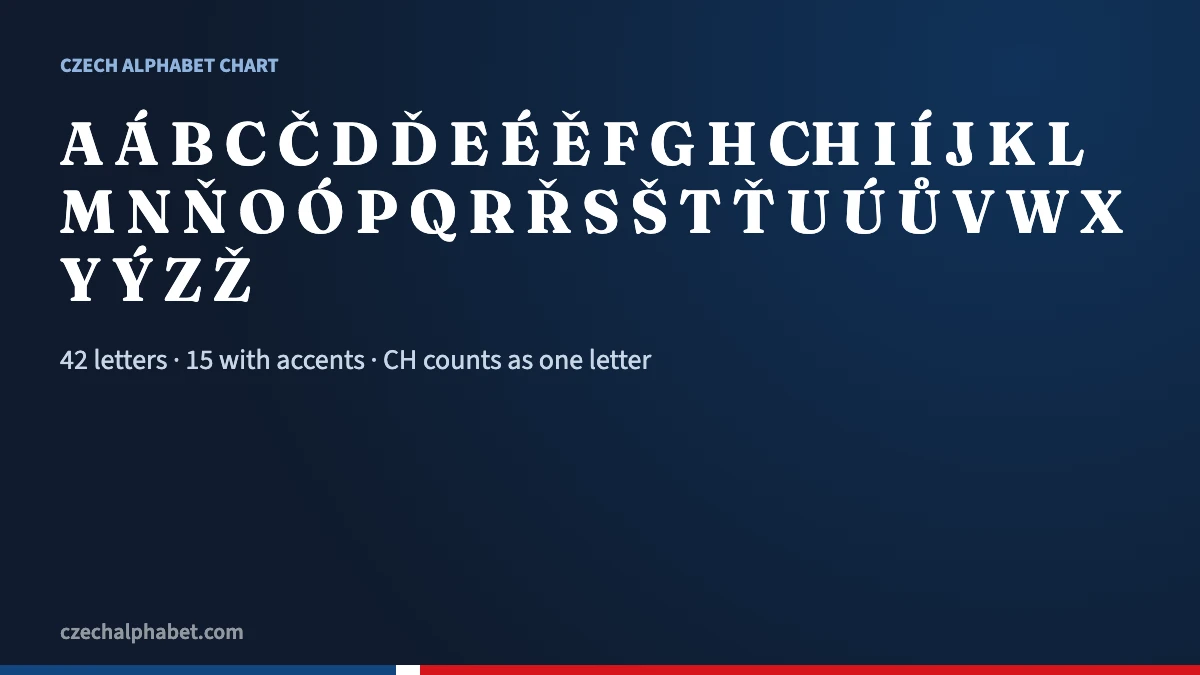
The Czech alphabet has 42 letters, counting CH as one letter and including Q, W and X, which appear only in foreign words. Fifteen letters carry an accent: the háček (č ď ě ň ř š ť ž), the čárka (á é í ó ú ý) and the kroužek (ů). Tap any tile in the chart above to hear it, or use the table below.
All 42 letters with names, sounds and examples
| # | Letter | Czech name | Sounds like | Example |
|---|---|---|---|---|
| 1 | A | a | short “uh/ah” | tam there |
| 2 | Á | á | long “ah” (father) | máma mum |
| 3 | B | bé | b; p at word end | chléb bread |
| 4 | C | cé | ts in “cats” | cena price |
| 5 | Č | čé | ch in “church” | čaj tea |
| 6 | D | dé | d; t at word end | den day |
| 7 | Ď | ďé | soft “dy” | teď now |
| 8 | E | é | e in “bed” | pes dog |
| 9 | É | dlouhé é | long e | mléko milk |
| 10 | Ě | e s háčkem | softens letter before | děti children |
| 11 | F | ef | f | fotka photo |
| 12 | G | gé | hard g (go) | guma rubber |
| 13 | H | há | voiced h | Praha Prague |
| 14 | CH | chá | loch | chléb bread |
| 15 | I | í | i in “sit” | pivo beer |
| 16 | Í | dlouhé í | ee in “see” | bílý white |
| 17 | J | jé | y in “yes” | jak how |
| 18 | K | ká | k, no puff of air | kde where |
| 19 | L | el | clear l | les forest |
| 20 | M | em | m | máma mum |
| 21 | N | en | n | noc night |
| 22 | Ň | eň | ny in “canyon” | kůň horse |
| 23 | O | ó | o in “hot”, rounded | voda water |
| 24 | Ó | dlouhé ó | long o (rare) | gól goal |
| 25 | P | pé | p, no puff of air | pivo beer |
| 26 | Q | kvé | foreign words only | squash |
| 27 | R | er | tapped or trilled r | ruka hand |
| 28 | Ř | eř | trill + buzz | řeka river |
| 29 | S | es | s in “sun” | sýr cheese |
| 30 | Š | eš | sh in “shop” | šest six |
| 31 | T | té | t, no puff of air | táta dad |
| 32 | Ť | ťé | soft “ty” | chuť taste |
| 33 | U | ú | oo in “book” | ruka hand |
| 34 | Ú | dlouhé ú | oo in “food” | úterý Tuesday |
| 35 | Ů | ů s kroužkem | oo in “food” | dům house |
| 36 | V | vé | v; f at word end | voda water |
| 37 | W | dvojité vé | v (foreign words) | wifi |
| 38 | X | iks | ks (foreign words) | taxi |
| 39 | Y | ypsilon | i in “sit” | syn son |
| 40 | Ý | dlouhé ypsilon | ee in “see” | sýr cheese |
| 41 | Z | zet | z in “zoo” | zima winter |
| 42 | Ž | žet | s in “pleasure” | žena woman |
Letters with their own in-depth page are linked; the others are covered below.
The letters that work like English (almost)
B, D, V, Z: voiced letters that change at the end
These sound like English, but at the end of a word or before a voiceless consonant they lose their voice: b → p (chléb = khlehp), d → t (hrad = hrat), v → f (lev lion = lef), z → s (mráz = mrahs). Spell them as written; say them as the sound.
P, T, K: no puff of air
English p, t, k at the start of a word come with a little burst of breath. Czech ones don’t. Hold your hand in front of your mouth: pivo, táta, kde should barely move the air. That one change makes your Czech sound much less foreign.
T
Plain t is made with the tongue tip touching the back of the upper teeth. Before i, í and ě it softens to ť: ticho is “tyi-kho”. See soft consonants.
K
As in English “skin” (no puff). Czech uses k where English often writes c: káva coffee, kino cinema.
G
Always hard, as in “go”, never as in “gem”. It’s rare in native words: guma (rubber), gól (goal). The g sound also appears when k is voiced before a voiced consonant: kde sounds like “gde”.
F
Mostly in loanwords (fotka, fotbal). Native Czech words rarely start with f, but you hear the f sound constantly because v at the end of a word becomes f: lev, krev (blood).
J
Always the y in “yes”: jak (how), já (I), jméno (name, with j and m both pronounced). In some words the j at the start is dropped in casual speech: jsem (I am) often sounds like “sem”.
L, M, N
L is clear, like in “leaf”, never the dark l of “full”. L and r can form a syllable on their own: vlk (wolf). M and n are as in English; n softens to ň before i and ě (nic = ňic), and m before ě gains an ň (město = mňesto).
N before k and g
Before k and g, n is pronounced like the ng in “finger”: banka (bank).
O and Ó
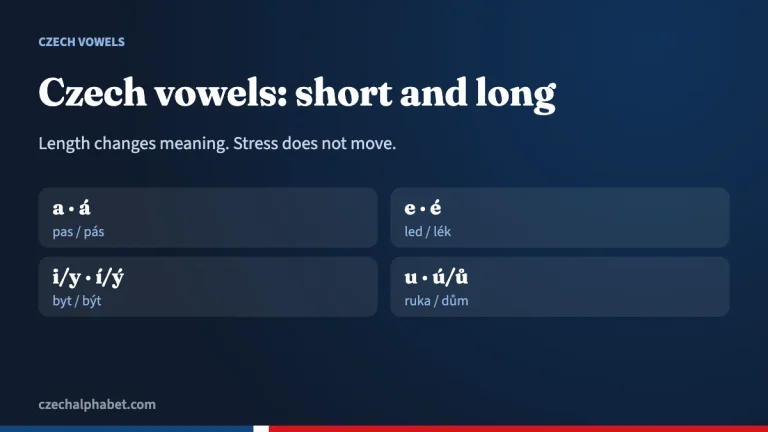
O is a rounded “o” as in British “hot”. Ó, the long version, appears mostly in loanwords (gól, móda fashion). Don’t turn o into the English “oh” glide: voda is VO-da, not “VOH-da”.
Q, W and X
These three are in the alphabet but only in foreign words and names: squash, watt, wifi, taxi, xylofon. W is pronounced v, x is ks. Native Czech words are often respelled: quiz → kvíz.
How to say the alphabet in Czech
Czech letter names are mostly the sound plus é or a short e: bé, cé, dé, ef, gé, há, chá, jé, ká, el, em, en… Accented letters are named by their mark: čé, or c s háčkem (c with a háček), dlouhé á (long á), ů s kroužkem (u with a ring). That’s how Czechs spell names over the phone.
Frequently asked questions
How many letters are in the Czech alphabet?
42, counting CH as a letter. Some sources say 41 because they don’t count CH separately. See how many letters are in the Czech alphabet.
What is the Czech alphabet in order?
A Á B C Č D Ď E É Ě F G H CH I Í J K L M N Ň O Ó P Q R Ř S Š T Ť U Ú Ů V W X Y Ý Z Ž.
Which Czech letters are not in English?
Á, Č, Ď, É, Ě, CH, Í, Ň, Ó, Ř, Š, Ť, Ú, Ů, Ý, Ž.
Keep going
Sources
- Wikipedia, “Czech orthography”: en.wikipedia.org
- Wikipedia, “Czech phonology”: en.wikipedia.org