Czech Female Surnames: How -ová Works and the 2022 Change
| Male surname | Rule | Female surname |
|---|---|---|
| Novák | noun: add -ová | Nováková |
| Svoboda | drop -a, add -ová | Svobodová |
| Novotný | adjective: -ý to -á | Novotná |
| Němec | lose the e, add -ová | Němcová |
| Krejčí | no change | Krejčí |
Czech female surnames are the feminine forms of family names: noun-type names add -ová (Novák, Nováková) and adjective-type names change -ý to -á (Černý, Černá). Names ending in -í or -ů do not change. Since 1 January 2022, Czech women may choose the male form without giving a reason.
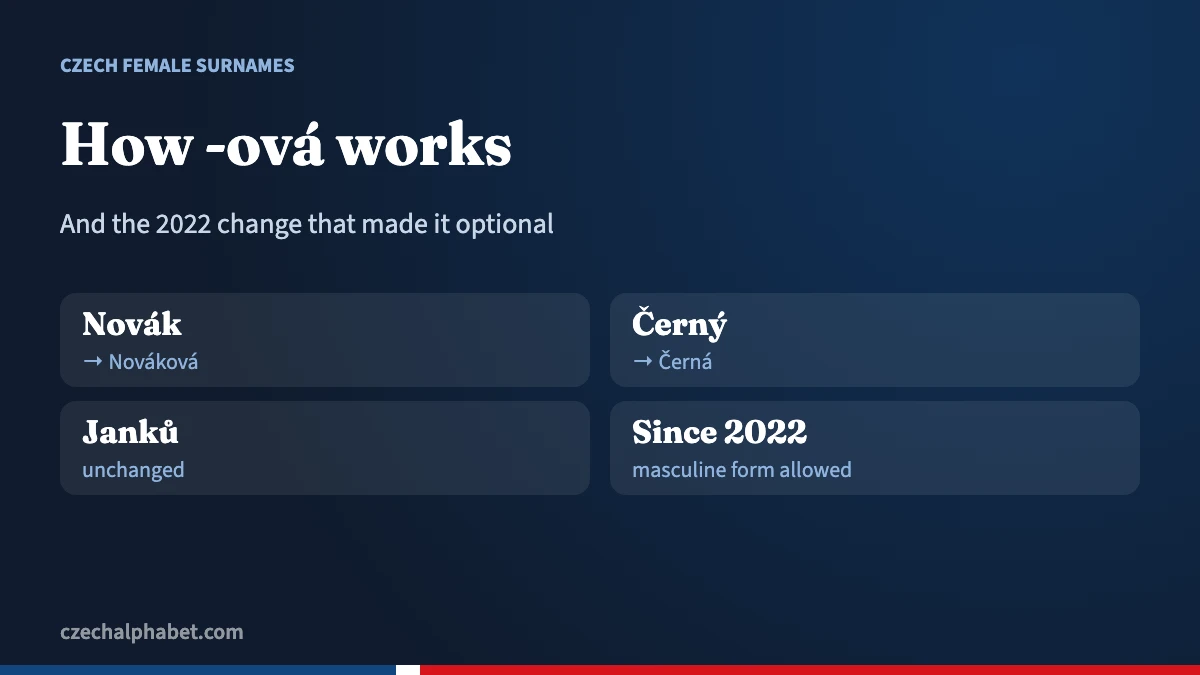
Czech female surnames are the feminine forms of family names, usually made by adding -ová to a man’s surname or by switching an adjective ending from -ý to -á. Mr. Novák‘s wife and daughter are traditionally Nováková, and Mr. Černý‘s are Černá. Since 1 January 2022, Czech women can also choose to use the unchanged male form without giving any reason.
How Czech female surnames are formed
Czech is a gendered language, and surnames behave like other nouns and adjectives. Wikipedia’s overview of Czech names puts it simply: female surnames are almost always feminine adjectives. In practice there are three patterns.
- Noun-type surnames add -ová. Novák becomes Nováková, Beneš becomes Benešová. A final -a is replaced: Svoboda, Svobodová.
- Adjective-type surnames change the ending. Names in -ý take -á: Novotný, Novotná. Names in -ský and -cký work the same way: Dobrovský, Dobrovská.
- Some surnames never change. Names ending in -í (Krejčí, Kočí) and old possessive names in -ů (Janů, Petrů) are the same for men and women.
The suffix -ová is historically possessive, close to “belonging to Novák’s family”. Modern speakers do not hear it that way; it is simply the female form, used for wives, daughters and unmarried women alike.
Examples of Czech female surnames
| Male | Female | What changes | Hear |
|---|---|---|---|
| Novák | Nováková | add -ová | |
| Dvořák | Dvořáková | add -ová | |
| Svoboda | Svobodová | final -a replaced | |
| Procházka | Procházková | final -a replaced | |
| Černý | Černá | adjective -ý to -á | |
| Veselý | Veselá | adjective -ý to -á | |
| Němec | Němcová | e drops out | |
| Havel | Havlová | e drops out | |
| Marek | Marková | e drops out | |
| Kafka | Kafková | final -a replaced |
Watch the “fleeting e”. Czech drops an e from the last syllable when an ending is added, just as it does in ordinary nouns: Němec gives Němcová, Havel gives Havlová. That is why the wife of Václav Havel was Olga Havlová, not “Havelová”.
The 2022 change: surnames without -ová
Until the end of 2021, a woman could register her surname without the feminine ending only in a few defined cases: if she was a foreign national, if she was a Czech citizen of another nationality, or if she lived abroad or had a foreign spouse or partner. An amendment to the Act on Registry Offices (zákon o matrikách) removed those conditions from 1 January 2022, as summarized by the legal news site Právní prostor and announced by the Ministry of the Interior.
- At marriage or registered partnership: a woman can ask for the non-feminine form, for example Novák instead of Nováková, simply on request.
- At birth: parents can ask for a daughter’s surname to be registered in the male form.
- No reason needed: the request does not have to be justified.
The traditional form remains the default and is still by far the most common. If you need the details for a specific case, the registry office (matrika) where the event is recorded is the place to ask. See the Právní prostor summary for the wording of the change.
Czech female surnames in sentences
Because -ová and -á names are adjectives, they decline like adjectives. That matters the moment you write an email or talk about someone. Paní Nováková (“Mrs. Nováková”) becomes paní Novákové in “to Mrs. Nováková” (napsal jsem paní Novákové, “I wrote to Mrs. Nováková”) and s paní Novákovou in “with Mrs. Nováková”. The title paní stays the same.
Addressing her directly is easy: the vocative of these names is identical to the basic form, so you say Dobrý den, paní Nováková. A man’s name does change: pane Nováku. When you refer to the whole family, use the plural Novákovi, or for adjective names Černí (“the Černýs”). Our guide to Czech cases explains the endings.
Foreign women’s names in Czech
Czech media and everyday speech often add -ová to foreign women’s surnames as well, so readers can see at a glance that the person is a woman and so the name can take case endings. Not everyone likes this, and usage varies between newspapers. In official records, a foreign woman’s surname is kept as in her own documents.
For Czech-Americans, the reverse applies. Female forms usually disappeared at immigration, so a great-grandmother born Marie Procházková may appear in US records as Mary Prochazka. When you search Czech archives, look for both forms. Our Czech surnames guide lists the most common family names.
How to say Czech female surnames
Keep the stress on the first syllable of the whole name and hold the long á at the end: Nováková is NO-vah-ko-vah, Dvořáková DVOR-zhah-ko-vah. Do not stress the -ová ending, even though it carries a long vowel. Our page on how to pronounce Czech names has a pronouncer, and Czech pronunciation explains why length and stress are separate.
Common mistakes
- Adding -ová to an adjective-type name: “Černýová” is wrong; write Černá.
- Keeping the fleeting e: “Němecová” instead of Němcová.
- Changing names that never change: Mrs. Krejčí stays Krejčí.
- Assuming every Czech woman uses -ová. Since 2022 some use the male form by choice.
- Using the female form for a man when quoting a couple: Mr. Novák and Mrs. Nováková, together Novákovi (“the Nováks”).
Female and male first names have their own celebrations; see Czech name days.
Frequently asked questions
Why do Czech female surnames end in -ová?
Czech surnames follow grammatical gender. Noun-type surnames take the feminine suffix -ová, so Novák becomes Nováková.
Can Czech women drop -ová?
Yes. Since 1 January 2022 a woman can ask for the non-feminine form, for example at marriage, and parents can request it for a newborn daughter, without giving a reason.
What is the female form of Černý?
Černá. Adjective-type surnames ending in -ý change to -á rather than adding -ová.
Which Czech surnames are the same for men and women?
Surnames ending in -í, such as Krejčí, and old possessive forms ending in -ů, such as Janů.
Why do Czech newspapers add -ová to foreign names?
It marks the person as a woman and lets the name take Czech case endings. Practice varies, and official records keep the original form.
Sources
- Právní prostor: Od ledna mohou ženy používat příjmení v nepřechýleném tvaru bez jakýchkoli dalších podmínek
- Ministry of the Interior: Změna od ledna, ženy mohou používat příjmení v nepřechýleném tvaru
- Wikipedia: Czech name