Czech Cases Explained: All 7 Cases with Questions and Examples
| No. | Case | Question | žena (woman) |
|---|---|---|---|
| 1. | nominative | kdo? co? | žena |
| 2. | genitive | koho? čeho? | ženy |
| 3. | dative | komu? čemu? | ženě |
| 4. | accusative | koho? co? | ženu |
| 5. | vocative | (calling someone) | ženo! |
| 6. | locative | o kom? o čem? | ženě |
| 7. | instrumental | kým? čím? | ženou |
Czech cases are the seven forms a noun, adjective or pronoun takes for its role in a sentence: nominative, genitive, dative, accusative, vocative, locative and instrumental. Czechs number them 1 to 7 (první pád, druhý pád…) and identify each with question words such as kdo? co? or komu? čemu?
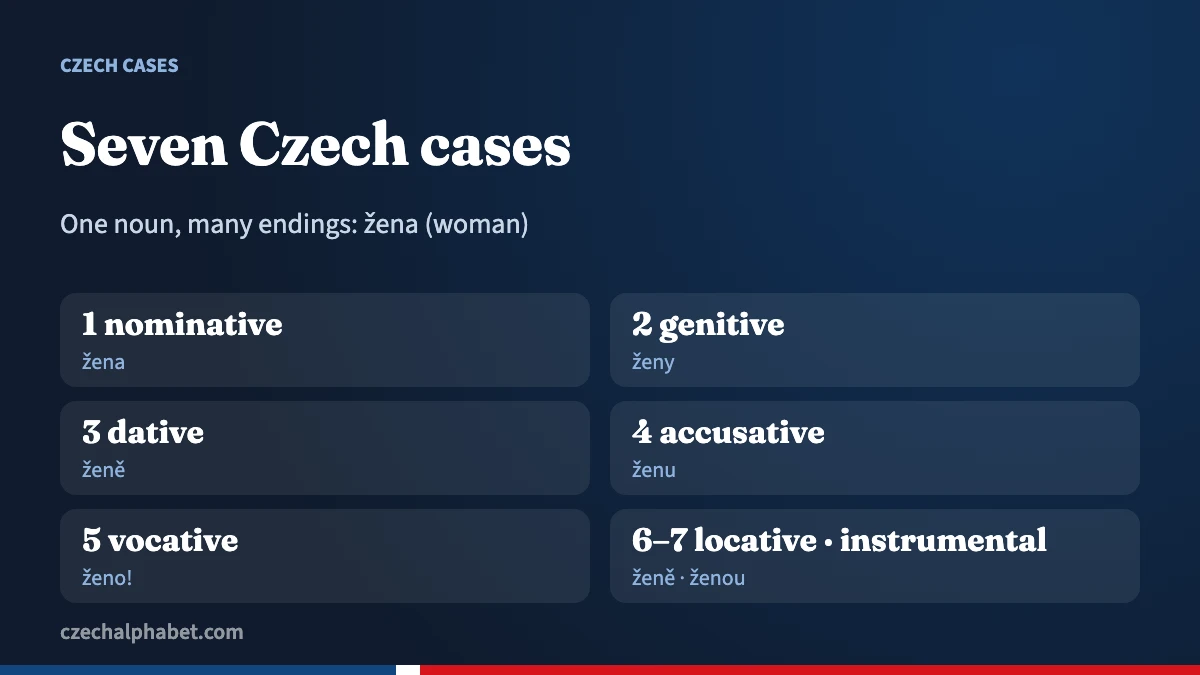
Czech cases are the seven forms a Czech noun, adjective or pronoun takes depending on its role in a sentence. English has traces of this in “he, him, his”; Czech does it with almost every noun. Praha (Prague) can appear as Prahy, Praze, Prahu, Praho or Prahou, and each form tells you something about who is doing what, where and with what.
The card above shows the seven cases with the question words Czech schools use to identify them, and the word žena (“woman”) in each form.
The seven Czech cases and their numbers
Czechs learn the cases in a fixed order and usually call them by number: první pád (first case), druhý pád (second case) and so on. A Czech teacher will say “that’s the sixth case” rather than “locative”. Each case answers a pair of questions, one for people and one for things.
- Nominative (1. pád), kdo? co? (“who? what?”): the subject and the dictionary form.
- Genitive (2. pád), koho? čeho? (“of whom? of what?”): possession, quantities, and after do, z, bez, od.
- Dative (3. pád), komu? čemu? (“to whom? to what?”): the indirect object, and after k, díky, proti.
- Accusative (4. pád), koho? co? (“whom? what?”): the direct object, and after pro and na with motion.
- Vocative (5. pád): used to call or address someone. It has no question word.
- Locative (6. pád), o kom? o čem? (“about whom? about what?”): only after prepositions such as v, na, o, po, při.
- Instrumental (7. pád), kým? čím? (“by whom? with what?”): the means or company, and after s (“with”), před, za, mezi.
One city through all seven cases
Seeing a single word move through the cases makes the system click. Here is Prague:
| Case | Czech | English | Hear |
|---|---|---|---|
| 1. | To je Praha. | That is Prague. | |
| 2. | Jedu do Prahy. | I’m going to Prague. | |
| 3. | Blížíme se k Praze. | We’re getting close to Prague. | |
| 4. | Mám rád Prahu. | I like Prague. | |
| 5. | Praho, ahoj! | Hello, Prague! | |
| 6. | Bydlím v Praze. | I live in Prague. | |
| 7. | Jsem nadšený Prahou. | I’m thrilled with Prague. |
Notice two things. The preposition often decides the case: do always takes the genitive, v meaning “in” takes the locative. And some endings change the stem: the h of Praha becomes z in Praze. Those consonant swaps (h to z, k to c, r to ř) are regular and you will see them everywhere.
Adjectives and pronouns change too
Czech cases do not stop at the noun. Every adjective and pronoun in front of it takes a matching ending. Krásná Praha (“beautiful Prague”) becomes v krásné Praze (“in beautiful Prague”) and do krásné Prahy (“to beautiful Prague”). Pronouns shift as well: já (“I”) becomes mě, mně or mnou depending on the case, which is behind one of the classic traps of Czech spelling.
The vocative: Czech cases in everyday speech
The vocative is the case learners notice first, because it changes names. You say Jano! to Jana, Petře! to Petr and pane Nováku to Mr. Novák. Slovak, the closest relative of Czech, has largely lost this case, which is one of the quick ways to tell the two languages apart; see Czech vs Slovak. Our page on pronouncing Czech names gives more vocative forms.
How hard are Czech cases, really?
Cases are the main reason Czech is called hard. Each noun belongs to a gender (masculine animate, masculine inanimate, feminine, neuter) and a pattern, and adjectives must match. That multiplies the endings. But there are shortcuts:
- Learn phrases, not tables. v Praze, do Prahy, s mámou (“with mom”) are worth more than an abstract chart.
- Learn prepositions with their case. Bez + genitive, k + dative, s + instrumental.
- Start with three cases. Nominative, accusative and locative cover a large share of tourist and daily conversation.
- Use the questions. If you are not sure which case you need, ask the question: Komu to dáš? (“To whom will you give it?”) points to the dative.
For the bigger picture, see is Czech hard to learn? and our Czech phrases list, where many cases appear in context.
Cases and Czech numbers
Numbers have a rule of their own. After 1 the noun is in the nominative singular, after 2, 3 and 4 in the nominative plural, and from 5 upward in the genitive plural: jedno pivo, dvě piva, pět piv (“one beer, two beers, five beers”). This is one of the first case patterns visitors meet in a Czech pub. More on our Czech numbers page.
Common mistakes
- Using the nominative after a preposition: “v Praha” instead of v Praze.
- Forgetting the vocative with names: calling out “Petr!” instead of Petře! (understood, but sounds foreign).
- Saying “pět piva”: from five upward Czech uses the genitive plural, pět piv.
- Mixing the two “koho” cases. Koho asks for both the genitive and the accusative; look at the verb or preposition to know which.
- Learning case names in Latin only. Czech speakers use the numbers, so learn both.
For full declension tables, Wikipedia’s Czech declension article is a solid reference, and the Internetová jazyková příručka shows every form of a word you type in.
Frequently asked questions
How many Czech cases are there?
Seven: nominative, genitive, dative, accusative, vocative, locative and instrumental.
What are the case questions in Czech?
1. kdo? co?, 2. koho? čeho?, 3. komu? čemu?, 4. koho? co?, 6. o kom? o čem?, 7. kým? čím? The vocative (5.) is used for calling someone and has no question.
Why do Czechs number the cases?
Czech schools teach them in a fixed order as první pád to sedmý pád, so native speakers usually refer to them by number rather than by Latin name.
Which Czech cases should I learn first?
Most learners start with the nominative, accusative and locative, then add the genitive for prepositions like do and z.
Does Slovak have the vocative case?
Standard Slovak has largely lost it, while Czech uses it every day, especially with names.
Sources
- Wikipedia: Czech declension
- Wikipedia: Czech name (vocative)
- Ústav pro jazyk český AV ČR: Internetová jazyková příručka