Czech Alphabet Song: How Czech Kids Learn the Abeceda
| Line | Chant (letter names) |
|---|---|
| 1 | á, bé, cé, čé, dé, ďé, é |
| 2 | ef, gé, há, chá, í, jé, ká |
| 3 | el, em, en, eň, ó, pé |
| 4 | er, er s háčkem, es, eš, té, ťé |
| 5 | ú, vé, ypsilon, zet, žet |
A Czech alphabet song is a rhyme or tune that runs through the letter names of the Czech alphabet, the abeceda: á, bé, cé, čé, dé, ďé and on to žet. Czech has no single national alphabet song like the English “ABC song”; children learn letters mainly from a school primer (slabikář), picture books, songs and TV.
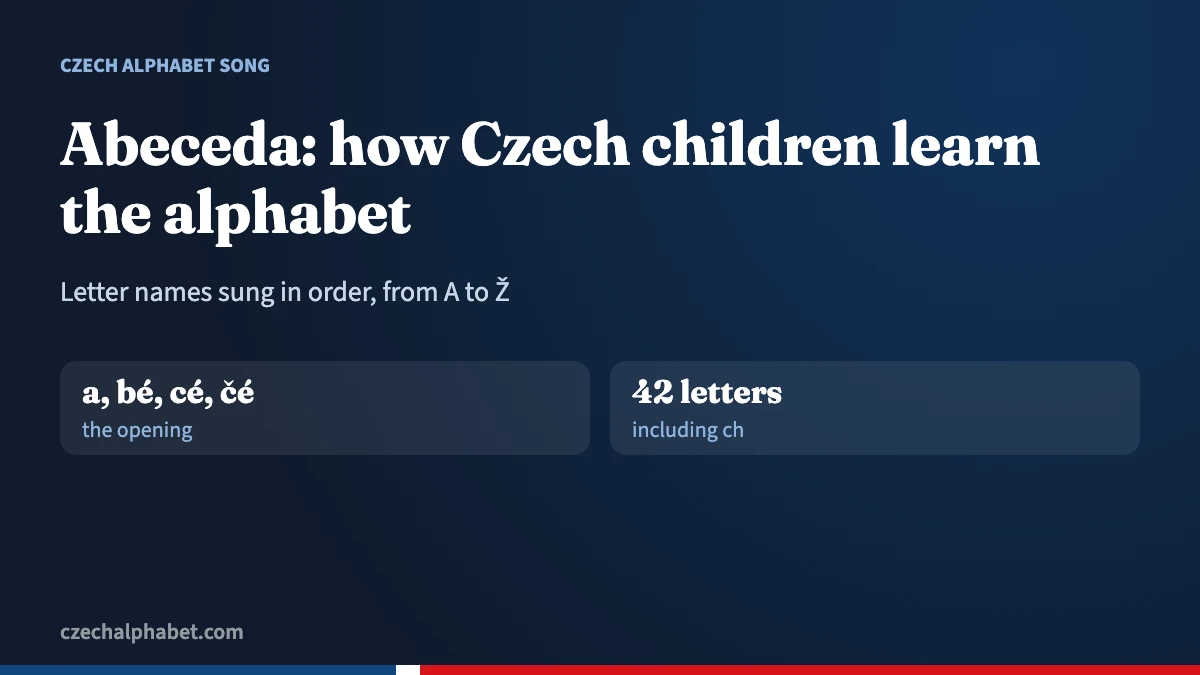
A Czech alphabet song is any tune that strings the Czech letter names together, from á, bé, cé to zet, žet. If you grew up with the English ABC song you may expect one famous Czech version. In practice, Czech children meet the abeceda (alphabet) through many songs, rhymes and books, and above all through their first-grade reading primer, the slabikář.
This page explains how Czech kids learn their letters, gives you a simple chant built from the official letter names (above), and shows how to make it stick. We do not reproduce copyrighted song lyrics here; the chant uses only the names of the letters themselves.
How Czech children learn the abeceda
Most Czech children learn to read and write in the first year of primary school (základní škola), around age six. Teachers use a slabikář, a primer that builds from letters to syllables (slabika means “syllable”) to words. Two teaching methods are common.
- The analytic-synthetic method (analyticko-syntetická metoda) works with sounds and syllables, splitting words into parts and putting them back together.
- The genetic method (genetická metoda) usually starts with capital printed letters and moves to handwriting later.
A study by Kucharská and Veverková, summarized by Charles University’s Faculty of Education, compared writing results of 467 first graders taught with these two methods. Both are in active use, and schools choose between them.
Alongside school, children pick up letters from picture alphabets, songs on CDs and streaming, and TV. One example is the 2013 Czech TV series Ábécédé s Michalem, which gave each episode to one letter of the alphabet. The title itself is the first four letter names run together: á, bé, cé, dé.
A Czech alphabet song you can make yourself
The easiest Czech alphabet song is the letter names sung to any tune you know. The chant at the top of this page splits the names into five lines that fit a simple four-beat rhythm. Clap once per name and pause at the end of each line.
Start slowly, one line a day. Say each name, then tap it on our Czech alphabet chart to hear it. Once the first line is smooth, add the next. By the end of a week most learners can run through all five lines.
Keep it rhythmic, not musical, if you are unsure of the tune. Children’s teachers often use clapping or stepping to the beat, which works just as well for adults.
Letter names to get right
- Ch is chá and comes after há, not after cé.
- Ř is er s háčkem (“r with a háček”); some speakers shorten it to eř.
- Y is ypsilon, and Z and Ž are zet and žet.
- Long vowels are named dlouhé á, dlouhé í and so on, but most chants leave them out to keep the rhythm.
The Czech letters page lists every name in one place.
An old Czech idea: the alphabet of sounds
Czech teaching has a famous ancestor for this kind of learning. The Czech educator Jan Amos Komenský (Comenius) published Orbis Sensualium Pictus in 1658, often called the first picture book for children. It opens with a “symbolical alphabet” that links each letter to an animal sound.
Princeton’s Cotsen Children’s Library describes it: a mouse squeaks for I, a hare’s cry stands for W, a duck’s call for another letter. The idea of tying a letter to a sound children can imitate is still at the heart of how many Czech primers work today.
Spelling aloud in Czech
A Czech alphabet song is not just for kids. Adults use letter names constantly: on the phone, at a hotel desk, or spelling a surname at the post office. If your name is Smith, you say es, em, í, té, há. If you are spelling a Czech name such as Dvořák, you say dé, vé, ó, er s háčkem, á s čárkou, ká, naming the marks as you go.
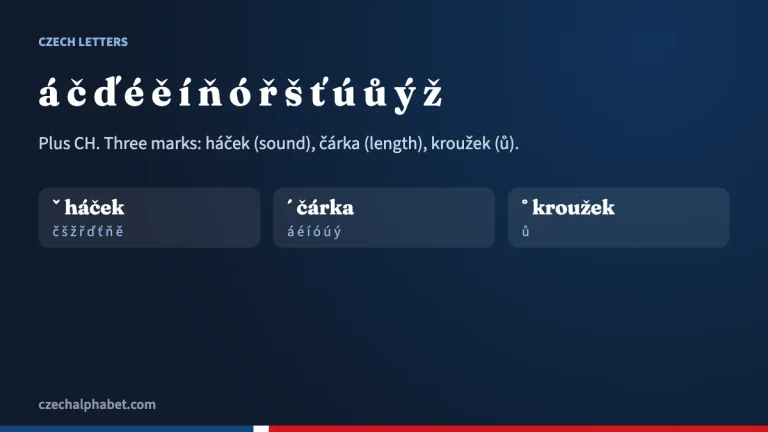
Naming the marks matters because they change letters. S čárkou means “with a čárka” (acute), and s háčkem means “with a háček”. Learn the three mark names on our Czech accents page.
Games to go with the chant
Once the chant feels easy, turn the Czech alphabet song into games. They work for families with children and for adult learners alike.
- Stop the song. One person chants; the other says “stop” at random. Whoever chants must name a Czech word starting with that letter, such as pes (dog) for pé.
- Mark call. Say a letter name and add a mark: “cé s háčkem“. The listener writes the letter, here č.
- Backwards round. Chant from žet back to á. It is harder than it sounds and shows which names you really know.
- Spell the menu. On a trip, spell out dish names from a Czech menu using letter names.
Common mistakes with the Czech alphabet song
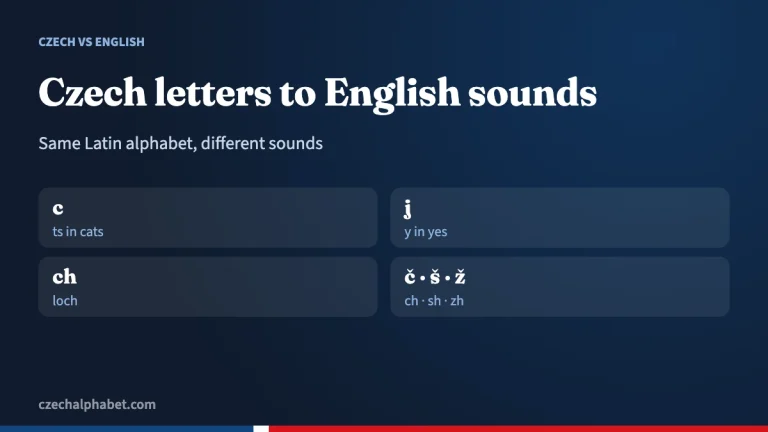
- Using English letter names. Czech H is há, not “aitch”; J is jé (“yeh”), not “jay”.
- Putting ch under C. It follows há.
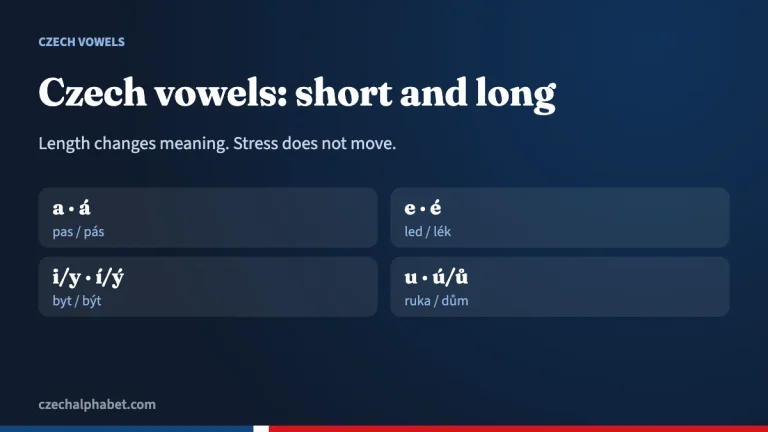
- Saying “ee” for E. Czech é is like the “e” in “bed”, held longer.
- Copying lyrics from videos. Many popular children’s songs are under copyright; sing the letter names instead, or buy the song.
- Stopping at the chant. Once you know the names, practice the sounds with the Czech alphabet pronunciation guide and the quiz.
Frequently asked questions
Is there an official Czech alphabet song?
No single song plays the role of the English ABC song. Czech children learn letters from a school primer, picture books, many different songs and TV programs.
How do you say the Czech alphabet?
With letter names: á, bé, cé, čé, dé, ďé, é, ef, gé, há, chá, í, jé, ká, el, em, en, eň, ó, pé, er, er s háčkem, es, eš, té, ťé, ú, vé, ypsilon, zet, žet (long vowels and Q, W, X are usually skipped in chants).
What is a slabikář?
A slabikář is the first-grade reading primer used in Czech schools. It teaches letters, then syllables (slabiky), then whole words.
At what age do Czech children learn the alphabet?
Most learn to read and write in the first year of primary school, around age six, though many know some letters earlier.
What is the Czech word for alphabet?
Abeceda. It comes from the first letter names, á, bé, cé, dé.
Sources
- Charles University, Faculty of Education: reading methods in first grade (Pedagogika 1-2/2012)
- Princeton University, Cotsen Children's Library: Comenius's symbolical alphabet
- ČÚZK: Toponymic Guidelines of the Czech Republic, 4th ed. (2024), UNGEGN
- Wikipedia: Czech orthography