Czech Letter Ě (and E, É): How Ě Softens the Letter Before It
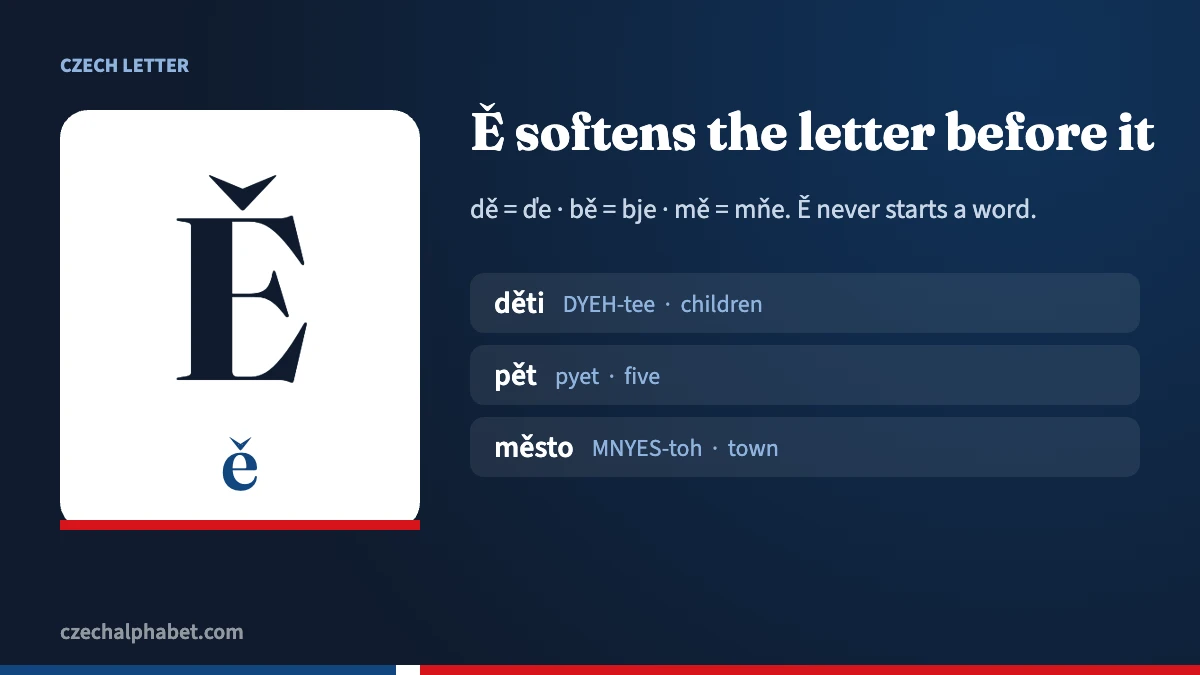
The Czech letter Ě (ě) is a short e that changes the consonant in front of it. After d, t, n it softens them: dě = ďe, tě = ťe, ně = ňe. After b, p, v, f it adds a y-sound: bě = bje. After m it adds ň: mě = mňe. On its own it sounds like the e in “bed”. Ě never starts a word.
The three rules of Ě
| Written | Said as | Sounds like | Example |
|---|---|---|---|
| dě, tě, ně | ďe, ťe, ňe | “dyeh”, “tyeh”, “nyeh” | děti children, tělo body, něco something |
| bě, pě, vě, fě | bje, pje, vje, fje | “byeh”, “pyeh”, “vyeh” | běžet to run, pět five, věc thing |
| mě | mňe | “mnyeh” | město town, mě me |
That’s the whole system: ě is a spelling device that saves writing ď, ť, ň or j before e. It’s why the Czech word for “thank you”, děkuji , starts “dyeh” and not “deh”.
Mě or mně? A trap even Czechs fall into
Both are pronounced the same, “mnyeh”, so native speakers mix them up in writing all the time. The short version:
- mně = “to me” or “about me” (dative and locative): Dej to mně. Give it to me. Mluví o mně. They’re talking about me.
- mě = “me” as the object, and after words like bez (without): Vidíš mě? Do you see me? Bez mě. Without me.
A quick test Czech pupils use: if you could replace it with mi, write mně. Inside ordinary words it’s always mě: město, změna, never “mněsto”.
E and É: the plain and long e
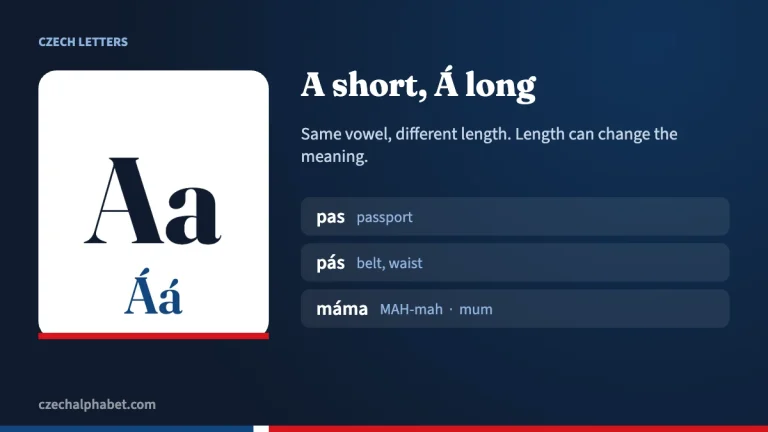
- E: short, as in “bed”: pes dog, den day.
- É: the same sound, held about twice as long: mléko milk, dobré good. In everyday speech around Prague, final -é in adjectives is often said like -ý (“dobrý ráno”), but the written form is é.
Vowel length is real in Czech, so keep é long, for example in dobré ráno.
Practice: ě in 12 common words
Typing Ě
- Czech keyboard: the 2 key on the number row.
- Mac: hold e and choose ě.
- Phone: long-press e.
Common mistakes
- Reading ě as a separate syllable. pět is one syllable: “pyet”.
- Forgetting to soften d, t, n. děti said as “deh-ti” sounds wrong to every Czech.
- Writing “mněsto”. Inside words it’s always mě: město.
- Expecting ě at the start of a word. It only ever follows a consonant.
Frequently asked questions
How do you pronounce ě in Czech?
As “ye” after b, p, v, f (pět = pyet), as a softener after d, t, n (děti = dyeh-ti), and as “mnye” after m (město = mnyes-to).
Is ě a vowel?
It is written as a vowel and sounds like e, but its main job is to change the consonant before it.
What is the difference between mě and mně?
They sound the same. Mně means “to me / about me”; mě is “me” as an object or after bez.
Keep going
- Ď, Ť and Ň: the soft consonants ě creates
- Czech vowels
- The háček
Sources
- Wikipedia, “Czech orthography” (ě and the soft consonants): en.wikipedia.org
- Wikipedia, “Czech phonology”: en.wikipedia.org