Czech Vowels: Short, Long, ě and the Diphthong ou
Czech vowels are five sounds, a, e, i, o, u, each with a short and a long form: a/á, e/é, i,y/í,ý, o/ó, u/ú,ů. Long vowels carry a čárka or ring and are held longer, which can change a word’s meaning, as in byt (apartment) and být (to be). Czech also has the letter ě and the diphthong ou.
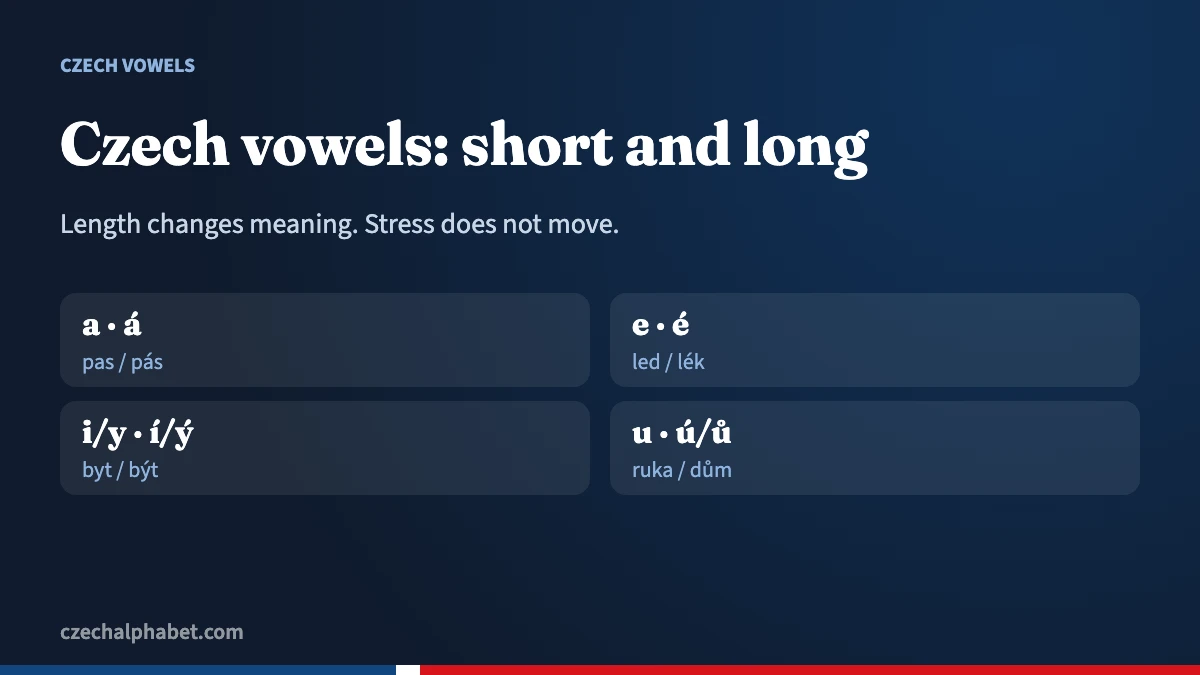
Czech vowels come in neat pairs: five short sounds and five long ones. The long version is spelled with a čárka (acute) or, for one letter, a ring. Length is not a matter of style. It changes words, so a learner who gets the length right sounds clear even with an imperfect accent.
Wikipedia’s Czech phonology article lists ten monophthongs and notes that vowel length is independent of stress. That second point trips up English speakers more than any single vowel sound.
The ten Czech vowels
| Short | Long | IPA | Close English sound | Example |
|---|---|---|---|---|
| a | á | [a] [aː] | “u” in “cup” / “a” in “father” | máma (mom) |
| e | é | [ɛ] [ɛː] | “e” in “bed” | mléko (milk) |
| i, y | í, ý | [ɪ] [iː] | “i” in “bit” / “ee” in “see” | mýdlo (soap) |
| o | ó | [o] [oː] | “o” in British “lot”, rounder | gól (goal) |
| u | ú, ů | [u] [uː] | “oo” in “book” / “food” | dům (house) |
Two spelling pairs share one sound. I and y are both [ɪ], and ú and ů are both [uː]. The choice between them is a spelling rule, not a pronunciation one. For the ú/ů rule, see Czech accents.
Long ó is the rarest. It appears mostly in loanwords such as gól and móda (fashion).
Why length matters in Czech vowels
Czech uses length to tell words apart. Here are pairs that differ only by a čárka. Tap both buttons and listen for the longer vowel.
| Short | Meaning | Long | Meaning | Hear |
|---|---|---|---|---|
| byt | apartment | být | to be | |
| pas | passport | pás | belt, strip | |
| rada | advice, council | ráda | glad (feminine) |
Length also does grammar work. Mladý muž is “young man” and mladí muži is “young men”; the long í marks the plural.
Length and stress are separate. In dobrý (good), stress is on do- and the final ý is long but unstressed. Keep the beat at the front and stretch the vowel at the back.
Ě: a vowel letter that changes consonants
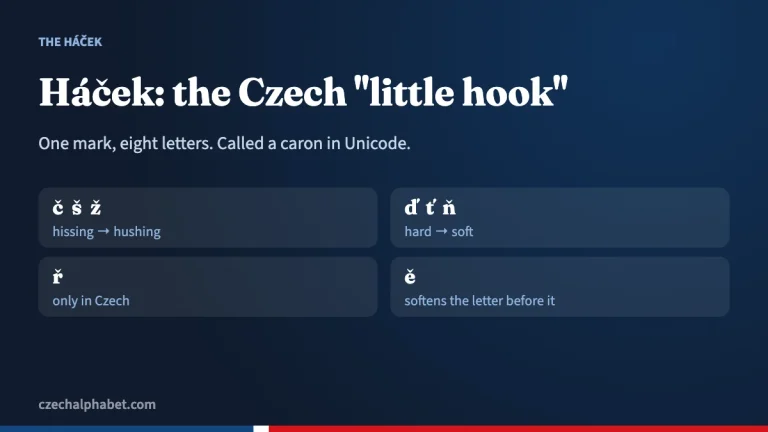
Ě looks like a sixth vowel, but it is said as a plain e with an effect on the consonant before it. The Czech phonology article describes three outcomes:
- After d, t, n: they become soft ď, ť, ň. Děti (children) .
- After b, p, v, f: a “y” sound slips in. Pět (five) is “pyet” .
- After m: it becomes “mnye”. Město (town) is “mnyesto” .
Ě never starts a word and is never long. More on its sound is on Czech letter Ě.
The diphthong ou and others
Czech has one common diphthong, ou, a glide from “o” to “u” in one syllable. Think of a quick “oh-oo”: mouka (flour) , pouze (only). Don’t split it into two syllables.
Au and eu also exist, but mostly in loanwords: auto (car), euro. In native words where two vowels meet across a boundary, they stay in separate syllables, sometimes with a light catch in the throat (a glottal stop), as in poučit (to instruct), said po-učit.
Syllables without vowels
Some Czech syllables have no vowel letter at all. R and l can act as the core of a syllable, so vlk (wolf), krk (neck) and prst (finger) are one full syllable each. Treat the r or l as the vowel and don’t add a hidden “e”. Our Czech tongue twisters page is full of these.
Czech vowels in places and names
Vowel length shows up in names you will see on any trip. Praha has two short vowels, PRA-ha. Plzeň has none at all in its first syllable apart from the syllabic l. Karlovy Vary is all short vowels, while Mariánské Lázně has three long ones: á, é and another á. Say them with first-syllable stress and stretched long vowels and locals will understand you at once.
Surnames follow the same rules. In Novák the á is long but the stress is on No-. Many women’s surnames end in long -ová, as in Nováková, which you can explore on Czech female surnames.
How to practice Czech vowels
- Clap the length. Clap once for a short vowel and hold your hands together for a long one while saying words such as máma or mléko.
- Record yourself. Say byt and být, play them back, and check that you can hear the difference.
- Read vowel-heavy words slowly. Úterý (Tuesday) has a long first vowel, two short ones, and a long final ý.
- Keep the jaw still. Pure vowels don’t glide, so watch your mouth in a mirror on é and ó.
Common mistakes with Czech vowels
- Gliding long vowels. Czech é is not English “ay”, and ó is not “oh-w”. Keep them steady.
- Stressing the long vowel. Stress stays on the first syllable.
- Reading y as in “yes”. As a vowel, Czech y is the “i” in “bit”.
- Saying ě as “yeh” everywhere. After d, t, n it softens the consonant instead.
- Rushing short a. Czech a is open, like “u” in “cup”, never the “a” of “cat”.
- Splitting ou. Mouka has two syllables, mou-ka, not three.
- Reducing unstressed vowels. English turns many unstressed vowels into a weak “uh”. Czech keeps every vowel clear, even at the end of a long word.
Practice the vowels on the Czech alphabet chart, then move on to the full Czech alphabet pronunciation guide or test yourself with the quiz.
Frequently asked questions
How many Czech vowels are there?
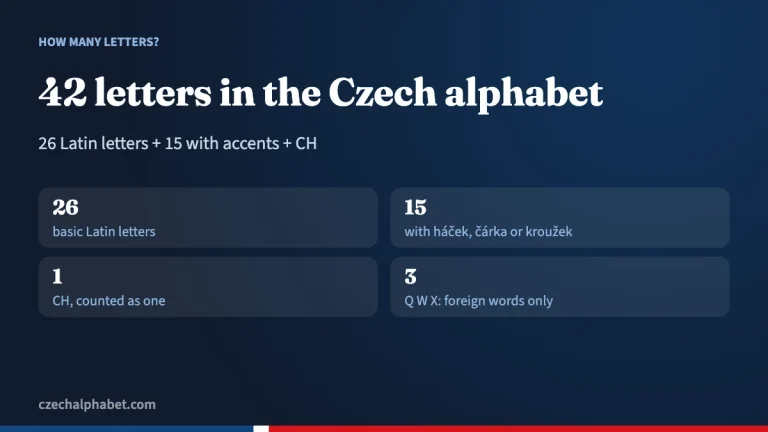
Czech has five vowel sounds, each short and long, so ten in total. They are written with 13 letters: a, á, e, é, i, í, y, ý, o, ó, u, ú, ů, plus ě, which marks a softened consonant.
What is the difference between á and a in Czech?
Á is held longer than a. The vowel quality is almost the same, but the length can change the word, as in pas (passport) and pás (belt).
Is ů pronounced differently from ú?
No. Both are a long oo sound. The ring on ů comes from an old diphthong uo and is kept as a spelling tradition.
Does the accent mark stress in Czech?
No. The čárka marks length only. Stress is always on the first syllable.
What is the Czech diphthong ou?
Ou is a glide from o to u in one syllable, as in mouka (flour). It is the only common native diphthong in Czech.
Sources
- Wikipedia: Czech phonology
- Wikipedia: Czech orthography
- ČÚZK: Toponymic Guidelines of the Czech Republic, 4th ed. (2024), UNGEGN