Czech Letter C: Why It Always Sounds Like TS
The Czech letter C is a consonant pronounced [t͡s], like the ts in “cats,” in every position. Its Czech name is cé. It never sounds like k or s, so cena (price) is “TSEH-nah.” Words borrowed with a k-sounding c are respelled with k, as in kultura.
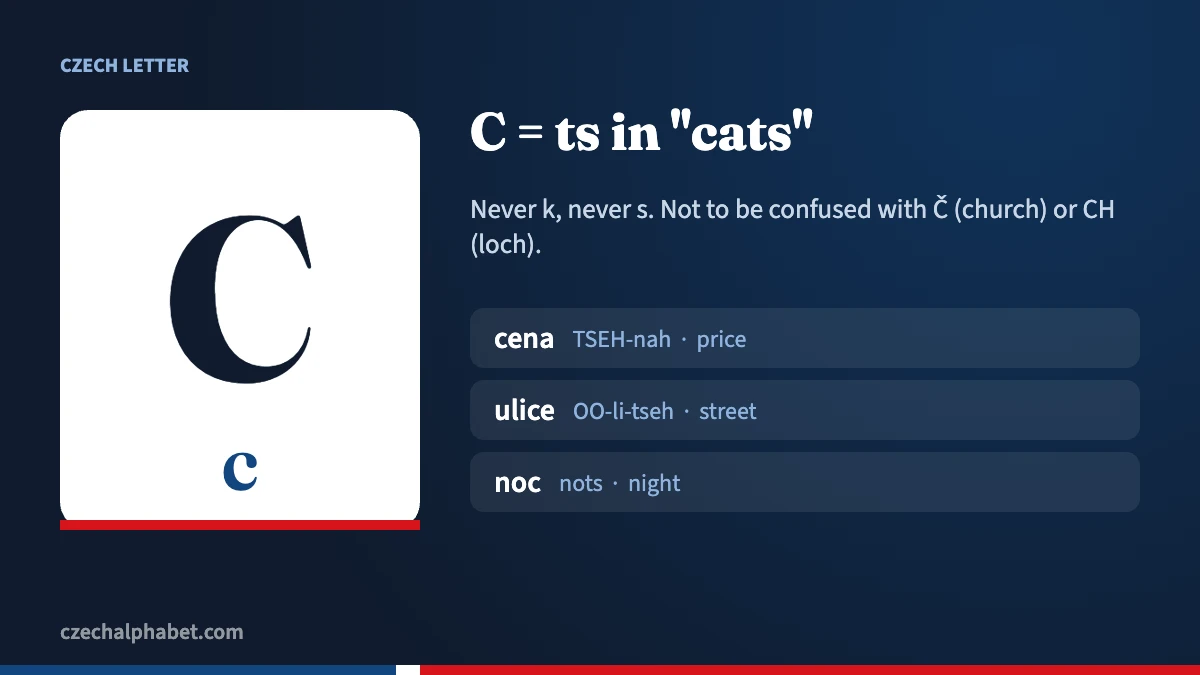
The Czech letter C always stands for the sound [t͡s], the ts at the end of “cats.” It never sounds like k or s, as it can in English. That single fact unlocks hundreds of Czech words and names, from cukr (sugar) to Václav.
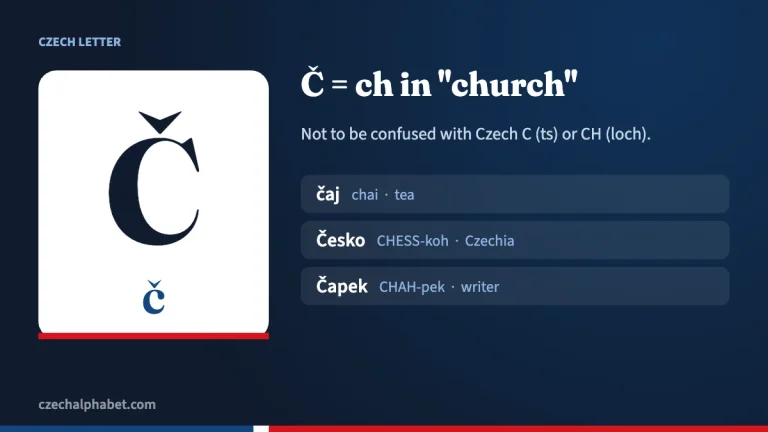
Its Czech name is cé. Note that C, Č and CH are three different letters with three different sounds.
How to pronounce the Czech letter C
Put your tongue where you say t, then release it straight into an s, as one quick sound. English speakers can already do this in the middle or at the end of words (“cats,” “pizza”). The challenge is doing it at the start of a word, as in cesta (road, journey) or celý (whole).
Practice by saying “cats” and then dropping the “ca”: you are left with the right sound. Then put a vowel after it: “tse,” “tsu.”
At the end of a word, C stays ts: noc (night), konec (end), měsíc (month, moon). It is already voiceless, so the Czech rule that devoices final consonants leaves it unchanged.
| Word | Meaning | Sound | Hear |
|---|---|---|---|
| cukr | sugar | [t͡sukr] | |
| cesta | road, journey | [t͡sɛsta] | |
| ulice | street | [ʊlɪt͡sɛ] | |
| Václav | Václav (name) | [vaːt͡slaf] | |
| noc | night | [not͡s] |
C is a “soft” consonant
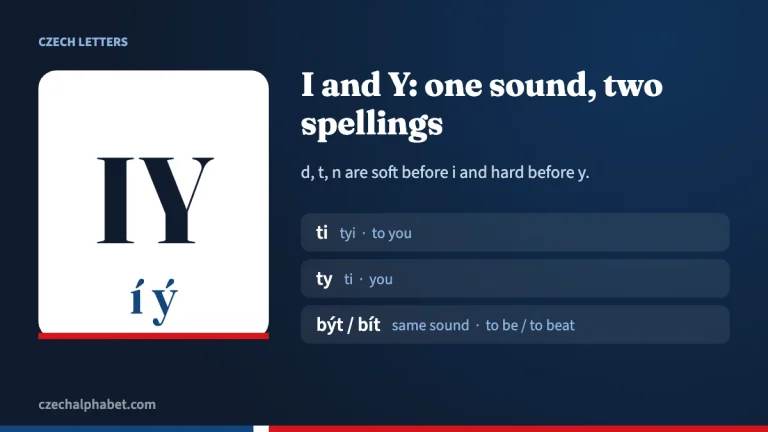
Czech spelling sorts consonants into hard, soft and neutral groups. The Czech letter C belongs to the soft group, so it is followed by i or í, never by y or ý, in native words. You will see ulice (street), cizí (foreign) and cibule (onion), but no native word with “cy.” This makes C one of the easier letters for spelling. See Czech spelling for the full system.
Where the English c went
Because C is always ts, loanwords where Latin or English c sounds like k are respelled with k. The Czech language institute’s rules for adapting loanwords give kakao (cocoa) and abstraktní (abstract) as examples. So English “culture” is kultura and “Canada” is Kanada.
Where Latin c was pronounced ts in the Czech tradition, it stays: cirkus (circus), centrum (center), Cicero. This is why English speakers sometimes read centrum correctly by luck and cena (price) wrongly.
When you meet C in a name, the Czech name pronouncer shows the respelling; Václav comes out as “VAHTS-lahf.”
C next to other consonants
Because C is a single sound, it can start a word before another consonant: cvičit (to exercise), ctít (to honor), cvrček (cricket). Keep the ts short and move straight on; do not insert a vowel, or cvičit turns into “tsuh-vichit.”
C also has a voiced partner, [d͡z], which has no letter of its own. It appears when C is pushed by a following voiced consonant, as in leckdo (many a person), said [lɛd͡zɡdo] according to the Czech language institute.
C can sit in clusters that look impossible to English eyes. Václav has cl; srdce (heart) has dc. In srdce, the Czech language institute says the standard pronunciation simplifies the cluster to [srt͡sɛ], without a separate d.
Common mistakes with the Czech letter C
- Reading c as k: cena is TSEH-nah, not KEH-nah.
- Reading c as s: ulice has ts, not s.
- Confusing c with č (ch as in church) or ch (as in loch).
- Writing English spellings in Czech: it is klub and kultura, not “club” or “cultura.”
Next letter: Č. For a sound-by-sound overview, see Czech alphabet pronunciation.
Frequently asked questions
How do you pronounce the Czech letter C?
Always as ts, as in “cats.” This holds at the start, middle and end of a word: cukr, ulice, noc.
Is Czech c ever pronounced like k?
Not in native Czech words. Loanwords with a k sound are spelled with k instead, such as kakao and kultura.
What is the difference between c, č and ch in Czech?
They are three letters: c is ts, č is ch as in “church,” and ch is the throaty sound of Scottish “loch.”
How do you pronounce Václav?
Roughly VAHTS-lahf, with stress on the first syllable and a long á. The final v sounds like f.
Can c be followed by y in Czech?
Not in native words. C is a soft consonant, so it takes i or í, as in ulice and cizí.
Sources
- Ústav pro jazyk český: Internetová jazyková příručka, Počešťování přejatých slov
- Ústav pro jazyk český: Internetová jazyková příručka, Vypouštění a vkládání hlásek
- Ústav pro jazyk český: Internetová jazyková příručka, Méně známé české souhlásky
- Wikipedia: Czech orthography