Czech Letter Ž (and Z): The “Pleasure” Sound and When It Turns to Š
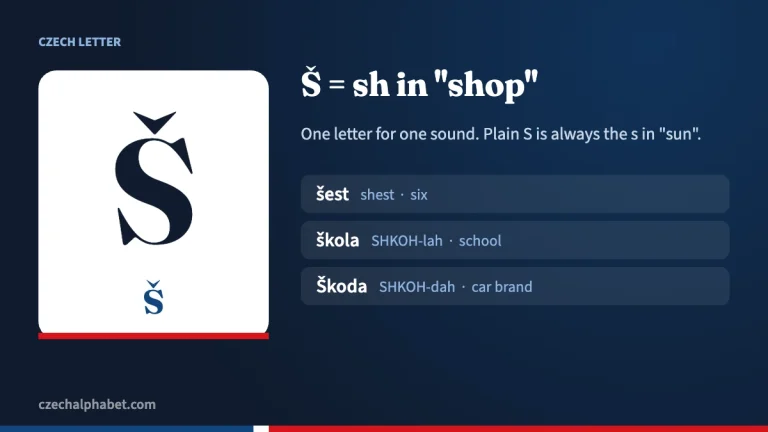
The Czech letter Ž (ž, named žet) sounds like the s in “pleasure” or the g in French “genre”, [ʒ]. It is the last letter of the Czech alphabet. At the end of a word or before p, t, k, s it loses its voice and sounds like Š (“sh”): muž (man) is “moosh”. Plain Z is simply the z in “zoo”.
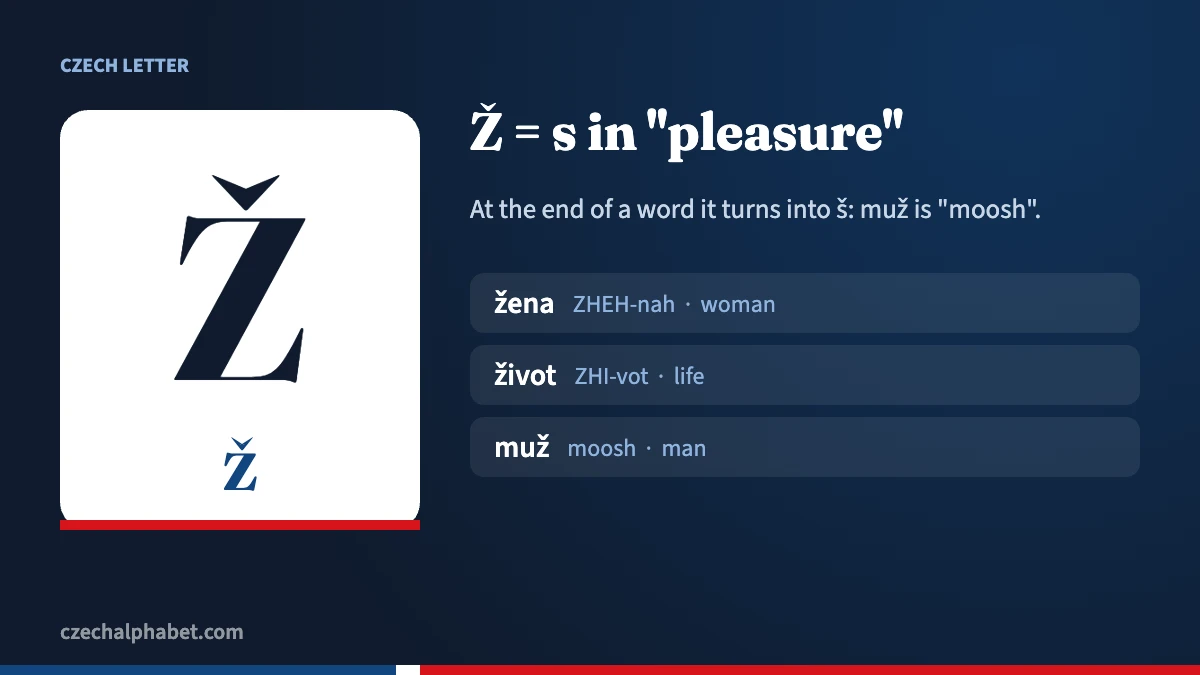
Ž and Z side by side
| Letter | Sound | Examples |
|---|---|---|
| Ž | s in “pleasure” | žena woman, život life, žlutý yellow |
| Z | z in “zoo” | zima winter, zub tooth, zámek castle |
The pairs matter: koza is a goat, kůže is skin; zeď is a wall, žeď is not a word. Train your ear with the buttons above; most have native-speaker recordings.
When Ž sounds like Š (and Z like S)
Czech consonants come in voiced and voiceless pairs, and the voiced one goes quiet at the end of a word or before a voiceless consonant. For these two letters:
- Ž → “sh”: muž (moosh), nůž knife (noosh), už already (oosh)
- Z → “s”: mráz frost (mrahs), obraz picture (ob-ras), z Prahy from Prague (s-prah-hih).
You spell the letter you hear in the other forms of the word: muž keeps ž because the plural is muži, where the ž is heard clearly.
Ž is not Ř
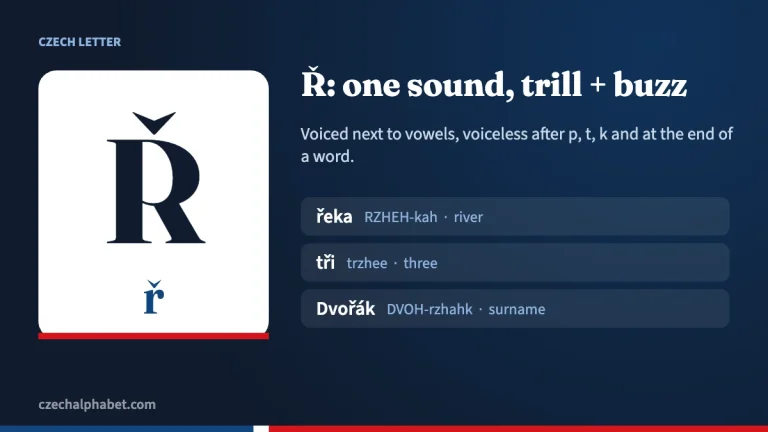
Learners often swap these. Ž is a smooth buzz with no trill. Ř is that same buzz plus a trill. If Dvořák comes out as “Dvožák”, you’ve dropped the trill. See how to pronounce Ř.
Practice words
Typing Ž
- Czech keyboard: the 6 key on the number row.
- Mac: hold z and choose ž.
- Phone: long-press z.
Common mistakes
- Saying ž as English j (“jena” for žena). English j has a d in front; ž doesn’t.
- Keeping ž voiced at the end. muž is “moosh”, not “moozh”.
- Writing š because you hear “sh”. Check another form of the word: muž → muži.
Frequently asked questions
How do you pronounce ž in Czech?
Like the s in “pleasure” or “measure”. At the end of a word it sounds like “sh”.
Is ž the same as English j?
No. English j is “dzh”; ž is the buzz without the d.
What is the last letter of the Czech alphabet?
Ž. It comes after Z, making it letter 42 of 42.
Keep going
- Š, the voiceless partner of Ž
- Ř
- Czech alphabet chart
Sources
- Wikipedia, “Czech phonology” (voicing assimilation and final devoicing): en.wikipedia.org