I Love You in Czech: Miluji Tě vs Mám Tě Rád
| Czech | English | Who says it | Hear |
|---|---|---|---|
| Miluji tě. | I love you. | anyone | |
| Miluju tě. | I love you (spoken). | anyone | |
| Mám tě rád. | I love you, I’m fond of you. | a man | |
| Mám tě ráda. | I love you, I’m fond of you. | a woman | |
| Já tebe taky. | I love you too. | anyone |
I love you in Czech is miluji tě, pronounced MIH-loo-yih tyeh [ˈmɪlujɪ cɛ]; in speech, miluju tě is more common. Czechs also say mám tě rád (a man speaking) or mám tě ráda (a woman speaking), a softer, broader “I love you” used with partners, family and close friends.
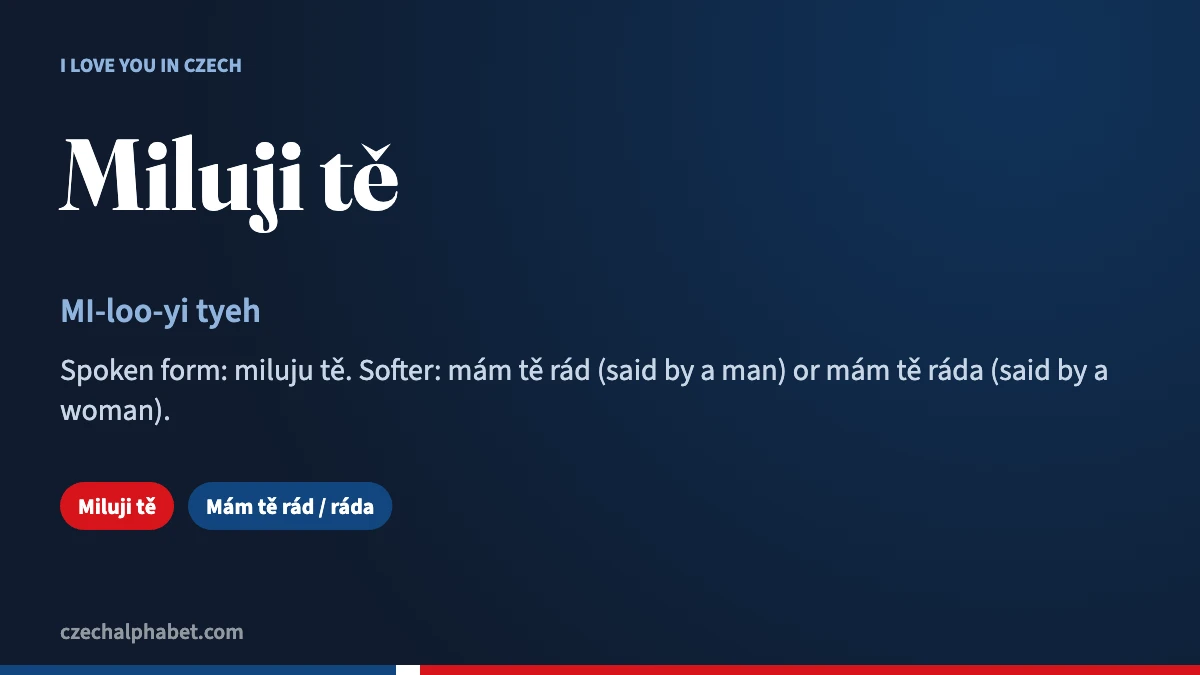
“I love you” in Czech is miluji tě [ˈmɪlujɪ cɛ], said MIH-loo-yih tyeh. In conversation most people say miluju tě. Czech also has a second, softer phrase, mám tě rád (said by a man) or mám tě ráda (said by a woman), which literally means “I have you dear” and covers everything from fondness to deep love. Choosing between them is the real question, and Czechs themselves do not all agree.
How to say I love you in Czech
| Czech | IPA | English | Hear |
|---|---|---|---|
| miluji tě | [ˈmɪlujɪ cɛ] | I love you | |
| miluju tě | [ˈmɪluju cɛ] | I love you (spoken) | |
| mám tě rád | [maːm cɛ raːt] | I love you, I like you (man speaking) | |
| mám tě ráda | [maːm cɛ ˈraːda] | I love you, I like you (woman speaking) | |
| já tebe taky | [jaː ˈtɛbɛ ˈtakɪ] | me too, I love you too | |
| taky tě miluju | [ˈtakɪ cɛ ˈmɪluju] | I love you too |
Miluji comes from milovat (to love). Tě is the short form of “you” used as an object. Its first sound is ť, a soft t made with the middle of the tongue, close to the “t y” in “got you” said fast. See the Czech letter Ť for practice. Stress the first syllable: MIH-loo-yih.
Miluji and miluju are both correct standard Czech; the second is what most people say aloud. The same pair exists for “thank you”, as explained in thank you in Czech.
In rád, the final d is pronounced as t, because Czech devoices consonants at the end of a word: RAHT. In ráda the d stays a d.
Miluji tě or mám tě rád?
Both phrases translate as “I love you”, but they feel different. Sources describe the line in slightly different ways, which reflects real variation between speakers.
- Radio Prague International presents mám tě rád / ráda as closer to “I like you” or “I’m fond of you”, and miluju tě as the phrase you save for being truly in love.
- Prague expat magazine Expats.cz notes that many native speakers rarely use miluju tě in everyday life and treat mám tě rád as the natural, heartfelt way to say it.
In practice: miluji tě is unmistakably romantic love and carries weight, so it suits big moments, cards and serious relationships. Mám tě rád is broader and everyday. You can say it to a partner, a parent, a child or a close friend, and context decides how deep it goes. Parents say mám tě ráda to their kids all the time.
The ending of rád / ráda follows the speaker’s gender, not the listener’s. A man always says mám tě rád; a woman always says mám tě ráda.
More ways to say I love you in Czech
| Czech | English | Hear |
|---|---|---|
| Jsem do tebe zamilovaný. | I’m in love with you (man speaking). | |
| Jsem do tebe zamilovaná. | I’m in love with you (woman speaking). | |
| Zbožňuji tě. | I adore you. | |
| Chybíš mi. | I miss you. | |
| Jsi moje láska. | You are my love. | |
| Mám tě moc rád. | I love you very much (man speaking). | |
| Mám tě moc ráda. | I love you very much (woman speaking). |
Chybíš mi literally means “you are missing to me”, so the person missed is the subject. Láska means “love” as a noun; addressing someone, it becomes lásko.
To sign a card or a message, Czechs write S láskou (with love) before their name. Between partners and close family, a message often ends with Líbám, literally “I kiss (you)”, or the short Pusu (a kiss). These work well under a birthday or holiday greeting.
Czech terms of endearment
Czech pet names usually appear in the vocative case, the form used to address someone directly, so the endings change.
| Pet name (when addressing) | Basic form | Meaning | Hear |
|---|---|---|---|
| miláčku | miláček | darling | |
| lásko | láska | love | |
| zlato / zlatíčko | zlato | gold, sweetie | |
| broučku | brouček | little beetle | |
| kočičko | kočička | kitten, little cat | |
| puso | pusa | kiss |
Insects and small animals are popular: broučku (little beetle) is used for children and partners alike. Many pet names use diminutive endings such as -ek, -ička and -íčko, which make words smaller and sweeter.
Love on 1 May
Czechs have their own day for lovers, and it is not 14 February. According to Radio Prague International, 1 May has long been a day for couples, and Valentine’s Day spread mainly after 1989. Tradition says a couple should kiss under a blossoming cherry tree on 1 May for a healthy, lucky year. Many lovers meet at the statue of the Romantic poet Karel Hynek Mácha on Petřín Hill in Prague. His long poem Máj (May), published in 1836, is one of the best-known works of Czech literature and opens with a famous line about evening, May, and love.
For wishes on other occasions, see happy birthday in Czech and Czech name days, a celebration many couples mark too.
Common mistakes
- A woman saying “mám tě rád”. Women say ráda; the ending follows the speaker.
- Pronouncing tě as “teh”. It is a soft “tyeh”, the sound of ť.
- Using miluji tě too early. It is a big statement. Mám tě rád / ráda is lighter.
- Using the basic form as a pet name. Say miláčku, not miláček, when you call someone.
- Writing “miluji te”. Keep the háček on tě. Our háček guide explains the mark, and Czech phrases has more to say to someone special.
Frequently asked questions
How do you say I love you in Czech?
Say miluji tě or, more casually, miluju tě. A softer option is mám tě rád (man) or mám tě ráda (woman).
What is the difference between miluji tě and mám tě rád?
Miluji tě is clearly romantic and weighty. Mám tě rád is broader and used with partners, family and friends; context sets its depth.
How do you say I love you too in Czech?
Já tebe taky (me too) or taky tě miluju (I love you too).
How do you say I miss you in Czech?
Chybíš mi.
What is the Czech day for lovers?
1 May. Couples traditionally kiss under a blossoming cherry tree, and Valentine’s Day became popular mainly after 1989.
Sources
- Radio Prague International: Love and marriage, Czech style
- Radio Prague International: Do Czechs prefer Valentine's Day to May 1st?
- Expats.cz: 10 sweet ways to express your love in Czech
- Britannica: May, poem by Karel Hynek Mácha