Czech Pronunciation: The Complete Guide With Native Audio
Czech pronunciation is regular: each letter has one sound, every letter is pronounced, and stress always falls on the first syllable. Once you know about a dozen letters that differ from English (c, č, ch, j, ř, ě, ď, ť, ň, h and the long vowels), you can read any Czech word aloud correctly, even one you’ve never seen.
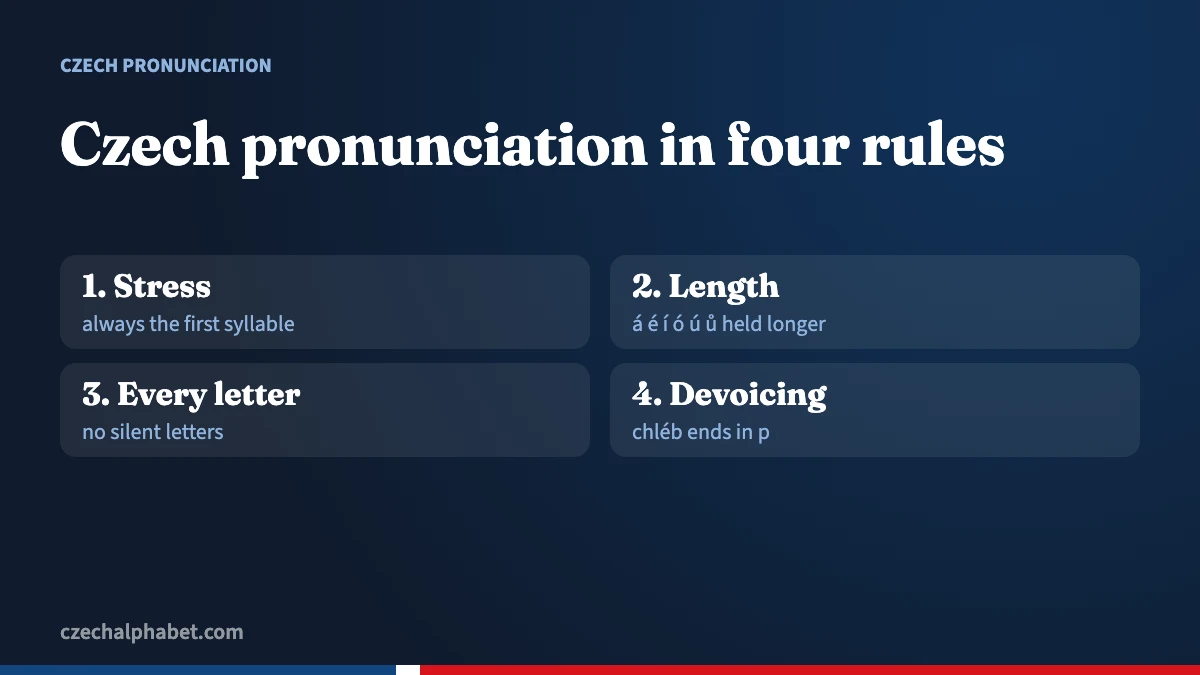
The four rules that do most of the work
- First-syllable stress, always. Praha is PRA-ha, Dvořák is DVO-řák, nemocnice (hospital) is NE-moc-ni-ce. Long vowels don’t attract the stress.
- Long vowels are held longer, not changed. á, é, í/ý, ó, ú/ů are the same vowels as a, e, i, o, u, held about twice as long. Length can change meaning: byt flat vs být to be.
- Every letter is pronounced. No silent e, no swallowed syllables: jméno (name) starts with a real j+m.
- Voiced consonants go voiceless at the end of a word. chléb (bread) ends in p, led (ice) in t, muž (man) in š.
Letters that don’t sound like English
| Letter | Sounds like | Example |
|---|---|---|
| c | ts in “cats” | cena price |
| č | ch in “church” | čaj tea |
| ch | ch in Scottish “loch” | chléb bread |
| h | a voiced, breathy h | hrad castle |
| j | y in “yes” | jak how |
| ř | trilled r + ž buzz | řeka river |
| š / ž | sh / s in “pleasure” | šest six, žena woman |
| ď ť ň | soft d, t, n (“dy”, “ty”, “ny”) | kůň horse |
| ě | softens the letter before it | děti children |
| r | tapped or trilled r | ruka hand |
| w, q, x | only in foreign words | taxi |
Vowels: short and long
| Short | Long | Sound | Pair |
|---|---|---|---|
| a | á | “uh” / “ah” (father) | pas passport · pás belt |
| e | é | “e” in bed | led ice · lék medicine |
| i / y | í / ý | “i” in sit / “ee” in see | byt flat · být to be |
| o | ó | “o” in hot (rounded) | gól goal (ó is rare) |
| u | ú / ů | “oo” in book / “oo” in food | ruka hand · dům house |
I and y sound the same; the difference is spelling and what it does to d, t, n before it. See I and Y. Czech also has three diphthongs: ou (dobrou noc), au and eu (mainly in loanwords).
Words without vowels
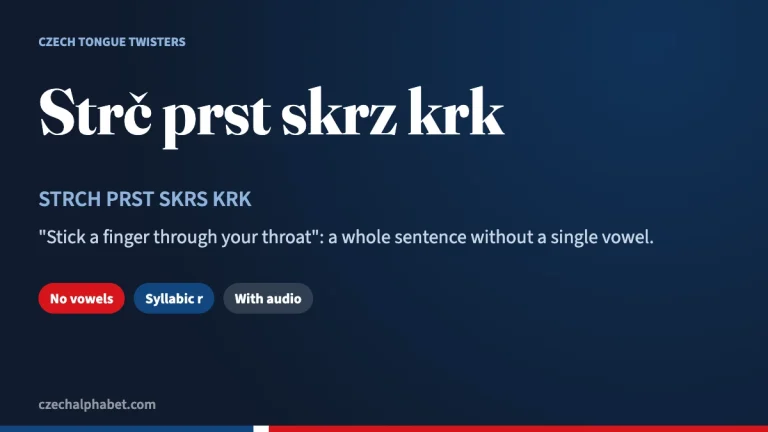
R and l can act as the core of a syllable, so Czech has real words with no written vowel: vlk (wolf), krk (neck), prst (finger), and the famous tongue twister Strč prst skrz krk (“stick a finger through your throat”). Say the r or l with a little more length and it works.
Consonants change with their neighbours
In clusters, the last consonant decides whether the group is voiced: kde (where) sounds like “gde”, všechno (everything) like “fšechno”, z Prahy like “s Prahy”. You don’t need to spell it that way; just let it happen naturally.
Five habits to drop
- Stressing the second or long syllable. Czech stress never moves.
- Reducing vowels to “uh”. Czech keeps every vowel clear.
- Aspirating p, t, k. English puffs air after them; Czech doesn’t.
- Pronouncing ch as in “church”. That’s č.
- Ignoring vowel length. It changes meaning.
Frequently asked questions
Where does stress fall in Czech words?
Always on the first syllable. Short words like prepositions join the next word: do školy is DO-ško-ly.
Is Czech pronunciation hard?
The spelling is very consistent, so reading aloud is easy to learn. The hard parts are ř, the soft consonants and long consonant clusters.
How do I pronounce a Czech name?
Type it into the pronouncer at the top of this page. It gives an English respelling and marks the stress.
Keep going
- How to pronounce Czech names
- Talking Czech alphabet chart
- Czech tongue twisters
Sources
- Wikipedia, “Czech phonology”: en.wikipedia.org
- Wikipedia, “Czech orthography”: en.wikipedia.org