Czech Cursive: School Handwriting and Comenia Script
| Joined cursive | Comenia Script | |
|---|---|---|
| Czech name | vázané psací písmo | nevázané písmo |
| Letters joined? | Yes, within a word | Little or not at all |
| Looks like | Classic slanted script | Simplified print |
| Pilot in schools | Long-standing standard | 2010–2012 (MŠMT) |
| Who decides | School director | School director |
Czech cursive is the joined handwriting taught in Czech primary schools, called psací písmo (“writing script”), in which letters in a word connect in one flowing line. Since a 2010–2012 pilot, schools may instead teach the unjoined Comenia Script. In both, the háček and čárka are written after the word, like dotting an i.
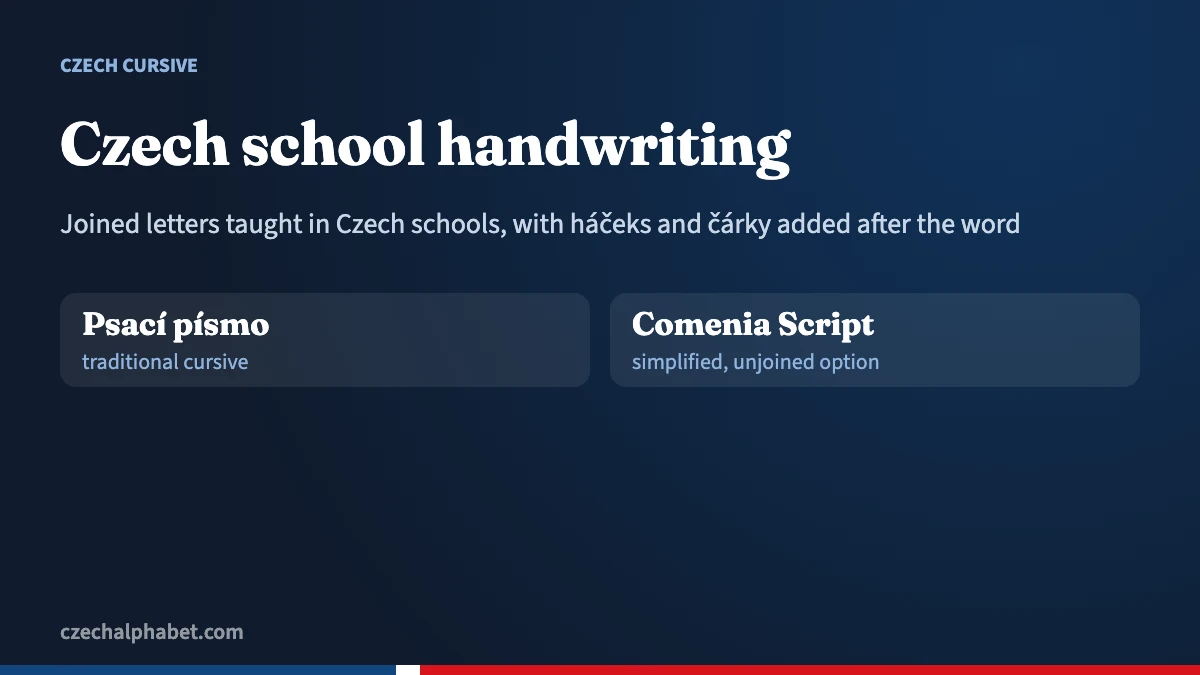
Czech cursive is the slanted, joined handwriting most Czech adults learned at school, known as psací písmo (literally “writing script”). Letters connect inside a word, and the diacritics are added on top once the word is written. If you have a letter from a Czech grandparent, this is almost certainly the script you are looking at.
Czech schools today have a choice. Alongside the traditional joined script, many teach an unjoined script called Comenia Script. This page explains both, then shows how to write Czech accents by hand.
Traditional Czech cursive (psací písmo)
The classic school script is a joined, slanted hand. Children start with printed capitals and small letters, then learn the joined forms during the first school year. The Ministry of Education (MŠMT) describes joined script (vázané písmo) as writing where the letters within a word are connected.
A few features make Czech cursive look different from American cursive:
- Diacritics on top. The čárka and háček are added after the word, in the same way you cross a t or dot an i.
- No dot on í. The čárka replaces the dot: í, never a dot plus a stroke.
- Full hooks on ď and ť. Print shows them with an apostrophe-like stroke, but handwriting often keeps a full háček above or beside the letter, as Wikipedia’s Caron article notes.
- Ů as a small circle. The ring is a little open loop or a tiny closed circle above u.
Comenia Script: Czech cursive without joins
Comenia Script is an unjoined handwriting model created by graphic designer Radana Lencová. Its letters look close to print and are joined little or not at all. The name honors the Czech educator Jan Amos Komenský (Comenius).
According to the Ministry of Education, the script was tested in a pilot project from September 2010 to June 2012, run with the Faculty of Education at Charles University in Prague. The name “Comenia Script” was registered as a trademark in 2012. A 2010 Charles University report describes the first schools preparing to teach it from the 2010/2011 school year.
Who chooses the script?
In 2015 the ministry issued guidance (MSMT-18492/2015) on joined and unjoined handwriting. Its key points:
- Neither joined nor unjoined script is codified as the standard.
- The school director decides which type the school teaches.
- Schools may teach both, for example in parallel classes.
- Pupils taught unjoined script should ideally learn to read joined script by the end of third grade.
You can read the original in the MŠMT information for schools. In practice, that means a Czech child today may write in either style, and some families meet both.
How to write Czech diacritics by hand
Whichever style you use, Czech letters only read correctly with their marks. Here is how Czechs usually write them.
| Mark | Letters | How to write it |
|---|---|---|
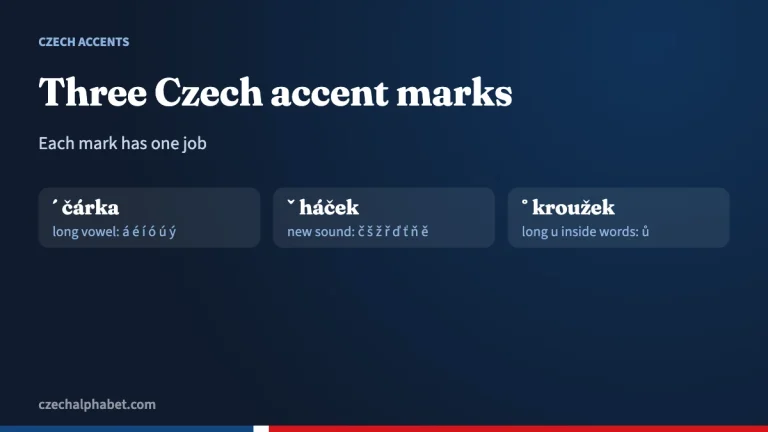
| čárka | á é í ó ú ý | A short stroke slanting up to the right, above the vowel |
| háček | č ě ň ř š ž | A small v, written above the letter after the word |
| háček on tall letters | ď ť | A small hook or stroke beside or above the stem |
| kroužek | ů | A tiny circle above the u |
Size matters. A čárka that is too long can look like a háček arm, and a háček that is too flat can look like a čárka. Keep the čárka short and slanted, and the háček clearly pointed. The Czech accents guide explains what each mark means.
If you are reading old family letters, watch for ř, ž and č, where the háček may be quick and faint. Context and a Czech dictionary usually settle any doubt.
Reading Czech cursive
For heritage families and genealogists, Czech cursive is often the main obstacle. A few tips help:
- Learn the alphabet first on the Czech alphabet chart. Knowing which letters exist narrows down guesses.
- Look for ch as a pair; it is a single letter and often a single flowing shape.
- Watch for ě after d, t, n, m, b, p, v; it is common in words like město (town).
- Names in old records may also be in German or Latin forms; our guide to Czech surnames covers spelling variants.
Older documents (before the 20th century) may use German Kurrent script, which is a different system entirely. Czech cursive itself is based on Latin letters.
Practicing Czech cursive as an adult
If you want to write Czech by hand, for a card to relatives or simply to learn faster, a few habits help.
- Write the word, then the marks. Finish the letters first, then go back for every čárka and háček. It keeps your line smooth.
- Practice the hard trio. Write ř, ě and ů ten times each inside real words, such as řeka (river), město (town) and dům (house).
- Copy short phrases. Greetings such as Veselé Vánoce (Merry Christmas) or Všechno nejlepší (all the best) are short and full of marks.
- Pick one style. Joined or unjoined both read as correct Czech, so choose what feels natural and stay consistent.
Common mistakes in Czech cursive
- Dotting í. The čárka replaces the dot.
- Writing a circumflex instead of a háček. The háček points down, like a small v.
- Leaving out marks to save time. byt and být become the same word.
- Writing the ring on ú. At the start of a word the long u is ú (a čárka), not ů.
- Assuming everyone writes joined script. Many younger Czechs learned Comenia Script.
Practice typing the same letters with Czech characters, or learn their sounds with Czech alphabet pronunciation.
Frequently asked questions
What is Czech cursive called?
Czech joined handwriting is called psací písmo, and the joined form is vázané písmo. The unjoined alternative used in some schools is Comenia Script.
Do Czech schools still teach cursive?
Yes, many do. Since 2015 ministry guidance lets each school’s director choose joined cursive or an unjoined script such as Comenia Script.
Who created Comenia Script?
Graphic designer Radana Lencová. It was piloted in Czech schools from 2010 to 2012 with the Ministry of Education and Charles University’s Faculty of Education.
How do you write a háček by hand?
As a small v above the letter, added after the word is written. On ď and ť it is often a small hook or stroke beside the stem.
Is there a dot on í in Czech cursive?
No. The čárka (acute) replaces the dot, both in print and in handwriting.
Sources
- MŠMT: Comenia Script (pilot project and materials)
- MŠMT: Information for schools on joined and unjoined handwriting (MSMT-18492/2015)
- Charles University iForum: Comenia Script pilot (2010)
- Wikipedia: Caron