Czech Alphabet to English: Letter by Letter Comparison
| Czech | Nearest English | Without diacritics |
|---|---|---|
| č | ch (church) | c |
| š | sh (shop) | s |
| ž | s (measure) | z |
| ř | none (r + zh at once) | r |
| ch | ch (Scottish loch) | ch |
| c | ts (cats) | c |
| j | y (yes) | j |
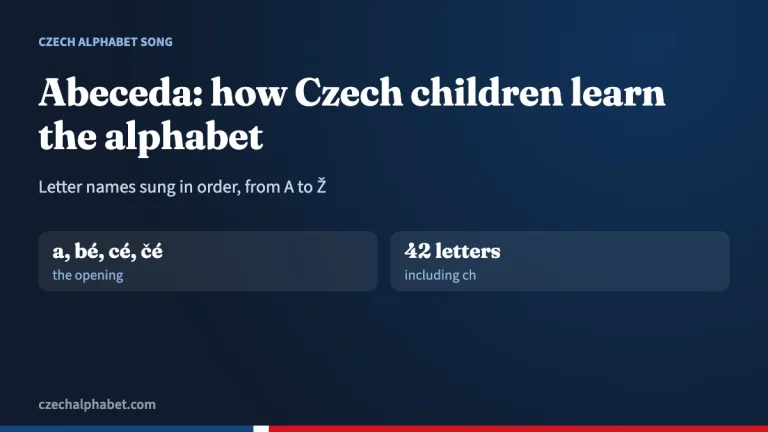
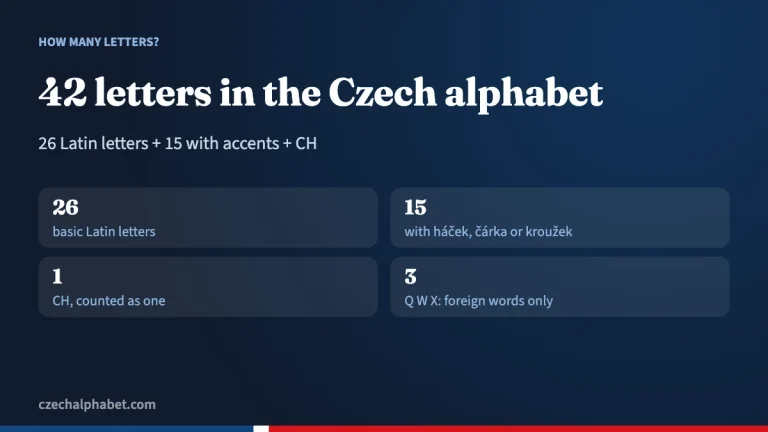
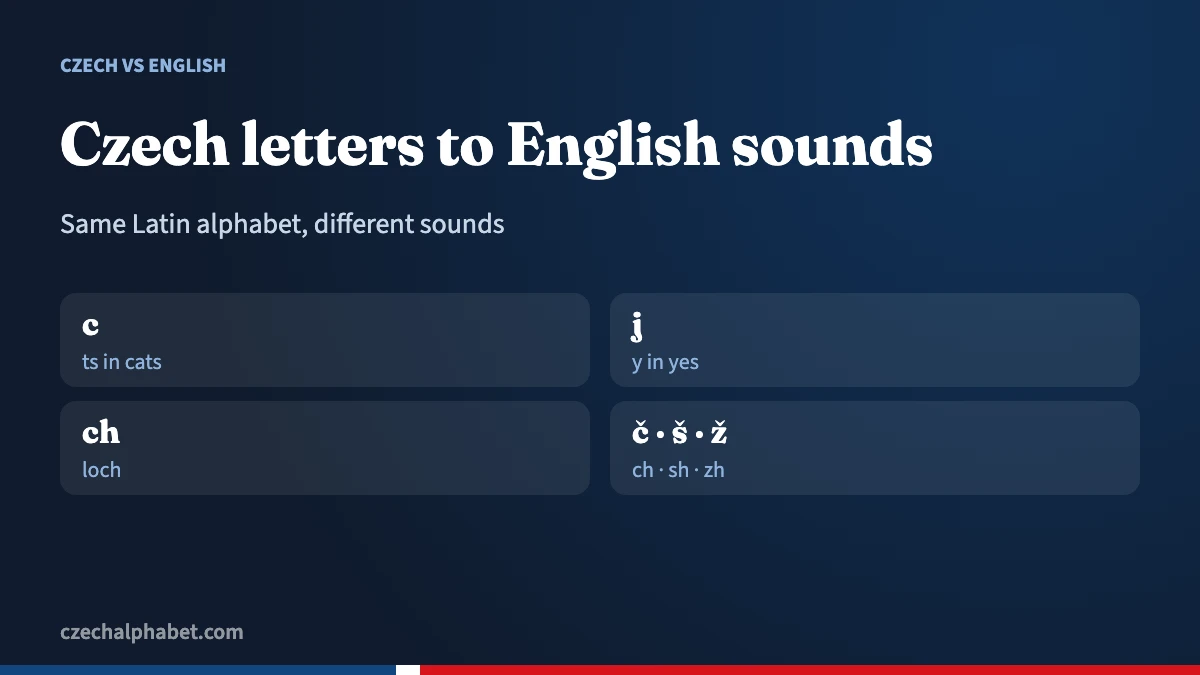
Czech alphabet to English comparison: Czech uses the same 26 Latin letters as English plus 15 accented letters and ch, for 42 in all. Many letters sound different from English: c is “ts”, j is “y”, ch is the “ch” of loch. In English texts, Czech letters are usually written without marks, so Dvořák becomes Dvorak.
The Czech alphabet to English comparison starts with good news: Czech uses the same Latin script as English. All 26 English letters exist in Czech. On top of them, Czech adds 15 letters with diacritics and treats ch as a letter, giving the 42-letter alphabet listed in the ČÚZK toponymic guidelines.
The catch is that shared letters do not always share sounds. Below you will find the letters that match, the ones that look the same but sound different, and the ones English simply lacks.
Czech alphabet to English: letters that match
These letters sound roughly as an English speaker expects: b, d, f, k, l, m, n, p, s, t, v, z. Two small notes: g is always hard, as in “go”, never as in “gem”, and s is always “s”, never “z” as in “rose”.
Czech p, t, k are said without the small puff of air English adds at the start of words. If Czech pivo (beer) sounds a little like “bivo” to you, that’s why.
Same letter, different sound
These are the letters that cause the most misreadings when going from the Czech alphabet to English habits.
| Czech letter | Czech sound | English trap | Example | Hear |
|---|---|---|---|---|
| c | “ts” as in “cats” | reading it as “k” or “s” | cena (price) | |
| j | “y” as in “yes” | reading it as “j” in “jam” | Jan (John) | |
| h | voiced, breathy “h” | dropping it or making it too light | hora (mountain) | |
| ch | “ch” as in Scottish “loch” | reading it as “ch” in “chip” | chata (cottage) | |
| r | tapped or rolled | using the English r | ruka (hand) | |
| y | “i” as in “bit” | reading it as “y” in “yes” | byt (apartment) | |
| w | “v” | reading it as “w” | web |
Vowels differ too. Czech a is the “u” of “cup”, e is the “e” of “bed”, i is the “i” of “bit”, u is the “oo” of “book”. English vowels shift with spelling; Czech ones don’t.
Czech letters English lacks
These letters have no English equivalent as letters, though most of their sounds exist in English words.
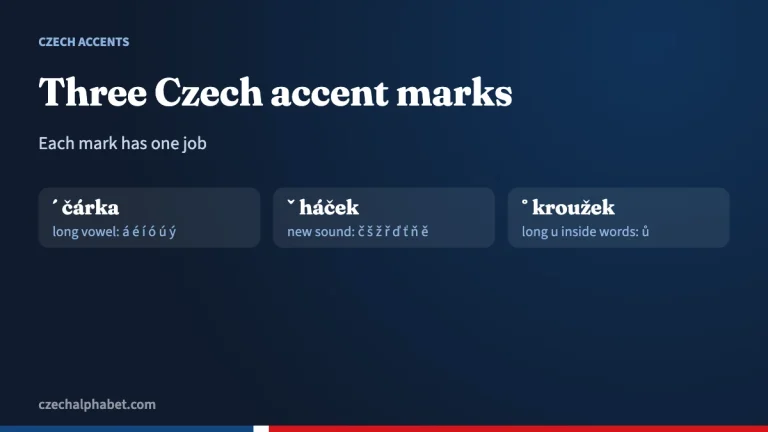
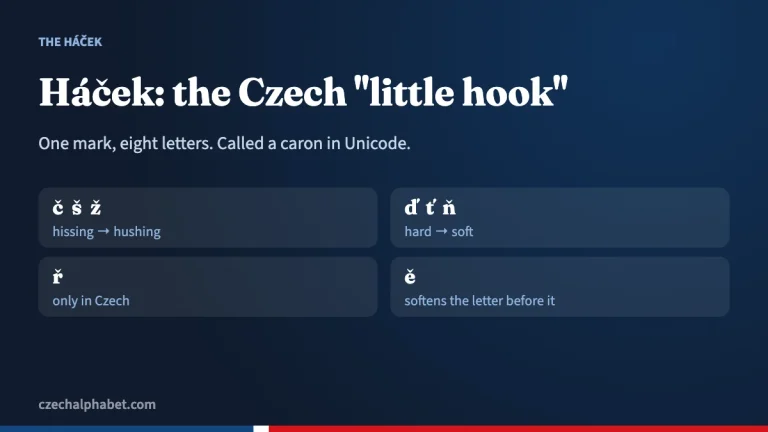
- Háček letters: č (English “ch”), š (“sh”), ž (the “s” in “measure”), ď, ť, ň (soft d, t, n), ě (softening e), and ř, which has no English sound at all. See háček.
- Long vowels: á é í ó ú ý ů, held longer than the short ones. See Czech vowels.
- Ch: one letter in Czech, filed after h.
English writes several Czech sounds with two letters: “ch”, “sh”, “ny”. Czech writes them with one letter plus a mark. That one-letter-per-sound idea dates back to a spelling reform credited to Jan Hus in the early 1400s, which Radio Prague discusses in What does Jan Hus have to do with Czech spelling?
Czech alphabet to English text: removing diacritics
When Czech words appear in English, publishers often drop the marks: Dvořák becomes Dvorak, Plzeň becomes Plzen. The simple rule is to keep the base letter and drop the mark.
| Czech | Plain form | What is lost |
|---|---|---|
| Dvořák | Dvorak | the ř sound and the long á |
| Plzeň | Plzen | the soft ň |
| Brno | Brno | nothing |
| České Budějovice | Ceske Budejovice | č, the long é and ě |
The text box in the copy tool on Czech characters strips diacritics for you. Be aware that plain forms change pronunciation for Czech readers, and that some words collide: být (to be) and byt (apartment) both become “byt”. Keep the marks wherever your system allows, and always in Czech addresses and official names.
Some places also have English names. Praha is Prague and Plzeň is often Pilsen, a German-derived name. For people, keep the Czech spelling; our guide to pronouncing Czech names helps with the sound.
English sounds Czech does not have
The comparison also runs the other way. Some English sounds have no Czech letter, which is why Czechs speaking English, and Czech spellings of English words, can surprise you.
- “th”: there is no Czech letter for it; loanwords and names usually swap in t or d.
- “w”: Czech w is said as v, so the English “w” sound has no native spelling.
- The vowel in “cat”: Czech a and e sit on either side of it.
- The weak “uh” (schwa) in “about”: Czech pronounces every vowel fully.
Czech adapts English loanwords to its own letters. “Weekend” is commonly written víkend, and “jeans” is džíny, using dž for the English “j” sound. Reading these respellings is good practice for the Czech alphabet itself.
Czech words English already uses
English has borrowed a few words from Czech, often without noticing. The best known is “robot”. It entered the world through Karel Čapek’s 1920 play R.U.R., and Karel credited his brother Josef with the word. It comes from Czech robota, forced labor owed by serfs, according to Wikipedia’s R.U.R. article.
“Pistol” may be another. The Online Etymology Dictionary lists Czech píšťala (pipe, whistle) as one proposed source, while calling the origin uncertain.
Common mistakes going from Czech to English
- Reading c as “k”. Cesta (road) is “tsesta”.
- Reading j as in “jam”. It is always “y”.
- Dropping marks in official text. Names, addresses and forms should keep them.
- Assuming English names exist for everything. Most towns, like Brno, have only the Czech name.
- Treating ch as c + h. It is one letter and one sound.
Next step: the full Czech alphabet pronunciation guide.
Frequently asked questions
Does Czech use the same alphabet as English?
Czech uses the same Latin script and all 26 English letters, plus 15 accented letters and ch, for 42 letters in total.
How do you convert the Czech alphabet to English?
Usually by keeping the base letter and dropping the mark: č becomes c, ř becomes r, á becomes a. So Dvořák becomes Dvorak.
Which Czech letters do not exist in English?
Á, č, ď, é, ě, í, ň, ó, ř, š, ť, ú, ů, ý, ž and the letter ch.
How is the Czech letter c pronounced in English terms?
Like ts in cats, at any position in the word. Cukr (sugar) is said tsukr.
What English words come from Czech?
Robot is the best known, from Karel Čapek’s 1920 play R.U.R. and the Czech robota (forced labor). Pistol may also come from Czech píšťala, though its origin is uncertain.
Sources
- ČÚZK: Toponymic Guidelines of the Czech Republic, 4th ed. (2024), UNGEGN
- Radio Prague International: What does Jan Hus have to do with Czech spelling?
- Wikipedia: R.U.R. (Karel Čapek)
- Online Etymology Dictionary: pistol