Is Czech Hard to Learn? What’s Easy, What’s Hard and How Long
| Question | Short answer |
|---|---|
| FSI category | III, “hard languages” |
| Estimated time | About 44 weeks, 1,012 class hours |
| Easiest part | Phonetic spelling, first-syllable stress |
| Hardest part | Seven cases, verb aspect, the sound ř |
Czech is a moderately hard language for English speakers, so the answer to “is Czech hard to learn?” is a qualified yes: the US Foreign Service Institute puts Czech in Category III, about 44 weeks (1,012 class hours). Reading is easy because spelling is phonetic and stress is always on the first syllable. The hard parts are seven cases, verb aspect and sounds like ř.
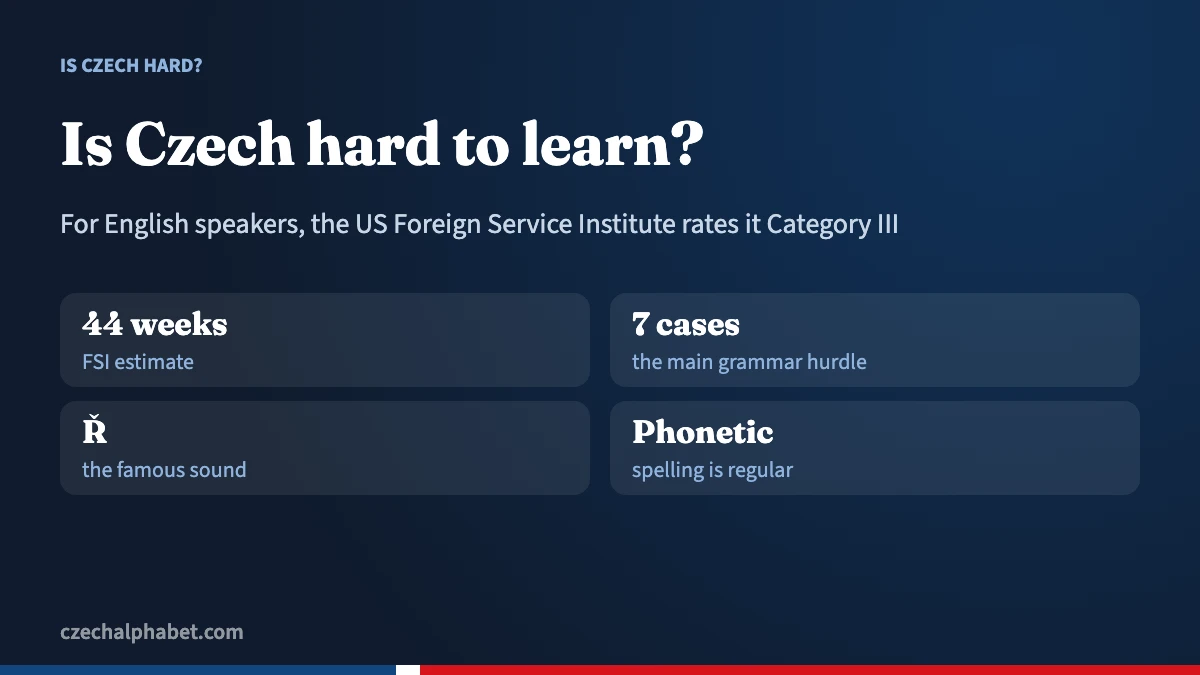
Czech is one of the harder European languages for English speakers, but far from the hardest in the world. So is Czech hard to learn? Moderately. The US Foreign Service Institute puts Czech in its “hard languages” group, with about 44 weeks of full-time study to reach working fluency. The good news is that the hardest parts are grammar, not reading: once you know the alphabet, you can pronounce almost any Czech word you see.
Is Czech hard to learn? What the FSI ranking says
The Foreign Service Institute (FSI) trains US diplomats and groups languages by how long its students need to reach “professional working proficiency.” Czech is in Category III, described as languages with significant linguistic or cultural differences from English. The FSI estimates about 44 weeks, or 1,012 class hours, plus self-study (US Department of State, Foreign Language Training).
| FSI category | Examples | Estimated time |
|---|---|---|
| I | Spanish, French, Italian | 24–30 weeks |
| II | German, Indonesian | about 36 weeks |
| III | Czech, Polish, Russian, Slovak | about 44 weeks |
| IV | Arabic, Chinese, Japanese, Korean | 88 weeks |
Older copies of the FSI list, still quoted on many websites, gave Czech as 44 weeks and 1,100 hours. The current figure is 1,012 class hours. Either way, the estimate assumes intensive classes of about 23 hours a week, so a part-time learner needs years, not months, to reach that level.
The FSI notes that real time varies with the learner’s ability and experience. If you already speak Polish, Russian or another Slavic language, Czech will come much faster. Slovak speakers can understand most Czech from day one; see Czech vs Slovak.
What makes Czech easy
- Phonetic spelling. Each letter stands for one sound, and words are written as they are said. Learn the Czech letters once and you can read street signs aloud on your first day.
- Fixed stress. Stress always falls on the first syllable. Britannica notes the same rule for Czech words and prepositional phrases (Britannica: Czech language).
- Latin alphabet. There is no new script to learn. The extra marks, the háček and the long-vowel accents, follow a short set of rules.
- No articles. Czech has no words for “a” or “the.” Pes is “a dog” or “the dog.”
- Familiar vocabulary. Modern Czech is full of international words, from telefon and hotel to fotbal and víkend. Our Czech words page lists more.
What makes Czech hard to learn
Seven cases. Czech nouns, adjectives and pronouns change their endings depending on their role in the sentence. Britannica lists seven cases for modern Czech. The city name Praha becomes do Prahy (to Prague), v Praze (in Prague) and za Prahou (beyond Prague). This is the main reason the FSI estimate is so long. Our guide to Czech cases breaks them down.
Gender everywhere. Nouns are masculine, feminine or neuter, and masculine nouns split again into animate and inanimate. Adjectives, numbers and past-tense verbs all agree: a man says byl jsem (“I was”), a woman byla jsem.
Verb aspect. Most Czech verbs come in pairs: one for an ongoing action, one for a completed action. Psát is “to be writing,” napsat is “to write (and finish).” English expresses this with tense and context, so learners must choose a verb form where English never asks.
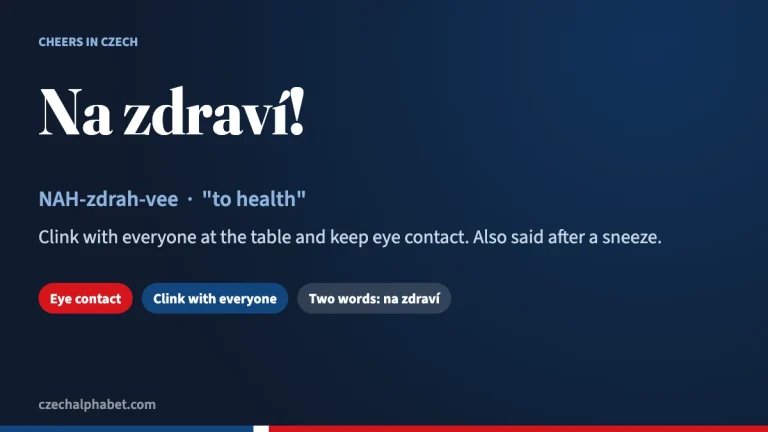
Sounds English lacks. The letter ř [r̝] is a trilled r said together with a “zh” sound, and it is rare among the world’s languages. Soft ď, ť and ň have no exact English match either. The long-versus-short vowel distinction matters for meaning: byt is a flat, být is “to be.” See how to pronounce the Czech Ř.
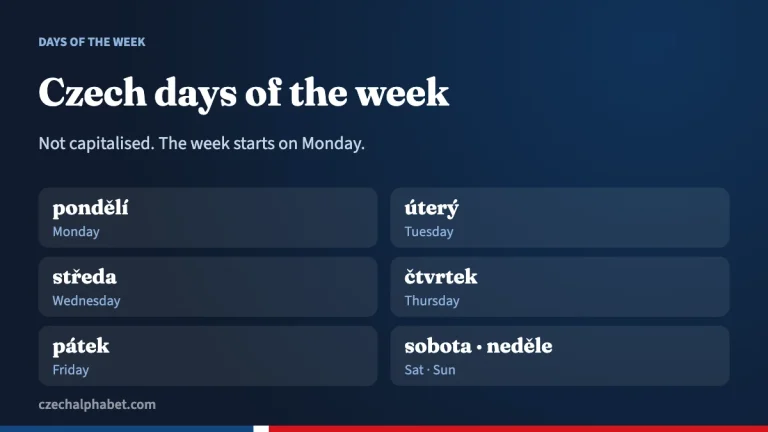
Consonant clusters. Words like čtvrtek (Thursday) or zmrzlina (ice cream) pack several consonants together, and r or l can act as a vowel.
Spoken Czech versus written Czech
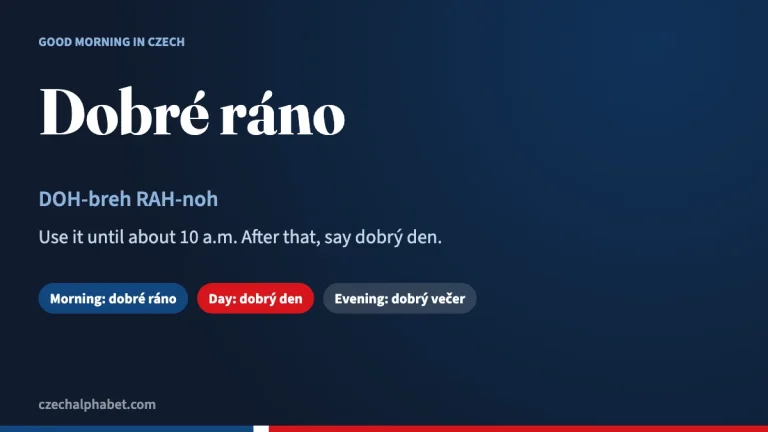
Learners also face a gap between textbook Czech and what they hear in Prague. Everyday speech, often called Common Czech (obecná čeština), changes some endings and vowels. A textbook dobré pivo (“good beer”) is often dobrý pivo in a pub, and okno (“window”) may sound like “vokno.” You need to understand both, though you can speak the standard form everywhere without sounding odd.
Formality adds a layer. Czech has a polite “you” (vy) and a familiar one (ty), with different verb forms. Radio Prague describes how switching to ty is an offer usually made by the older or more senior person (Radio Prague International). Our page on Czech greetings explains the rules.
Is Czech hard to learn in practice? How long it takes
The honest answer depends on your goal. For travel, a few dozen Czech phrases and the alphabet take a week or two. Reading menus and signs takes a few months of regular practice. Holding a comfortable conversation usually takes a year or more of steady study and real contact with speakers.
About 9 million people in Czechia gave Czech as their only mother tongue in the 2021 census, according to the Czech Statistical Office (CZSO). Outside the country there are communities in the US, Canada and elsewhere, but the learning materials and podcasts are fewer than for German or Spanish.
A realistic plan: learn the alphabet and the stress rule first, then the present tense and the accusative case, the form used for direct objects. With those you can already say things like Mám rád kávu, “I like coffee” (a woman says Mám ráda kávu).
Common mistakes when starting Czech
- Memorizing case tables before speaking. Learn phrases first and let the endings come with use.
- Ignoring vowel length. Long and short vowels change meaning, so practice them early; see Czech vowels.
- Stressing English-style. Always stress the first syllable, even in long words.
- Using ty with strangers. Start with vy and wait to be offered ty.
- Giving up on ř. Many Czech children learn it late too. Use a plain trilled r while you practice.
- Studying only textbook Czech. Listen to real speech so that Common Czech forms do not throw you.
Frequently asked questions
Is Czech hard to learn for English speakers?
It is harder than Spanish or French but easier than Arabic or Japanese. The FSI estimates about 44 weeks of full-time study to reach working proficiency.
How many hours does it take to learn Czech?
The FSI’s current estimate is 1,012 class hours plus self-study. Older lists often quote 1,100 hours.
Is Czech harder than Polish or Russian?
The FSI places Czech, Polish, Russian and Slovak in the same category, so they take a similar time for English speakers.
What is the hardest part of Czech?
Most learners say the case system, where word endings change with their role in the sentence. The sound ř is the hardest single sound.
Is Czech pronunciation hard?
Reading aloud is easy because spelling is phonetic. A few sounds, especially ř, the soft ď, ť, ň and long vowels, take practice.
Sources
- US Department of State: Foreign Language Training (FSI language categories)
- Britannica: Czech language
- Czech Statistical Office: Census 2021 data on mother tongue
- Radio Prague International: The delicacies of you and You