Czech vs Slovak: Alphabet, Sounds and How Close They Are
| Czech | Slovak | |
|---|---|---|
| Letters | 42 | 46 |
| Only in this alphabet | ě ř ů | ä ĺ ľ ô ŕ dz dž |
| Ch as a letter | Yes | Yes |
| Long-vowel mark | čárka | dĺžeň |
| Hook mark | háček | mäkčeň |
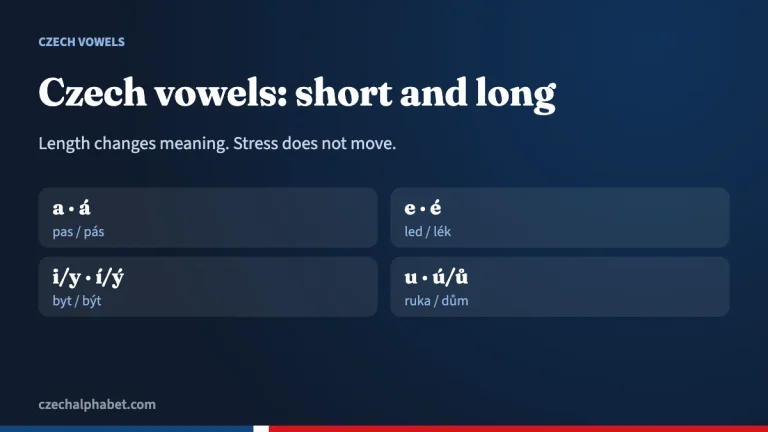
| Stress | First syllable | First syllable |
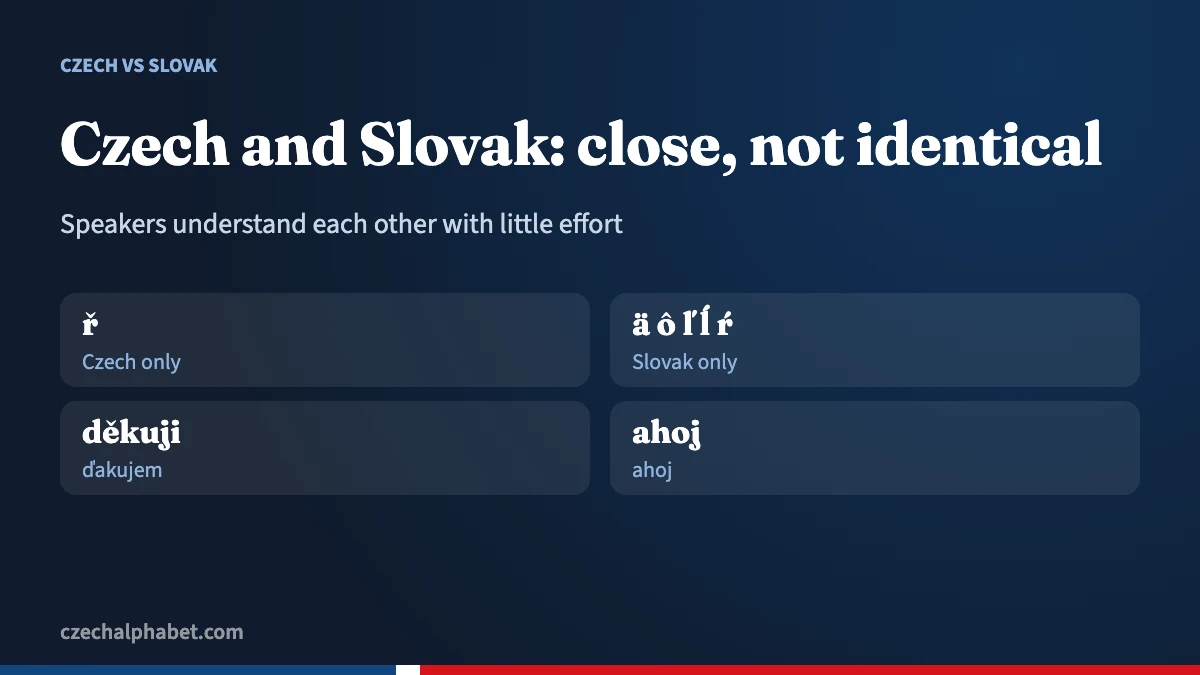
Czech vs Slovak: they are two closely related West Slavic languages that most adult speakers understand without study. Their alphabets differ in a handful of letters. Czech has ě, ř, ů (42 letters); Slovak has ä, ĺ, ľ, ô, ŕ, dz, dž (46 letters). Both stress the first syllable and use the háček and the acute.
Czech vs Slovak is one of the classic comparisons in European languages. Czech and Slovak are separate standard languages, each official in its own country, yet close enough that most adults on both sides understand each other in everyday talk. Their alphabets share most letters, and the differences tell you a lot about how each language sounds.
This page compares the alphabets first, then the sounds, then how the two languages relate. For the Czech side in detail, see Czech letters.
Czech vs Slovak alphabet: the letter counts
The Czech alphabet has 42 letters, as the ČÚZK toponymic guidelines state. Slovak has 46, according to Wikipedia’s Slovak orthography article, because it counts dz and dž as letters and adds several of its own.
Letters only Czech has
- Ř, the famous rolled-and-buzzed sound in Dvořák. Slovak uses plain r: Czech řeka (river) is Slovak rieka.
- Ů, long “oo” written with a ring. Slovak writes ô or ú: Czech kůň (horse) is Slovak kôň.
- Ě, the softening e. Slovak writes e or ie: Czech město (town) is Slovak mesto.
Letters only Slovak has
- Ä, a sound between “a” and “e”; many speakers simply say “e”.
- Ľ, a soft l, [ʎ], as in the name Ľubica.
- Ĺ and Ŕ, long versions of l and r that act as syllable centers: vĺča (wolf cub).
- Ô, the diphthong “uo”: kôň.
- Dz and dž as letters. In Czech they exist as sounds but are written as two letters.
Both alphabets count ch as one letter after h, and both use Q, W and X mainly for loanwords.
Same marks, different names
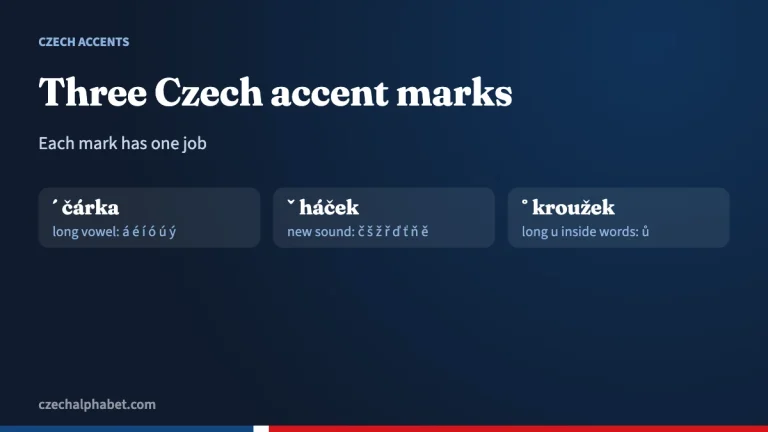
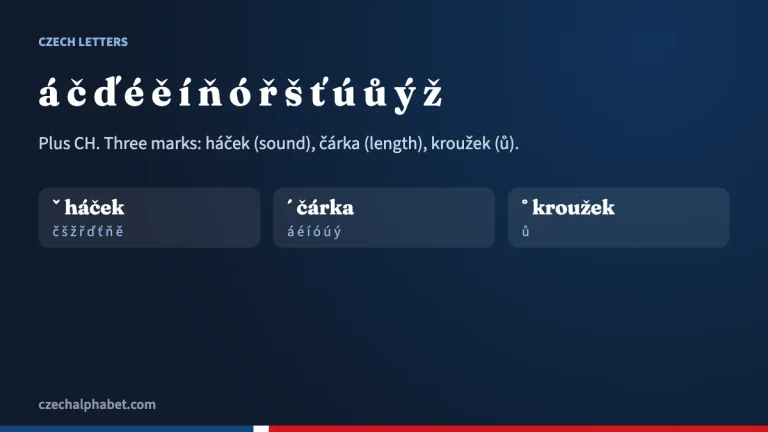
Both languages use the háček and the acute, but they name them differently. Czech says háček; Slovak says mäkčeň (“softener”). Czech says čárka; Slovak says dĺžeň (“lengthener”). Slovak adds the vokáň (circumflex) on ô, and Czech adds the kroužek (ring) on ů.
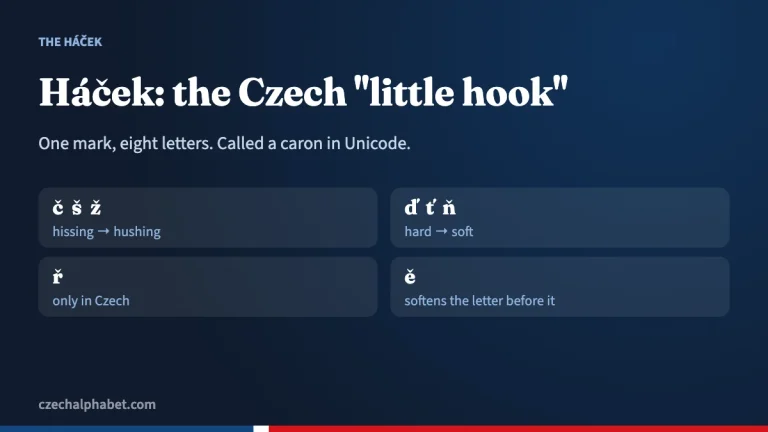
A small visual difference: the Slovak mäkčeň appears on ľ as well, printed as an apostrophe-like stroke, just like Czech ď and ť. Read more on the háček page.
How Czech vs Slovak sounds differ
Beyond the letters, a few sound habits separate the two.
- The rhythmic rule. In Slovak, two long syllables normally cannot follow each other in one word; the second is shortened. Czech has no such rule. Wikipedia calls this the “rule of rhythmical shortening”.
- Soft l. Slovak keeps a soft ľ; Czech lost it, so Czech l is always plain.
- Diphthongs. Slovak has ia, ie, iu, ô; Czech mostly has ou. Compare Czech chléb with Slovak chlieb (bread).
- Stress. Both put stress on the first syllable.
Can Czechs and Slovaks understand each other?
Mostly yes, with a twist. Scholars call the situation “passive bilingualism”: each person speaks their own language and understands the other. Tilman Berger of the University of Tübingen notes that the main barriers are vocabulary, such as Czech vteřina versus Slovak sekunda (second), and a few false friends. Specialist topics are harder than daily chat.
How widespread is this? Old survey data give a rough idea. Berger cites a 1971 study by Budovičová in which 12% of Czechs said they could speak Slovak, 55% claimed passive understanding and 33% said they understood none. He warns that the figures are of limited reliability, since people tend to overstate their skills, but they show that passive understanding, not fluent speaking, was the norm.
Understanding is not equal in both directions. Radio Prague International reports that Slovaks generally understand Czech better than Czechs understand Slovak, partly because Slovak TV still airs a lot of Czech-language content. Younger Czechs born after the split have less exposure and sometimes struggle.
The legal side reflects this closeness. Czech administrative procedure has long allowed Slovak to be used alongside Czech, as a legal commentary on epravo.cz notes, although the 2009 tax code dropped that allowance for tax proceedings.
Everyday words that differ
Most words are shared or close, but some common ones differ enough to cause a pause. A few examples:
| English | Czech | Slovak |
|---|---|---|
| thank you | děkuji | ďakujem |
| good day | dobrý den | dobrý deň |
| potatoes | brambory | zemiaky |
| pencil | tužka | ceruzka |
| January | leden | január |
The month names are a classic case. Czech uses native Slavic names (leden, únor, březen), while Slovak uses Latin-based ones close to English. See Czech months for the full list.
A short history
Both languages grew from the same West Slavic dialects. A first standard form of literary Slovak was set by Anton Bernolák in the late 18th century, and linguist Karel Oliva dates the main separation of the two literary languages to roughly 1800 to 1850. Czechoslovakia, founded in 1918, split peacefully into the Czech Republic and Slovakia at the end of 1992, an event known as the Velvet Divorce. Learn more about Czech itself on the Czech language page.
Common mistakes in Czech vs Slovak
- Calling them dialects of one language. They are separate standard languages with separate spelling rules.
- Using ř in Slovak. Slovak has no ř; rieka, not řeka.
- Writing ô in Czech. Czech uses ů for that history: kůň, not kôň.
- Assuming equal understanding. Slovaks usually find Czech easier than the reverse.
- Mixing the mark names. In Czech it is háček and čárka.
Curious how hard Czech is overall? See is Czech hard to learn.
Frequently asked questions
Is Czech the same as Slovak?
No. They are two separate but closely related West Slavic languages with their own spelling rules. Most adult speakers understand each other in everyday conversation.
Can Czechs understand Slovak?
Mostly, yes, though understanding is uneven. Slovaks generally understand Czech better than Czechs understand Slovak, and younger Czechs often have less exposure.
What letters does Slovak have that Czech does not?
Ä, ĺ, ľ, ô, ŕ, and dz and dž as separate letters. Slovak has 46 letters in all.
What letters does Czech have that Slovak does not?
Ě, ř and ů. Slovak writes these sounds or their historical equivalents with e or ie, r, and ô or ú.
Is Czech vs Slovak stress different?
No. Both languages stress the first syllable of a word.
Sources
- Wikipedia: Slovak orthography
- Radio Prague International: Czech and Slovak, languages or dialects?
- Tilman Berger, University of Tübingen: Slovaks in Czechia, Czechs in Slovakia
- ČÚZK: Toponymic Guidelines of the Czech Republic, 4th ed. (2024), UNGEGN
- epravo.cz: Úřední a jednací jazyk v daňovém řízení (Slovak in Czech administrative proceedings)