How Are You in Czech: Jak Se Máš and How to Reply
| Czech | English | Say it to | Hear |
|---|---|---|---|
| Jak se máš? | How are you? | one friend, family, child | |
| Jak se máte? | How are you? | a stranger, older person, or a group | |
| Mám se dobře. | I’m well. | anyone | |
| Jde to. | Not bad, it’s OK. | anyone |
How are you in Czech is Jak se máš? (yahk seh mahsh) to a friend and Jak se máte? to a stranger or a group. It literally means “How do you have yourself?”. Typical answers are Mám se dobře (I’m well) and the modest Jde to (not bad), followed by A ty? or A vy? (and you?).
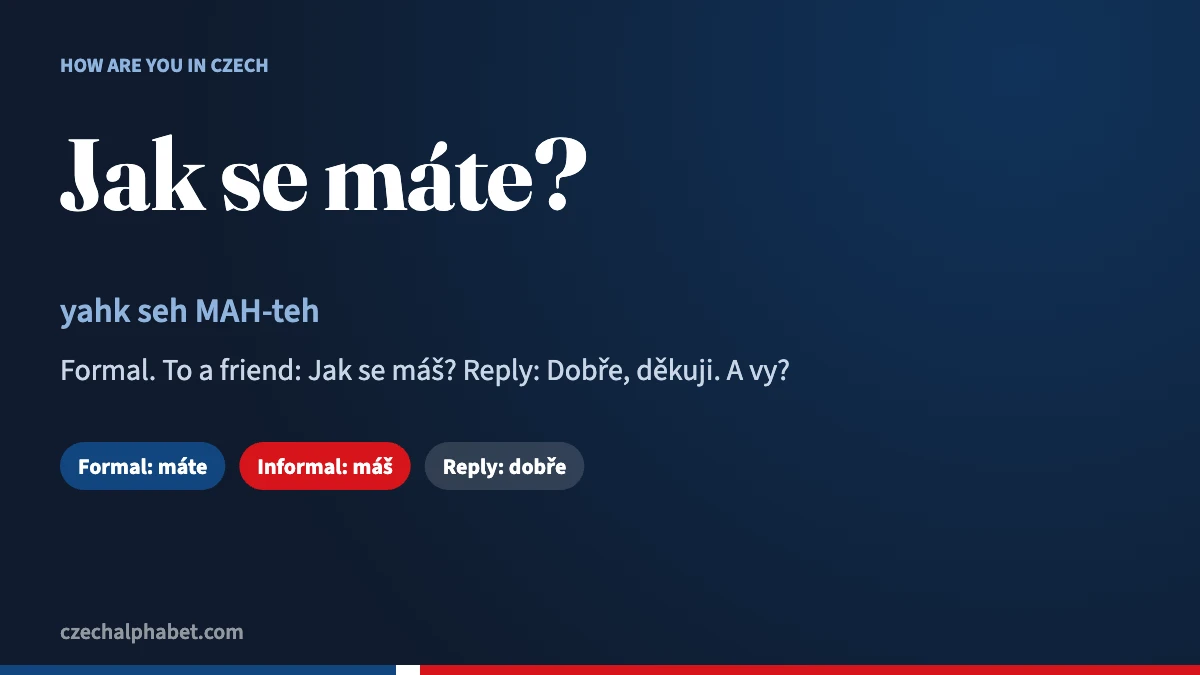
To ask how are you in Czech, say Jak se máš? [jak sɛ maːʃ] to a friend and Jak se máte? [jak sɛ ˈmaːtɛ] to someone you address formally. Literally it means “How do you have yourself?”. The usual answers are Mám se dobře (I’m well) or a modest Jde to (it’s going OK). Czechs treat the question more seriously than English speakers do, so the reply is often honest and understated.
How to ask how are you in Czech
| Czech | IPA | English | Hear |
|---|---|---|---|
| Jak se máš? | [jak sɛ maːʃ] | How are you? (informal) | |
| Jak se máte? | [jak sɛ ˈmaːtɛ] | How are you? (formal or plural) | |
| Jak se vede? | [jak sɛ ˈvɛdɛ] | How’s it going? | |
| Jak to jde? | [jak to jdɛ] | How’s it going? | |
| Co je nového? | [t͡so jɛ ˈnovɛːɦo] | What’s new? | |
| Co ty? | [t͡so tɪ] | And you? How about you? |
The verb is mít se, literally “to have oneself”. Máš is the informal “you have” and máte is the formal or plural one. The á is a long “ah”, and š is “sh”, so máš sounds like “mahsh”.
Jak se vede? and Jak to jde? are friendly, slightly casual alternatives that work in both formal and informal settings. Co je nového? (What’s new?) invites news rather than a status report.
Máš or máte?
Use máš with people you call by first name: friends, family, children, close colleagues. Use máte with strangers, older people, your partner’s parents (until they offer otherwise), and any group, because vy is also the plural “you”. The same split applies to greetings: ahoj goes with máš, and dobrý den goes with máte. See hello in Czech.
How to answer how are you in Czech
| Czech | English | Hear |
|---|---|---|
| Mám se dobře, děkuji. | I’m well, thank you. | |
| Dobře. | Good, fine. | |
| Jde to. | It’s OK, not bad. | |
| Ujde to. | It’s passable, so-so. | |
| Docela dobře. | Pretty well. | |
| Nic moc. | Not great. | |
| Špatně. | Badly. | |
| Výborně! | Excellent! |
Because the question uses the adverb jak (how), the answer is an adverb too: dobře (well), špatně (badly). The ř in dobře is the famous Czech sound; our guide on how to pronounce the Czech ř helps, but a rolled r followed by “zh” is a fair first attempt.
Always bounce the question back. Add A ty? (And you?) informally or A vy? formally. A complete, polite reply is Mám se dobře, děkuji. A vy?.
Two short conversations
Between friends:
- A: Ahoj, jak se máš? Hi, how are you?
- B: Jde to. A ty? Not bad. And you?
- A: Docela dobře, díky. Pretty good, thanks.
Meeting a neighbor’s mother:
- A: Dobrý den, jak se máte? Hello, how are you?
- B: Děkuji, dobře. A vy? Thank you, well. And you?
- A: Taky dobře, děkuji. Also well, thank you.
Taky means “also, too” and is a handy word for echoing someone’s answer. Notice that the older speaker gets máte and vy throughout.
Understatement: the Czech way to answer
In English, “How are you?” is often a greeting, and “Great!” is the expected answer. Czech works differently. Radio Prague International notes an unspoken rule against claiming to be too well, and advises learners to go easy on enthusiastic words like výborně (excellent) or skvěle (great). Its verdict: Czech is “not a language for overstatement”.
So the most common real answers sit in the middle: jde to, ujde to, docela dobře. A cheerful “Výborně!” is fine with close friends, but in other settings it can sound like bragging.
Do not ask Jak se máte? as a passing hello to a shop assistant. It is a real question, so save it for people you know or have time to talk to. For a quick greeting, dobrý den is enough.
Feeling well or unwell
When the question is about health or how you feel right now, Czech uses a different structure: Je mi dobře (I feel well) and Je mi špatně (I feel sick or unwell), literally “it is well or bad to me”.
- Jak ti je? How do you feel? (informal)
- Je mi líp. I feel better.
- Je mi zima. I’m cold.
- Je mi teplo. I’m warm.
Je mi špatně usually means you feel physically ill, so do not use it to say your week has been bad. For that, Mám se špatně or Nic moc is the right choice.
How are you in Czech in messages
In texts, the question usually stays in full, though friends also write Jak se vede? or just Jak? after a shared event, such as an exam or a date. A friendly opener is Ahoj, jak se máš? Co je nového?. Formal emails rarely ask at all; they start with Dobrý den and go straight to the point.
To end a chat warmly, Czechs say Měj se (take care) or Mějte se formally, from the same verb mít se. That link is explained on our page on goodbye in Czech.
Common mistakes
- Answering “Jsem dobrý”. That sounds like “I’m good at it” or “I’m a good person”. Say Mám se dobře or just Dobře.
- Using máš with strangers. Use máte unless you are on first-name terms.
- Saying “je mi špatně” about a bad day. It means you feel ill.
- Not asking back. Add A ty? or A vy?.
- Overdoing the enthusiasm. A modest jde to sounds more natural than “fantastic”. More ready-made lines are on our Czech phrases and Czech greetings pages.
Frequently asked questions
How do you say how are you in Czech?
Jak se máš? to a friend, or Jak se máte? to a stranger, an older person or a group.
How do you answer jak se máš?
Say Mám se dobře (I’m well), Jde to (not bad) or Nic moc (not great), and ask back with A ty?
What is the difference between jak se máš and jak se máte?
Máš is informal and singular; máte is formal or plural.
What does jde to mean?
Literally “it goes”. It means “OK, not bad”, a very common modest answer.
Is it rude to say I’m great in Czech?
Not rude, but Czechs tend to understate. Výborně (excellent) can sound boastful outside close friends.
Sources
- Radio Prague International: How you doin'? …Czech style
- Radio Prague International: Czech goodbyes (mějte se, mít se)
- Radio Prague International: G for greetings