Czech Days of the Week: Pondělí to Neděle with Audio
| Day | Czech |
|---|---|
| Monday | pondělí |
| Tuesday | úterý |
| Wednesday | středa |
| Thursday | čtvrtek |
| Friday | pátek |
| Saturday | sobota |
| Sunday | neděle |
The Czech days of the week are pondělí (Monday), úterý, středa, čtvrtek, pátek, sobota and neděle (Sunday). They are written in lower case, and the week starts on Monday. Most names describe a position: pondělí means “after Sunday” and pátek “the fifth day.”
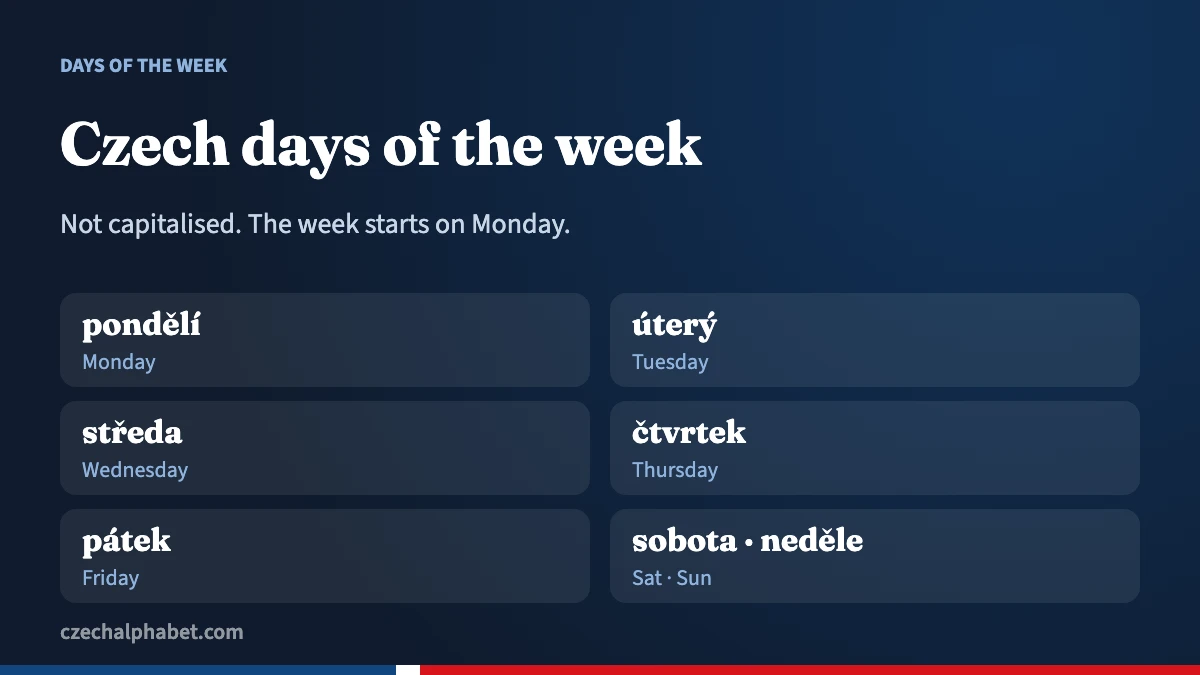
The Czech days of the week are pondělí, úterý, středa, čtvrtek, pátek, sobota and neděle, from Monday to Sunday. Most of the names are numbers or descriptions rather than gods or planets. Čtvrtek is simply “the fourth day,” and neděle means “the day you do not work.” Below are all seven with audio, their meanings, and the forms you need to say “on Monday.”
The 7 Czech days of the week
| Czech | English | Literal meaning | Respelling |
|---|---|---|---|
| pondělí | Monday | “after Sunday” (po neděli) | PON-dye-lee |
| úterý | Tuesday | “the second day,” an Old Slavonic word | OO-te-ree |
| středa | Wednesday | “the middle,” from střed | STRZHE-da |
| čtvrtek | Thursday | “the fourth day,” from čtvrtý | CHTVR-tek |
| pátek | Friday | “the fifth day,” from pátý | PAA-tek |
| sobota | Saturday | from the Sabbath, via Latin | SO-bo-ta |
| neděle | Sunday | “no work,” from nedělat | NE-dye-le |
Radio Prague gives the same explanations: pondělí from po neděli, středa from střed (“middle”), pátek from pátý den (“fifth day”), and neděle from nedělat, “not to do” (Radio Prague International). Only sobota is borrowed, from the word for the Sabbath.
The counting is worth a second look. Monday is “after Sunday,” Tuesday is “the second,” Thursday “the fourth” and Friday “the fifth.” So the numbers run from Monday as day one, and Czech calendars start the week on Monday.
How to pronounce the Czech days of the week
Stress always falls on the first syllable: PON-dye-lee, not pon-DYE-lee. Long vowels are held a little longer, whether stressed or not, so the í at the end of pondělí and the ý in úterý are both long. See our Czech vowels guide for how length works.
Two days are harder for English speakers:
- Středa starts with stř, so the ř comes right after a t. Try “st” plus a quick “rzh”: STRZHE-da. Our guide to pronouncing the Czech Ř has exercises.
- Čtvrtek has four consonants before the first vowel sound. The r works as a vowel here [ˈt͡ʃtvr̩tɛk], so say CHTVR-tek in two beats. Words like this are why Czech has famous tongue twisters.
The ě in pondělí and neděle softens the consonant before it: dě sounds like “dye.” The page on the letter Ě explains why.
Saying “on Monday”: v, ve and the case ending
To say “on” a day, Czech uses v or ve with the accusative case. Several days change their ending.
| Day | “On …” | Short form |
|---|---|---|
| pondělí | v pondělí | po |
| úterý | v úterý | út |
| středa | ve středu | st |
| čtvrtek | ve čtvrtek | čt |
| pátek | v pátek | pá |
| sobota | v sobotu | so |
| neděle | v neděli | ne |
Ve replaces v before středu and čtvrtek, because a bare v in front of those consonant clusters would be hard to say. Středa and sobota change -a to -u; neděle becomes neděli. The other days stay the same.
For a habit, add každý or každou (“every”): každé pondělí (every Monday), každou středu (every Wednesday), každý pátek (every Friday). The word for “every” agrees with the day’s gender.
Czech days of the week are not capitalized
Days are ordinary nouns in Czech, so they are written in lower case: v pondělí jdu do práce (“on Monday I go to work”). The same is true of the Czech months. Use a capital only at the start of a sentence.
The short forms in the table above, such as po, út and pá, appear on calendars, timetables and shop doors. A sign reading Po–Pá 9–17 means the shop is open Monday to Friday, 9 a.m. to 5 p.m. Czech uses the 24-hour clock in writing.
Useful words for the week
| Czech | English |
|---|---|
| týden | week |
| víkend | weekend |
| pracovní den | working day |
| dnes | today |
| zítra | tomorrow |
| včera | yesterday |
| příští týden | next week |
| minulý týden | last week |
From týden you get the adverb týdně, “weekly,” as in dvakrát týdně, “twice a week.” The matching word for “daily” is denně. Both are handy for timetables, gym schedules and medicine labels.
Two days also appear in the Easter calendar. Zelený čtvrtek, “Green Thursday,” is Maundy Thursday, and Velký pátek, “Great Friday,” is Good Friday, which is a public holiday in Czechia (Public holidays in the Czech Republic).
When greeting people, remember that den means “day,” as in Dobrý den. Our page on Czech greetings covers when to use it.
Asking what day it is
To ask the day, say Jaký je dnes den?, “What day is it today?” The answer uses the plain form: Dnes je čtvrtek, “Today is Thursday.” To ask the date instead, Czechs say Kolikátého je dnes?, literally “the how-manyth is it today?”, and the reply is an ordinal: Dnes je pátého, “Today is the fifth.”
Ranges use od (“from”) and do (“until”), both followed by the genitive case. So “from Monday to Friday” is od pondělí do pátku. The genitive forms are pondělí, úterý, středy, čtvrtka, pátku, soboty and neděle. You will hear do neděle (“until Sunday”) and od středy (“from Wednesday”) all the time in shops and offices. “At the weekend” is o víkendu.
Common mistakes
- Capitalizing the days. Write pátek, not “Pátek,” inside a sentence.
- Saying “v středu.” The standard form is ve středu, and likewise ve čtvrtek.
- Forgetting the ending. It is v sobotu and v neděli, not “v sobota” or “v neděle.”
- Stressing the second syllable. Czech stress is always on the first syllable: PON-dye-lee.
- Dropping diacritics. “Pondeli” and “utery” lose the long vowels and the soft dě.
- Mixing up neděle and nedělat. Neděle is Sunday; nedělat is the verb “not to do.”
Frequently asked questions
What are the Czech days of the week?
Pondělí, úterý, středa, čtvrtek, pátek, sobota, neděle, from Monday to Sunday.
What does neděle mean in Czech?
Neděle is Sunday. The name comes from nedělat, “not to do,” meaning the day without work.
Are Czech days of the week capitalized?
No. Days are written in lower case unless they begin a sentence.
How do you say “on Wednesday” in Czech?
Ve středu. Note ve instead of v and the ending -u.
Does the Czech week start on Monday?
Yes. Czech calendars start on Monday, and the day names count from it: Thursday is “the fourth” and Friday “the fifth.”
Sources
- Radio Prague International: Many a Friday (day-name origins)
- Wikipedia: Public holidays in the Czech Republic
- Britannica: Czech language