Czech Words: Everyday Basics, Robot and Words Without Vowels
| Say it | Meaning |
|---|---|
| ano | yes |
| ne | no |
| prosím | please |
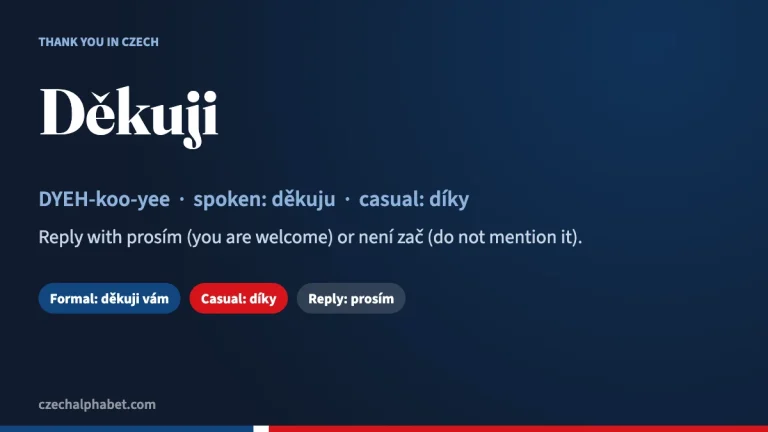
| děkuji | thank you |
| robota | forced labor, the root of robot |
Czech words are spelled the way they sound, with stress always on the first syllable. Essential ones include ano (yes), ne (no), prosím (please) and děkuji (thank you). English borrowed a few from Czech, most famously robot, from robota, “forced labor,” first used in Karel Čapek’s 1920 play R.U.R.

Czech words are spelled almost exactly as they sound, which makes them easier to read aloud than English ones once you know the letters. This page collects the Czech words a beginner uses every day, the English words that came from Czech (including robot), the famous Czech words with no vowels, and a few false friends that look English but are not.
Useful Czech words for every day
| Czech | English | Respelling |
|---|---|---|
| ano | yes | A-no |
| ne | no | ne |
| prosím | please; here you go | PRO-seem |
| děkuji | thank you | DYE-ku-yi |
| ahoj | hi; bye (informal) | A-hoy |
| dobrý den | hello (formal) | DO-bree den |
| na shledanou | goodbye (formal) | NA-skhle-da-noh |
| promiňte | excuse me; sorry | PRO-min-te |
| voda | water | VO-da |
| pivo | beer | PI-vo |
| kde | where | gde |
| kolik | how much, how many | KO-lik |
| účet | the bill | OO-chet |
| nádraží | train station | NAA-dra-zhee |
| záchod | toilet | ZAA-khot |
A few of these behave differently from English. Prosím means “please,” but it is also what you say when you hand something over, and what a waiter says to take your order. Ahoj works for both hello and goodbye among friends. And kde is pronounced “gde,” because the k takes on the voicing of the d that follows. For full sentences, see our list of Czech phrases, and for the basics, hello in Czech and thank you in Czech.
English words that come from Czech
English has borrowed only a handful of Czech words, but some are famous. The best known is robot.
| English | Czech source | Original meaning |
|---|---|---|
| robot | robota | forced labor, drudgery |
| pistol | píšťala | pipe, whistle (via an older Czech form) |
| howitzer | houfnice | a short cannon |
| dollar | tolar | a silver coin from Jáchymov |
| kolache | koláč | a round filled pastry |
| polka | polka | a dance; origin disputed |
Robot. Karel Čapek used the word in his play R.U.R. (Rossum’s Universal Robots), published in 1920 and first staged in January 1921. Čapek credited his brother Josef, a painter, with inventing it. It comes from robota, the forced labor that serfs owed their lords (Wikipedia: R.U.R.).
Pistol. The word reached English in the 1570s through French pistole and German, and most dictionaries trace it to a Czech word for a pipe or whistle, the 15th-century name of a Hussite hand firearm. Etymonline marks the origin as likely but not certain (Online Etymology Dictionary).
Howitzer comes from houfnice, a Hussite cannon; houf means a crowd or troop. Dollar goes back to the tolar, short for the silver jáchymovský tolar minted from 1520 in Jáchymov (German Joachimsthal), which became the German thaler (Expats.cz). Kolache is the Texan spelling of koláč, brought by Czech immigrants.
English words in Czech spelling
The borrowing also runs the other way, and Czech respells English words to fit its own rules. You will recognize fotbal (football), hokej (hockey), víkend (weekend), džíny (jeans) and mobil (cell phone). The spelling tells you the Czech pronunciation: j is the “y” sound, dž is the “j” of “jeans,” and a long í shows the long “ee.” Seeing these words is a quick way to check that you read Czech letters correctly.
Czech words without vowels
Czech is known for words that seem to have no vowels at all. They work because r and l can act as vowels and carry a syllable, the way the “l” does in English “bottle.” These are everyday words, not jokes:
| Czech | English |
|---|---|
| vlk | wolf |
| krk | neck |
| prst | finger |
| smrt | death |
| vlna | wave; wool |
| čtvrt | quarter |
The classic example is the tongue twister Strč prst skrz krk, “stick a finger through your neck,” a full sentence with no vowel letters. Wikipedia lists longer ones, including scvrnkls, “you flicked (it) away” (Wikipedia: Strč prst skrz krk). The m can do the same job in sedm (seven) and osm (eight). For more practice, try our Czech tongue twisters.
False friends: Czech words that fool English speakers
Some Czech words look like English but mean something else.
| Czech | Looks like | Actually means |
|---|---|---|
| host | host | guest |
| šéf | chef | boss |
| sympatický | sympathetic | likable, nice |
| aktuální | actual | current, up to date |
| konzerva | conserve | a can of food |
| list | list | leaf; sheet of paper |
| no | no | well; yeah (casual) |
The last one causes real confusion. In casual Czech, no often means “yeah” or “well,” so a Czech friend saying “no, no” may be agreeing with you. The polite yes is ano, and the casual one is jo. Our page on yes in Czech explains the difference.
How Czech words are built
Many Czech words are built from a short root plus prefixes and suffixes, so one root unlocks a family of words. From psát (“to write”) you get dopis (letter), podpis (signature), spisovatel (writer) and nápis (sign, inscription).
Small endings also change meaning. The suffix -ek or -ka often makes a diminutive: dům (house) becomes domek (little house), and kniha (book) becomes knížka. Czechs use diminutives a lot, often just to sound friendly: pivečko is “a nice little beer.” Nouns also change their endings in sentences; our overview of Czech cases explains why Praha becomes v Praze, “in Prague.”
Common mistakes
- Reading Czech letters the English way. C is always “ts,” j is “y,” and ch is a throat sound. Check our alphabet pronunciation chart.
- Dropping diacritics. They change meaning: byt is a flat, být is “to be.”
- Taking “no” as no. In casual speech it usually means “yeah.”
- Stressing the wrong syllable. Every Czech word is stressed on its first syllable: NAA-dra-zhee, not na-DRA-zhee.
- Inserting vowels into vlk or krk. Say them as one syllable with a strong r or l.
Frequently asked questions
What English words come from Czech?
The best known are robot (from robota), pistol, howitzer (from houfnice) and, indirectly, dollar (from tolar).
Who invented the word robot?
Josef Čapek, according to his brother Karel, who used it in the play R.U.R. (1920).
Which Czech words have no vowels?
Common ones include vlk (wolf), krk (neck), prst (finger) and smrt (death). The r or l acts as the vowel.
What are the most useful Czech words for travelers?
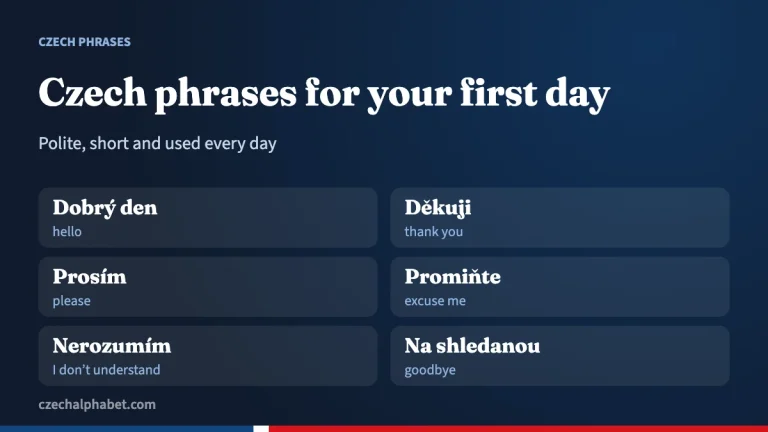
Dobrý den (hello), prosím (please), děkuji (thank you), promiňte (excuse me), kolik (how much) and účet (the bill).
Does “no” mean no in Czech?
Not usually. In casual Czech no means “yeah” or “well.” No is ne.
Sources
- Wikipedia: R.U.R.
- Online Etymology Dictionary: pistol
- Expats.cz: English words borrowed from Czech
- Wikipedia: Strč prst skrz krk