Merry Christmas in Czech: Veselé Vánoce and Holiday Wishes
| Say it | Meaning |
|---|---|
| Veselé Vánoce! | Merry Christmas! |
| Šťastný nový rok! | Happy New Year! |
| Veselé Vánoce a šťastný nový rok! | Merry Christmas and a happy New Year! |
Merry Christmas in Czech is Veselé Vánoce, said roughly VE-se-leh VAA-no-tse. Vánoce is a plural noun written with a capital V. The usual card wish adds the New Year: Veselé Vánoce a šťastný nový rok. Czechs celebrate mainly on the evening of 24 December, when Ježíšek brings the presents.
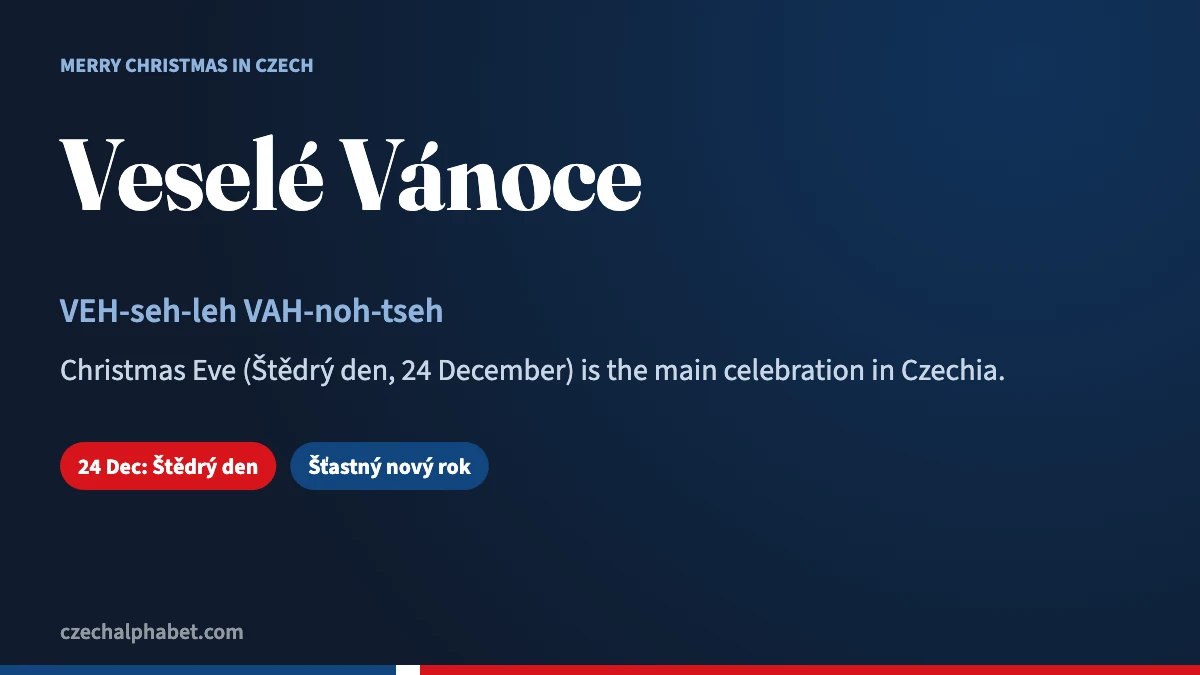
Merry Christmas in Czech is Veselé Vánoce! The word veselé means “merry” or “cheerful,” and Vánoce is Christmas. Most Czech cards pair it with a New Year wish: Veselé Vánoce a šťastný nový rok, “Merry Christmas and a happy New Year.” Below you will find the main phrases with audio, the words behind a Czech Christmas, and the customs that shape them.
How to say Merry Christmas in Czech
| Czech | English | Rough English respelling |
|---|---|---|
| Veselé Vánoce! | Merry Christmas! | VE-se-leh VAA-no-tse |
| Veselé Vánoce a šťastný nový rok! | Merry Christmas and a happy New Year! | VE-se-leh VAA-no-tse a SHTYAST-nee NO-vee rok |
| Šťastné a veselé Vánoce! | Happy and merry Christmas! | SHTYAST-neh a VE-se-leh VAA-no-tse |
| Krásné Vánoce! | Lovely Christmas! | KRAAS-neh VAA-no-tse |
| Hezké svátky! | Happy holidays! | HEZ-keh SVAAT-ki |
Three sounds matter. The c in Vánoce is always “ts,” as in “cats,” never “k.” The á is long, so the first syllable is held. And šť at the start of šťastný is “sh” followed by a soft ť [c], close to the “t” in British “tune.” English has no exact match, so a quick “shty” is a fair approximation. Our pages on the letter Ť and on Czech accents explain the marks.
Vánoce is a plural noun, so the adjective takes a plural ending: veselé, not veselá. Czech also writes it with a capital V, even in the middle of a wish. A Masaryk University lesson on Czech customs gives Veselé Vánoce a šťastný nový rok! and Šťastné a veselé vánoční svátky! as the standard Christmas wishes (Masaryk University).
Merry Christmas in Czech cards and emails
Written wishes are a little more formal than spoken ones. In business mail you will often see Příjemné prožití vánočních svátků, roughly “have a pleasant Christmas holiday,” followed by a wish for success in the new year.
| Czech | English |
|---|---|
| Příjemné prožití vánočních svátků. | Have a pleasant Christmas holiday. |
| Klidné Vánoce a hodně zdraví v novém roce. | A peaceful Christmas and lots of health in the new year. |
| Krásné svátky a vše dobré v roce 2027. | Happy holidays and all the best in 2027. |
| Šťastný nový rok! | Happy New Year! |
Many Czechs also send New Year cards marked PF plus the coming year, as in “PF 2027.” PF stands for French pour féliciter, “to congratulate,” and the cards go out before the year starts. In a wish for the whole coming year, nový rok is written in lower case; a capital Nový rok names 1 January itself.
Christmas words: Štědrý den, Ježíšek and cukroví
In Czechia the main celebration is on the evening of 24 December, Štědrý den, literally “generous day.” Families eat a festive dinner and open presents the same night. The gifts are not brought by Santa Claus but by Ježíšek, “little Jesus.” Radio Prague notes that Ježíšek is never shown in pictures, and that a ringing bell after dinner tells children he has been (Radio Prague International).
| Czech | English |
|---|---|
| Vánoce | Christmas |
| Štědrý den | Christmas Eve, 24 December |
| Ježíšek | little Jesus, the Czech gift-bringer |
| vánoční stromeček | Christmas tree |
| dárky | presents |
| cukroví | Christmas cookies |
| vánočka | braided Christmas bread |
| Silvestr | New Year’s Eve, 31 December |
Two more days follow. 25 December is 1. svátek vánoční (first Christmas holiday) and 26 December is 2. svátek vánoční, also known as St. Stephen’s Day. All three days are public holidays. Since 2016, shops larger than 200 square meters must close at noon on 24 December and stay shut on 25 and 26 December (Public holidays in the Czech Republic).
Carp, potato salad and the golden pig
The classic Christmas Eve dinner is fried carp, smažený kapr, with potato salad, bramborový salát. Many families start with fish soup, rybí polévka. Carp became the dish because fish did not count as meat on a fast day.
The habit shows up in the fish trade. According to Radio Prague, carp makes up close to 90 percent of all fish farmed in the Czech Republic, and most of it is eaten at Christmas. In December roughly 600 temporary stands sell carp on the street, often from large tubs of water (Radio Prague International). Some families still keep a live carp in the bathtub for a day or two.
Folk custom says that anyone who fasts all day on 24 December will see the zlaté prasátko, the golden pig, by evening. Children are told this mostly to keep them busy until dinner. Other old customs include cutting an apple crosswise to read the star of seeds inside, and floating walnut-shell candles in a bowl of water.
Before Christmas: Advent and Mikuláš
The season starts with advent, the four weeks before Christmas, when towns put up markets and Advent wreaths (adventní věnec). On the evening of 5 December, Mikuláš (St. Nicholas) walks the streets with an angel (anděl) and a devil (čert). Children recite a poem or sing a song and get sweets in return. Radio Prague explains why the visit comes on the 5th: in old reckoning the day began at sunset, so that evening already counted as St. Nicholas Day (Radio Prague International).
Common mistakes
- Lower-case vánoce. Write Vánoce with a capital V, in wishes too.
- Singular adjective. It is Veselé Vánoce, not Veselá Vánoce, because Vánoce is plural.
- Saying “Vanoke.” The c is always “ts”: VAA-no-tse.
- Expecting Santa. Czech children wait for Ježíšek, and presents arrive on 24 December, not on the morning of the 25th.
- Dropping the háček. “Stastny novy rok” loses the háček and the long marks; type the real letters with our guide to typing Czech characters.
- Confusing Nový rok and nový rok. Capital N is the date, 1 January; lower case is the year ahead.
For other seasonal wishes, see happy birthday in Czech and our list of Czech phrases.
Frequently asked questions
How do you say Merry Christmas in Czech?
Say Veselé Vánoce! (VE-se-leh VAA-no-tse). Add a šťastný nový rok to include a happy New Year.
Who brings Christmas presents in Czechia?
Ježíšek, “little Jesus,” brings them on the evening of 24 December. Santa Claus is known but is not the Czech tradition.
Why do Czechs eat carp at Christmas?
Fish was allowed on the Christmas Eve fast, so carp became the festive dish. It is usually fried and served with potato salad.
Is Vánoce capitalized in Czech?
Yes. Vánoce is written with a capital V, including in wishes such as Veselé Vánoce.
What does PF mean on Czech New Year cards?
PF is short for French pour féliciter, “to congratulate.” It appears with the coming year, as in PF 2027.
Sources
- Radio Prague International: Czech Christmas traditions explained
- Radio Prague International: carp sales and share of Czech fish output
- Masaryk University: Czech customs and traditions lesson (PDF)
- Wikipedia: Public holidays in the Czech Republic
- Seznam Zprávy: Vánoce and capital letters