Czech Months: Leden to Prosinec, Meanings and Audio
| Month | Czech |
|---|---|
| January | leden |
| February | únor |
| March | březen |
| April | duben |
| May | květen |
| June | červen |
| July | červenec |
| August | srpen |
| September | září |
| October | říjen |
| November | listopad |
| December | prosinec |
The Czech months are twelve native Slavic names, written in lower case: leden, únor, březen, duben, květen, červen, červenec, srpen, září, říjen, listopad, prosinec. Most come from nature or farm work: leden from ice, duben from oak, listopad “leaf fall.” In dates they take the genitive: 1. ledna.
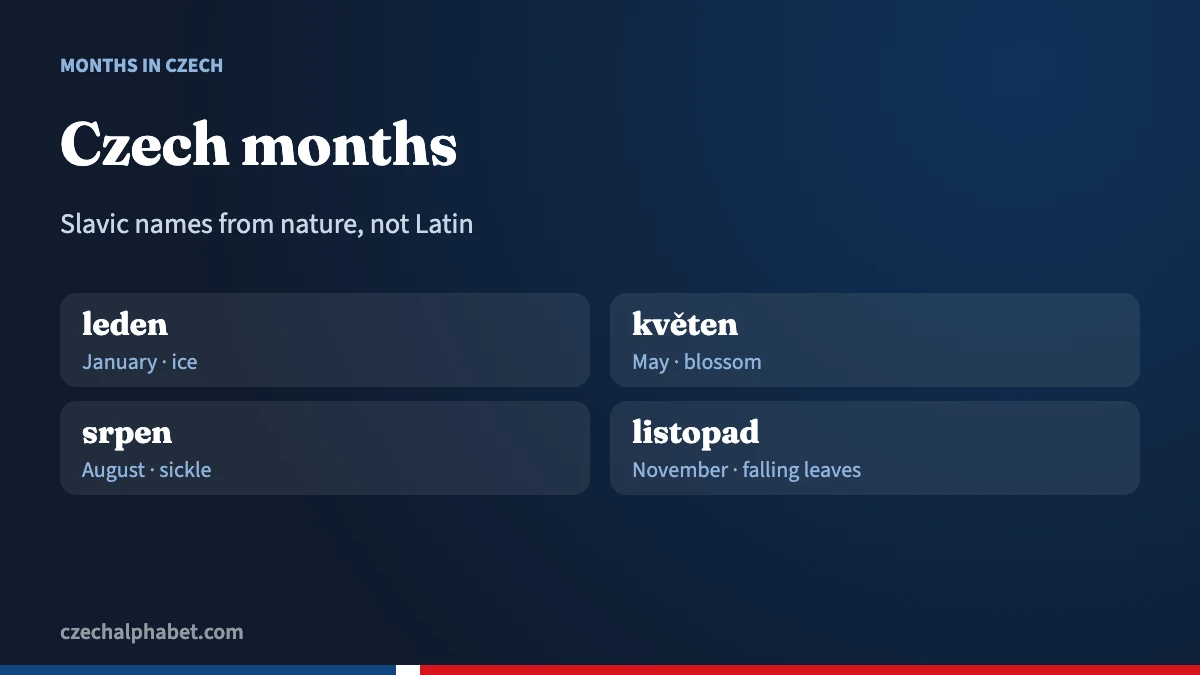
The Czech months have their own Slavic names instead of the Latin-based ones used in English. Leden (January) comes from the word for ice, duben (April) from the oak, and listopad (November) means “leaf fall.” This guide lists all twelve Czech months with audio, explains what each name means, and shows the forms you need for dates.
The 12 Czech months and what they mean
| Czech | English | Meaning of the name |
|---|---|---|
| leden | January | from led, “ice” |
| únor | February | probably from nořit se, “to plunge,” as ice sinks under water |
| březen | March | bříza “birch,” or březí “with young” |
| duben | April | from dub, “oak” |
| květen | May | from květ, “blossom” |
| červen | June | červený “red” or červ “worm” |
| červenec | July | “little červen” |
| srpen | August | from srp, “sickle” |
| září | September | Old Czech zářij, “before the rut” |
| říjen | October | from říje, the deer rut |
| listopad | November | “leaf fall” |
| prosinec | December | unclear; perhaps prosit “to beg” or a word for “pale” |
The meanings above follow the summary in Wikipedia’s article on the Slavic calendar. Some are certain, such as srpen from srp, the sickle used at harvest. Others, like březen and prosinec, have two competing explanations, and linguists still argue about them.
Květen has an unusual history. Czech originally called May máj, and the word květen spread only after Josef Jungmann used it in his 1805 translation of Chateaubriand’s Atala. Máj survives in poetry and in 1. máj, the first of May.
Czech months are not capitalized
Czech writes month names with a small letter, just like ordinary nouns: v lednu, narodil se v srpnu (“he was born in August”). The same goes for Czech days of the week. A capital letter appears only at the start of a sentence.
The names also have no short forms like “Jan” or “Feb.” In tables and forms Czechs simply write the month as a number.
Czech months in dates: the genitive
When you write a date in words, the month takes the genitive case, a form that means roughly “of.” So 1 January is 1. ledna, “the first of January.” The Czech Language Institute’s guide shows dates such as 25. května 2020 and 11. listopadu 2021, and recommends a space after each period in numeric dates: 1. 2. 2007 (Internetová jazyková příručka, ÚJČ AV ČR).
To say “in January,” use v plus the locative case: v lednu. The table gives both forms.
| Month | Date form (genitive) | “In …” (locative) |
|---|---|---|
| leden | ledna | v lednu |
| únor | února | v únoru |
| březen | března | v březnu |
| duben | dubna | v dubnu |
| květen | května | v květnu |
| červen | června | v červnu |
| červenec | července | v červenci |
| srpen | srpna | v srpnu |
| září | září | v září |
| říjen | října | v říjnu |
| listopad | listopadu | v listopadu |
| prosinec | prosince | v prosinci |
Most months follow a pattern: drop the e before the final consonant and add -a (duben → dubna). Září never changes. Listopad keeps its vowel (listopadu), and červenec and prosinec soften to července and prosince. If case endings are new to you, our overview of Czech cases explains them.
Day numbers in dates are ordinals: prvního ledna (“on the first of January”), dvacátého čtvrtého prosince (24 December). See Czech numbers for the full list.
Červen or červenec? Telling June and July apart
Even Czech children mix up červen (June) and červenec (July). The second name is simply the first plus a suffix, -ec, that makes it “the little one” after June. A handy trick: the longer word is the later month.
Listen to the stress. Both start with čer-, stressed, and červenec adds an extra syllable at the end: CHER-ve-nets. The č is the “ch” in “church”; see the letter Č.
Why Czech kept Slavic month names
Most European languages use Latin month names, and so do several Slavic ones. Slovak, the closest relative of Czech, says január, február, marec. Russian uses Latin-based names too. Czech, along with Polish, Croatian and Ukrainian, kept or revived native names tied to nature and farm work. Our page on Czech vs Slovak compares more everyday differences.
Months in Czech public holidays
Many Czech public holidays are known simply by their date, so the genitive month names come up in the news all the time. You will hear:
- 8. května: Liberation Day, the end of World War II in Europe
- 28. září: St. Wenceslas Day, the Czech statehood day
- 28. října: the founding of Czechoslovakia in 1918
- 17. listopadu: Struggle for Freedom and Democracy Day, linked to 1939 and 1989
Many Czech towns also name a street after one of these dates, such as 28. října. The full list is on the public holidays in the Czech Republic page.
Seasons and other time words
| Czech | English |
|---|---|
| jaro | spring |
| léto | summer |
| podzim | autumn, fall |
| zima | winter (also “cold”) |
| měsíc | month (also “moon”) |
| rok | year |
| týden | week |
Use na jaře for “in spring,” v létě for “in summer,” na podzim for “in autumn” and v zimě for “in winter.” The prepositions do not follow a neat rule, so learn them as set phrases.
Common mistakes
- Capitalizing months. Write leden, not “Leden,” unless it starts a sentence.
- Using the dictionary form in dates. It is 5. května, not “5. květen.”
- Mixing up červen and červenec. June is the shorter word.
- Translating Latin names. “Januar” or “Juli” are not Czech; only the native names are standard.
- Dropping diacritics. “Rijen” and “brezen” lose the ř sound; see the letter Ř.
- Writing dates without spaces. In standard text, 1. 2. 2026 has a space after each period.
Frequently asked questions
What are the Czech months?
Leden, únor, březen, duben, květen, červen, červenec, srpen, září, říjen, listopad, prosinec. They run January to December.
Are Czech months capitalized?
No. Czech writes month names in lower case unless they start a sentence.
What does listopad mean?
Listopad (November) means “leaf fall,” from list (leaf) and padat (to fall).
Why are Czech month names different from English?
Czech kept native Slavic names based on nature and farm work instead of adopting Latin ones. Slovak and Russian, by contrast, use Latin-based names.
How do you write a date in Czech?
Use the genitive of the month, as in 1. ledna 2026, or numbers with a space after each period: 1. 1. 2026.
Sources
- Wikipedia: Slavic calendar
- Ústav pro jazyk český: Internetová jazyková příručka, Kalendářní datum
- Wikiversity: Czech Language, Months and Dates