Czech Colors: Names, Endings and the Czech Flag
| Color | Czech |
|---|---|
| red | červená |
| blue | modrá |
| white | bílá |
| black | černá |
| green | zelená |
| yellow | žlutá |
| orange | oranžová |
| brown | hnědá |
Czech colors are adjectives that change their ending with the noun’s gender: červený (masculine), červená (feminine), červené (neuter) for red. The core colors are červená, modrá, bílá, černá, zelená, žlutá and hnědá. The word for color is barva, and the Czech flag is white, red and blue.
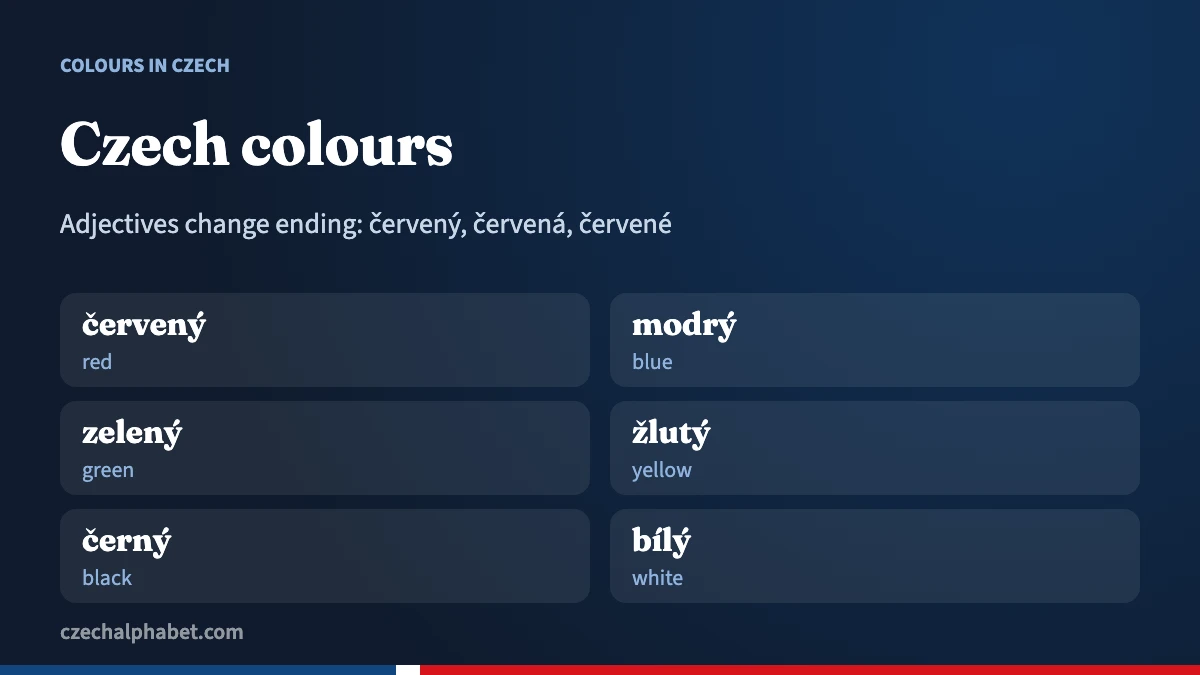
Czech colors are adjectives, so each one changes its ending to match the noun it describes. Red is červený for a masculine noun, červená for a feminine one and červené for a neuter one. The word for color itself is barva, which is feminine, so color names are often quoted in the feminine form: červená barva, “the color red.” Below are the main Czech colors with audio, the ending rules, and the colors of the Czech flag.
Basic Czech colors with audio
| Czech (feminine form) | English | Respelling |
|---|---|---|
| červená | red | CHER-ve-naa |
| modrá | blue | MOD-raa |
| bílá | white | BEE-laa |
| černá | black | CHER-naa |
| zelená | green | ZE-le-naa |
| žlutá | yellow | ZHLU-taa |
| oranžová | orange | O-ran-zho-vaa |
| hnědá | brown | HNYE-daa |
| šedá | gray | SHE-daa |
| růžová | pink | ROO-zho-vaa |
| fialová | purple | FI-a-lo-vaa |
| zlatá | gold | ZLA-taa |
| stříbrná | silver | STRZHEE-br-naa |
A few sounds need care. Č in červená and černá is the “ch” of “church.” Ž in žlutá and růžová is the “s” in “pleasure.” Hnědá starts with an h followed straight by n, which takes practice: let the h breathe, then add “nye.” In stříbrná the second r acts as a vowel, so there is no written vowel between b and n. Our Czech alphabet pronunciation chart lets you hear each letter.
For gray you will hear both šedá and šedivá. Both are correct; šedivý is the usual word for gray hair.
Czech color endings: -ý, -á, -é
Almost all Czech color words are “hard” adjectives. They take one of three endings in the basic singular form:
| Gender | Ending | Example | English |
|---|---|---|---|
| masculine | -ý | červený svetr | a red sweater |
| feminine | -á | červená taška | a red bag |
| neuter | -é | červené auto | a red car |
| plural (most nouns) | -é | červené boty | red shoes |
Dictionaries list the masculine form, so you will find modrý, zelený, žlutý. The endings shift again in other Czech cases: “with a red car” is s červeným autem. That sounds like a lot, but the pattern is the same for every color on this page.
A few loanwords do not change at all. Khaki is one: you say khaki kalhoty, “khaki trousers,” with no ending.
Czech colors in light and dark shades
To make a color lighter or darker, put světle (“light”) or tmavě (“dark”) in front of it:
| Czech | English |
|---|---|
| světle modrá | light blue |
| tmavě modrá | dark blue, navy |
| tmavě zelená | dark green |
| světle hnědá | light brown |
| blankytná | sky blue |
The same two words describe beer. Světlé pivo is pale lager, the default in any Czech pub, and tmavé pivo is dark beer. Wine is bílé víno (white) or červené víno (red). If you plan to order, see cheers in Czech and our Czech phrases list.
The colors of the Czech flag
The Czech flag is white, red and blue: bílá, červená a modrá. It has a white band on top, a red band below, and a blue wedge pointing in from the flagpole side, in a 2:3 ratio. The Czech Foreign Ministry cites Act No. 3/1993 on state symbols as its legal basis (Ministry of Foreign Affairs of the Czech Republic).
The design is older than the Czech Republic. The National Assembly of Czechoslovakia approved it on 30 March 1920, and Czechia kept it after the split in 1993, while Slovakia chose its own flag. White and red are the old colors of Bohemia; blue originally stood for Slovakia (Flag of the Czech Republic). The law names the three colors only in general terms. The Ministry of the Interior says no binding CMYK or Pantone values exist, and its own print shop uses reference values such as RGB 255/0/0 for the red (Ministry of the Interior).
Czechs often call the three colors trikolóra, the tricolor, and you will see them painted on fans’ faces at hockey matches.
Color idioms worth knowing
- dát zelenou: “to give the green,” meaning to give the green light
- černý pasažér: “black passenger,” a fare dodger on public transport
- modrá krev: “blue blood,” aristocratic family
- Červená Karkulka: Little Red Riding Hood
- vidět všechno černě: “to see everything black,” to be pessimistic
The first two are useful in daily life. Ticket inspectors on Prague trams are hunting for the černý pasažér.
Colors in Czech names and places
Color words turn up in Czech place names and surnames. Bílá hora, “White Mountain,” on the edge of Prague, gave its name to the 1620 battle that shaped Czech history for centuries. Surnames such as Černý (“black”), Bílý (“white”) and Zelený (“green”) are common, and like the adjectives they change form for women: Černá, Bílá, Zelená. Our page on Czech female surnames explains the pattern.
Asking about colors
To ask “What color is it?”, say Jakou to má barvu?, literally “What color does it have?” In a shop you can ask Máte to v modré?, “Do you have it in blue?” The answer may come as v modré barvě, “in blue color.” The question word jaký also follows the gender rules above.
Common mistakes
- Using the dictionary form for everything. It is červené auto, not “červený auto,” in standard Czech. (Casual spoken Czech does use -ý for neuter nouns, but do not copy that in writing.)
- Forgetting the long vowel. Bílá has two long vowels; “bila” means “she was beating.”
- Saying “oranžná.” The form is oranžová.
- Mixing up černá and červená. Black is černá; red is červená, with an extra syllable.
- Dropping the ring in růžová. Ů is a long u; see the letter Ů.
- Calling the flag “blue, white, red.” Czechs list it top to bottom, then the wedge: white, red, blue.
Frequently asked questions
What are the basic Czech colors?
Červená (red), modrá (blue), bílá (white), černá (black), zelená (green), žlutá (yellow), hnědá (brown) and šedá (gray).
How do you say “color” in Czech?
Barva. “What color is it?” is Jakou to má barvu?
Why do Czech color words have different endings?
They are adjectives, so they agree with the noun: modrý svetr, modrá taška, modré auto.
What do the colors of the Czech flag mean?
White and red are the traditional colors of Bohemia. Blue was added for Slovakia in 1920 and is now usually explained as standing for the state’s sovereignty and impartiality.
How do you say light blue in Czech?
Světle modrá. Dark blue is tmavě modrá.
Sources
- Ministry of Foreign Affairs of the Czech Republic: State symbols
- Wikipedia: Flag of the Czech Republic
- Ministry of the Interior: Colors of the state symbols