Czech Ď, Ť and Ň: The Soft Consonants (and Where They Hide)
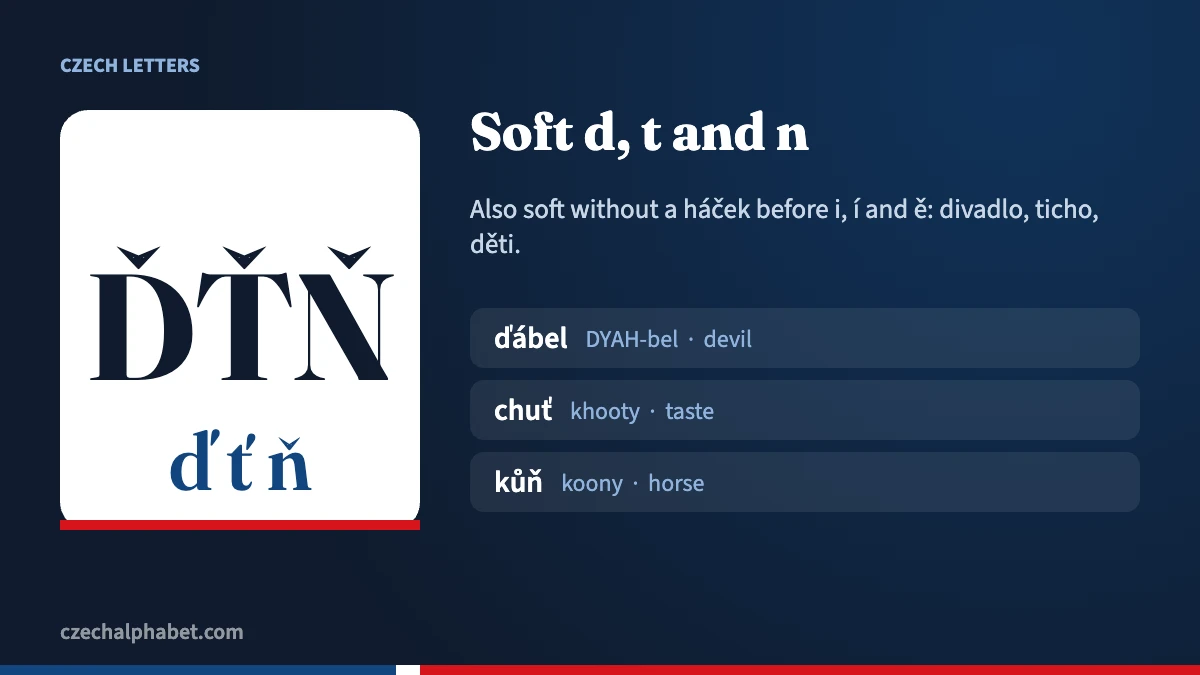
Ď, Ť and Ň are the Czech soft consonants. You make them with the middle of your tongue pressed against the hard palate, giving d, t and n a “y” colour: ď ≈ “dy” (ďábel, devil), ť ≈ “ty” (ťukat, to tap), ň = ny in “canyon” (kůň, horse). They are often hidden: di, ti, ni and dě, tě, ně are pronounced soft without any háček.
Hard and soft: D, T, N vs Ď, Ť, Ň
| Hard | Soft | Tongue | Pair |
|---|---|---|---|
| d | ď | tip on the ridge vs middle on the palate | dýně pumpkin · dítě child |
| t | ť | same as above, voiceless | ty you · ti to you (soft t) |
| n | ň | same, through the nose | den day · dlaň palm |
A good model: British English “dew”, “tune” and “new” said with the y fused into the consonant, not as two sounds.
The hidden soft consonants (the rule that matters most)
You’ll see the letters ď, ť, ň fairly rarely, because Czech spelling hides the softness in two places:
- Before i and í: divadlo (theatre) = ďivadlo, ticho (silence) = ťicho, nic (nothing) = ňic.
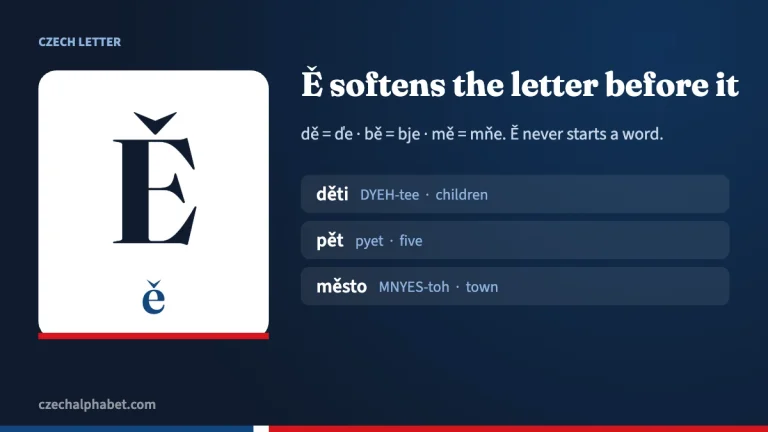
- Before ě: děti (children) = ďeťi, tělo = ťelo, něco = ňeco. See Ě.
Before y and ý, d, t, n stay hard: ty (you) is a plain t. That’s the real reason Czech keeps two letters for the same i sound. More on I and Y.
Exceptions: loanwords stay hard
Many international words keep a hard d, t, n before i: diplom, titul, nikotin, politika. If a word looks international, say it hard.
Why ď and ť look like d’ and t’
The háček on tall lowercase letters shrinks to a small stroke so it fits: ď, ť. It is still a háček. Capitals use the full mark: Ď, Ť, Ň. Always type the real character, not an apostrophe.
Plain D
Czech d is like English d but with the tongue tip a little further forward, touching the back of the upper teeth. At the end of a word it sounds like t: led (ice) = “let”, hrad (castle) = “hrat”.
Practice words
Typing Ď, Ť, Ň
- Czech keyboard: Shift + ´ (left of Backspace) gives the háček dead key; then press d, t or n.
- Mac: hold the letter and choose the háček version.
- Phone: long-press d, t or n.
Common mistakes
- Saying d + y as two sounds. ďábel is not “d-yah-bel” but one soft sound.
- Hard d, t, n before i. divadlo with an English d sounds very foreign.
- Softening before y. ty (you) has a hard t.
Frequently asked questions
How do you pronounce ď in Czech?
Like a d with the middle of the tongue on the palate, close to the d in British “dew”.
Is ň the same as Spanish ñ?
Yes, it’s the same sound: ny in “canyon”.
Why is ti soft in Czech?
Before i, í and ě, Czech d, t, n are automatically soft. Before y and ý they stay hard.
Keep going
Sources
- Wikipedia, “Czech phonology” (palatal stops and nasal): en.wikipedia.org
- Wikipedia, “Czech orthography” (di, ti, ni and dě, tě, ně): en.wikipedia.org