Please in Czech: Prosím and Its Many Meanings
| Prosím can mean | Example | Hear |
|---|---|---|
| please | Kávu, prosím. (A coffee, please.) | |
| you’re welcome | Děkuji. Prosím. | |
| pardon? | Prosím? | |
| here you are | Prosím, vaše káva. | |
| after you | Prosím. (holding a door) |
Please in Czech is prosím, pronounced PRO-seem [ˈprosiːm]. It literally means “I ask” and is one of the most versatile words in Czech: it also means “you’re welcome”, “pardon?”, “here you are” and “after you”. Add it to any request, as in Pivo, prosím (a beer, please).

“Please” in Czech is prosím [ˈprosiːm], said PRO-seem. It literally means “I ask” or “I beg”, from the verb prosit, and it does far more work than English “please”. The same word answers “thank you”, asks someone to repeat themselves, hands over your change, and holds a door open. Learn prosím well and you can get through a surprising number of daily situations with one word.
How to say please in Czech
To ask for something, add prosím at the end of the request, just as in English:
| Czech | English | Hear |
|---|---|---|
| Pivo, prosím. | A beer, please. | |
| Účet, prosím. | The bill, please. | |
| Jeden lístek, prosím. | One ticket, please. | |
| Prosím vás, kde je nádraží? | Excuse me, where is the station? | |
| Ještě jednou, prosím. | Once more, please. | |
| Pomalu, prosím. | Slowly, please. |
Pronunciation is straightforward. Stress the first syllable, tap the r once, and hold the long í like the “ee” in “seem”. The s is always a clear s, never a z.
You can also put prosím first, which sounds slightly more insistent or polite depending on tone: Prosím, můžete mi pomoct? (Please, can you help me?).
The many meanings of prosím
Radio Prague International lists a whole set of jobs for this word. Here is how each one sounds in real life. All of them grow from the same root as prosba (a request) and poprosit (to ask for something), so the core idea is always a polite asking or offering.
1. You’re welcome
The standard reply to děkuji is prosím. Someone thanks you, you answer prosím, and the exchange is complete. Alternatives are on our thank you in Czech page.
2. Pardon? Sorry, what?
Said with rising intonation, Prosím? asks someone to repeat. It is the polite version; the casual one is Co? (What?), which can sound rude to strangers.
3. Here you are
Handing something over, Czechs say prosím. A waiter setting down your soup, a cashier passing back change, a friend giving you a pen: all prosím.
4. After you
Holding a door or letting someone go first, a short prosím with a small gesture does the job.
5. Yes? How can I help?
A shop assistant or bartender may look at you and say Prosím?, meaning “What would you like?”. Some people answer the phone with prosím instead of hello.
Prosím tě and prosím vás
Adding a pronoun changes the tone. Prosím vás (formal) and prosím tě (informal) are used:
- to get attention politely: Prosím vás, kolik to stojí? (Excuse me, how much is it?);
- to make a request stronger: Prosím tě, pomoz mi (Please, help me);
- to show disbelief or mild exasperation: Ale prosím tě! (Oh, come on!).
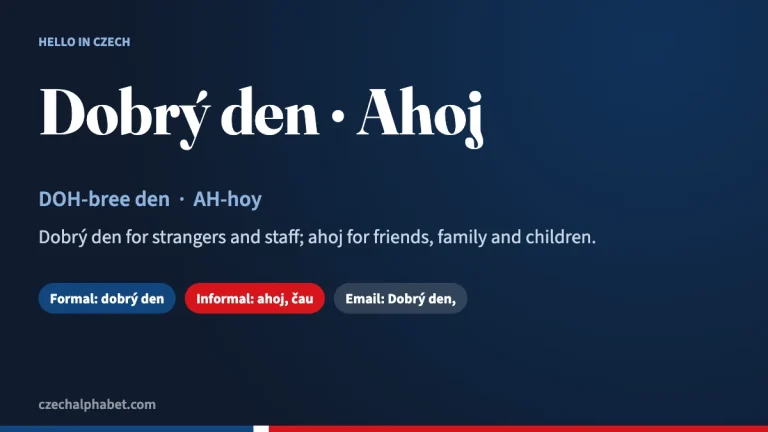
Tone matters here: the same prosím tě can be gentle or impatient depending on how you say it. Use vás with strangers and older people, tě with friends, children and family. The same formal-informal split runs through Czech greetings; see hello in Czech.
Because Czech uses prosím so often, Czechs sometimes overuse “please” in English. Radio Prague quotes a lecturer at Masaryk University who noticed flight attendants asking “Tea, please? Coffee, please?” where English speakers would say “Coffee, sir?”.
Polite requests beyond please in Czech
Prosím on its own is fine, but a few set phrases make requests sound natural:
| Czech | English | Hear |
|---|---|---|
| Chtěl bych… | I would like… (said by a man) | |
| Chtěla bych… | I would like… (said by a woman) | |
| Můžete mi pomoct? | Can you help me? | |
| Mohl byste…? | Could you…? (to a man, formal) | |
| Mohla byste…? | Could you…? (to a woman, formal) | |
| Promiňte | Excuse me, sorry (formal) |
Notice the gender pairs: chtěl and chtěla follow the speaker, while mohl and mohla follow the person you are asking. Promiňte is for getting past someone or apologizing; the informal form is promiň. Our list of Czech phrases has more.
One word, five times: a café exchange
Here is a short, realistic exchange in a Prague café. Count how often prosím appears and what it means each time.
- Waiter: Dobrý den, prosím? Hello, what would you like?
- You: Jedno kafe, prosím. One coffee, please.
- Waiter, bringing it: Prosím. Here you are.
- You: Děkuji. Thank you.
- Waiter: Prosím. You’re welcome.
- You, not catching the price: Prosím? Sorry, how much?
Five different meanings, one word. Kafe is the everyday word for coffee; the standard form is káva. Once you notice the pattern, you will hear prosím everywhere, from tram stops to the post office. To read the numbers on the bill, see Czech numbers.
Please in Czech in writing
In emails, prosím often opens a request: Prosím o zaslání faktury (Please send the invoice). The phrase prosím o plus the thing you want is polite and businesslike. Signs use it too: Prosím, nekuřte (Please do not smoke).
Keep the accent on the í. Without it, prosim is a misspelling, though you will see it in quick text messages. If you need to type it, see how to type Czech characters.
Common mistakes
- Answering “děkuji” with “děkuji”. The usual reply is prosím.
- Saying “Co?” to a stranger. Use Prosím? to ask someone to repeat.
- Stressing the second syllable. It is PRO-seem, not pro-SEEM.
- Using prosím tě with strangers. Tě is informal; use prosím vás.
- Mixing up prosím and promiňte. Prosím asks or offers; promiňte apologizes or gets attention when you need to pass. For more polite basics, see Czech greetings.
Frequently asked questions
How do you say please in Czech?
Say prosím (PRO-seem), usually at the end of a request.
Does prosím also mean you’re welcome?
Yes. Prosím is the most common reply to děkuji (thank you).
What does prosím vás mean?
It is a polite “please” or “excuse me” used with strangers, often to get attention before a question. The informal version is prosím tě.
How do you say excuse me in Czech?
Promiňte to apologize or pass someone, or prosím vás to get someone’s attention.
What does prosím mean when a shop assistant says it?
Said as a question, it means “Yes? What would you like?”.
Sources
- Radio Prague International: ABC of Czech, prosím
- Czech Tourism (VisitCzechia): useful words and phrases
- Wiktionary: prosit