Czech Phrases for Travel: 50 Useful Phrases with Audio
| Say it | Meaning |
|---|---|
| Dobrý den. | Hello (formal) |
| Prosím. | Please |
| Děkuji. | Thank you |
| Kolik to stojí? | How much is it? |
| Zaplatím, prosím. | The bill, please |
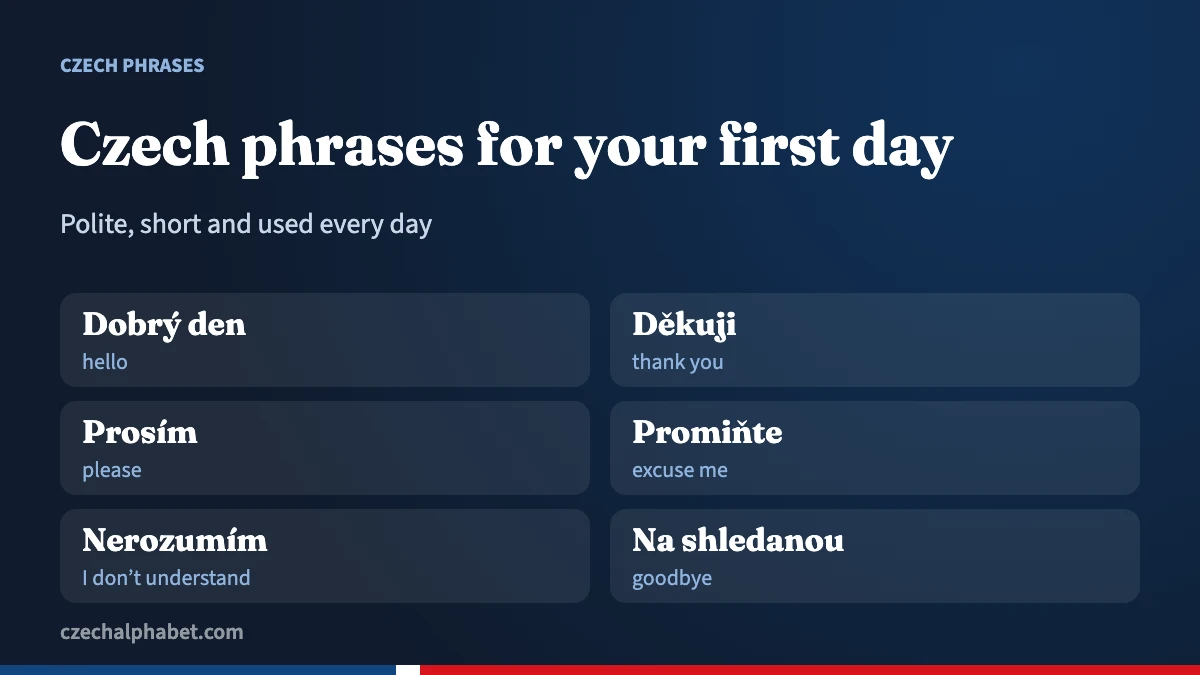
Czech phrases for travel center on a few polite formulas: Dobrý den (hello), prosím (please), děkuji (thank you), promiňte (excuse me) and Na shledanou (goodbye). Add Kolik to stojí? (how much is it?) and Zaplatím, prosím (I’d like to pay) and you can handle most shops and restaurants.
Czech phrases for travel come down to a small set of polite formulas that Czechs use every day: Dobrý den when you walk into a shop, prosím and děkuji at the counter, Na shledanou on the way out. This page groups the most useful Czech phrases by situation, each with an audio button and a rough English respelling. Press ▶ to hear the browser’s Czech voice.
All phrases here use the polite “you” (vy), which is the safe choice with strangers, staff and anyone older than you. Stress the first syllable of every word.
Basic Czech phrases: greetings and courtesy
| Czech | English | Respelling |
|---|---|---|
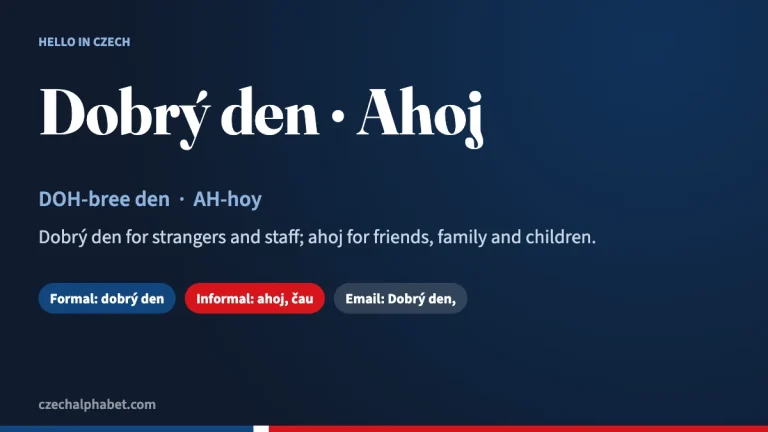
| Dobrý den. | Hello. (formal, all day) | DO-bree den |
| Ahoj. | Hi. / Bye. (informal) | A-hoy |
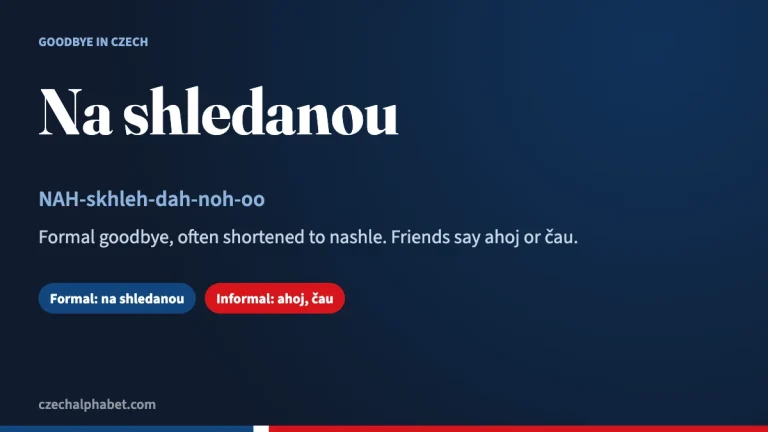
| Na shledanou. | Goodbye. (formal) | NA-skhle-da-noh |
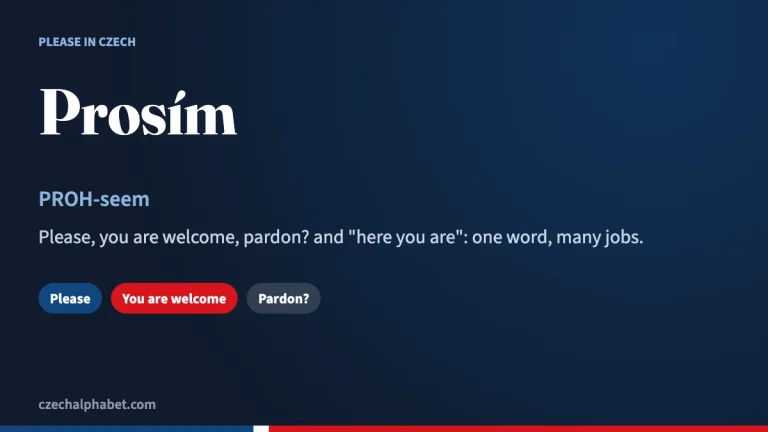
| Prosím. | Please. / Here you are. | PRO-seem |
| Děkuji. | Thank you. | DYE-ku-yi |
| Promiňte. | Excuse me. / Sorry. | PRO-min-te |
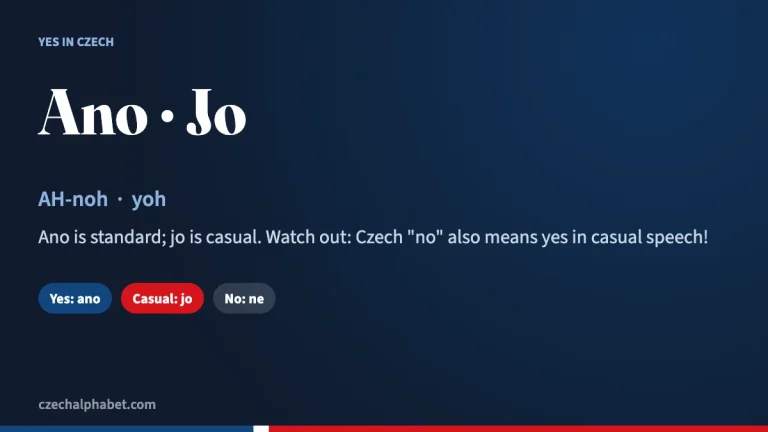
| Ano. / Ne. | Yes. / No. | A-no / ne |
| Nerozumím. | I don’t understand. | NE-ro-zu-meem |
| Mluvíte anglicky? | Do you speak English? | MLU-vee-te AN-glits-ki |
| Můžete to zopakovat? | Can you repeat that? | MOO-zhe-te to ZO-pa-ko-vat |
Dobrý den literally means “good day,” and Czechs say it from morning to evening. Saying it when you enter a small shop, a lift or a doctor’s waiting room is expected, not optional. More options are in hello in Czech and goodbye in Czech.
Czech phrases for restaurants and pubs
| Czech | English | Respelling |
|---|---|---|
| Máte volný stůl? | Do you have a free table? | MAA-te VOL-nee stool |
| Jídelní lístek, prosím. | The menu, please. | YEE-del-nyee LEES-tek, PRO-seem |
| Jedno pivo, prosím. | One beer, please. | YED-no PI-vo, PRO-seem |
| Dvě piva, prosím. | Two beers, please. | dvyeh PI-va, PRO-seem |
| Vodu bez bublinek, prosím. | Still water, please. | VO-du bez BU-bli-nek |
| Jsem vegetarián. | I am vegetarian. (man) | ysem VE-ge-ta-ri-aan |
| Na zdraví! | Cheers! | NA-zdra-vee |
| Dobrou chuť! | Enjoy your meal! | DO-broh khut’ |
| Zaplatím, prosím. | I’d like to pay, please. | ZA-pla-teem, PRO-seem |
| Dohromady, nebo zvlášť? | Together or separately? | DO-hro-ma-di, NE-bo zvlaasht |
The waiter usually asks the last question when a group pays. Answer dohromady for one bill or zvlášť to split it. A woman says Jsem vegetariánka. Before you clink glasses, read the eye-contact rule on our cheers in Czech page. Notice that “two beers” is dvě piva: Czech numbers change the noun, as our Czech numbers guide explains.
Getting around
| Czech | English | Respelling |
|---|---|---|
| Kde je nádraží? | Where is the train station? | gde ye NAA-dra-zhee |
| Kde je záchod? | Where is the toilet? | gde ye ZAA-khot |
| Jak se dostanu na letiště? | How do I get to the airport? | yak se DOS-ta-nu na LE-tyish-tye |
| Jednu jízdenku do Brna, prosím. | One ticket to Brno, please. | YED-nu YEEZ-den-ku do BR-na |
| Zastaví to v …? | Does it stop in …? | ZAS-ta-vee to v |
| Je to daleko? | Is it far? | ye to DA-le-ko |
| vlevo / vpravo / rovně | left / right / straight on | VLE-vo / FPRA-vo / ROV-nye |
Toilets are often labeled WC, read “vay-tsay,” with muži (men) and ženy (women) on the doors. City names change form after prepositions: Brno becomes do Brna, Prague becomes do Prahy. This is the Czech case system at work, covered in Czech cases.
Czech phrases for hotels
| Czech | English | Respelling |
|---|---|---|
| Mám rezervaci. | I have a reservation. | maam RE-zer-va-tsi |
| Na jméno … | Under the name … | na YMEH-no |
| Máte volný pokoj? | Do you have a free room? | MAA-te VOL-nee PO-koy |
| Je snídaně v ceně? | Is breakfast included? | ye SNYEE-da-nye f TSE-nye |
| Jaké je heslo na wifi? | What is the wifi password? | YA-keh ye HES-lo na VI-fi |
| V kolik hodin je odhlášení? | What time is checkout? | f KO-lik HO-dyin ye OD-hlaa-she-nyee |
Many hotels in Prague work in English, but these lines help in smaller towns and family-run guesthouses, called penzion. Breakfast is snídaně, and “the room key” is klíč od pokoje.
Shopping and paying
| Czech | English | Respelling |
|---|---|---|
| Kolik to stojí? | How much is it? | KO-lik to STO-yee |
| Můžu platit kartou? | Can I pay by card? | MOO-zhu PLA-tyit KAR-toh |
| Jenom se dívám. | I’m just looking. | YE-nom se DYEE-vaam |
| To je všechno. | That’s all. | to ye FSHEKH-no |
| Chtěl bych tohle. | I’d like this. (man) | khtyel bikh TO-hle |
| Chtěla bych tohle. | I’d like this. (woman) | KHTYE-la bikh TO-hle |
Shop staff often ask Ještě něco?, “Anything else?” Reply Ne, děkuji, to je všechno. Notice the man/woman forms: Czech past and conditional verbs change with the speaker’s gender, so chtěl becomes chtěla for a woman.
Help and emergencies
| Czech | English | Respelling |
|---|---|---|
| Pomoc! | Help! | PO-mots |
| Zavolejte doktora! | Call a doctor! | ZA-vo-ley-te DOK-to-ra |
| Ztratil jsem pas. | I’ve lost my passport. (man) | ZTRA-tyil ysem pas |
| Je mi špatně. | I feel sick. | ye mi SHPAT-nye |
| Kde je lékárna? | Where is the pharmacy? | gde ye LEH-kaar-na |
Emergency numbers in Czechia: 112 (general European emergency line), 155 (ambulance), 150 (fire), 158 (police) and 156 (city police). Calls are free and answered around the clock, according to the government’s Portál veřejné správy.
Small talk
| Czech | English | Respelling |
|---|---|---|
| Jak se máte? | How are you? (formal) | yak se MAA-te |
| Dobře, děkuji. | Fine, thank you. | DOB-rzhe, DYE-ku-yi |
| Jmenuji se … | My name is … | YME-nu-yi se |
| Odkud jste? | Where are you from? | OT-kut yste |
| Jsem z Ameriky. | I’m from America. | ysem z A-me-ri-ki |
| Těší mě. | Nice to meet you. | TYE-shee mnye |
Jak se máte? is a real question in Czech, not a passing hello, so expect an honest answer. Our page on how are you in Czech covers the replies.
Common mistakes
- Skipping Dobrý den. Walking into a small shop in silence comes across as rude.
- Using ahoj with strangers. Ahoj is for friends, family and children. Use Dobrý den with staff.
- Reading c as k. Pomoc ends in “ts”: PO-mots.
- Ignoring gender in verbs. Men say chtěl bych, women chtěla bych.
- Pronouncing kde as “kuh-deh.” It is one syllable: “gde.”
- Typing without diacritics. “Dekuji” and “prosim” are readable, but děkuji and prosím are correct; see how to type Czech characters.
Frequently asked questions
What are the most important Czech phrases for tourists?
Dobrý den (hello), prosím (please), děkuji (thank you), promiňte (excuse me), Kolik to stojí? (how much?) and Na shledanou (goodbye).
How do you ask for the bill in Czech?
Say Zaplatím, prosím (“I’ll pay, please”). Účet, prosím (“the bill, please”) also works.
How do you say “Do you speak English?” in Czech?
Mluvíte anglicky? (MLU-vee-te AN-glits-ki).
How do you order a beer in Czech?
Jedno pivo, prosím for one, dvě piva, prosím for two.
What is the emergency number in the Czech Republic?
Dial 112 for any emergency. Direct lines are 155 (ambulance), 150 (fire) and 158 (police).
Sources
- Portál veřejné správy: Emergency calls
- Masaryk University: Czech customs and traditions lesson (PDF)
- Radio Prague International: The delicacies of you and You