Czech Numbers: Count from 0 to 1,000,000 with Audio
Czech numbers are words such as jeden (1), dva (2), tři (3), deset (10) and sto (100). The numbers 1 and 2 change with the noun’s gender (jeden, jedna, jedno; dva, dvě). From 5 up, the noun takes the genitive plural, so “five beers” is pět piv.
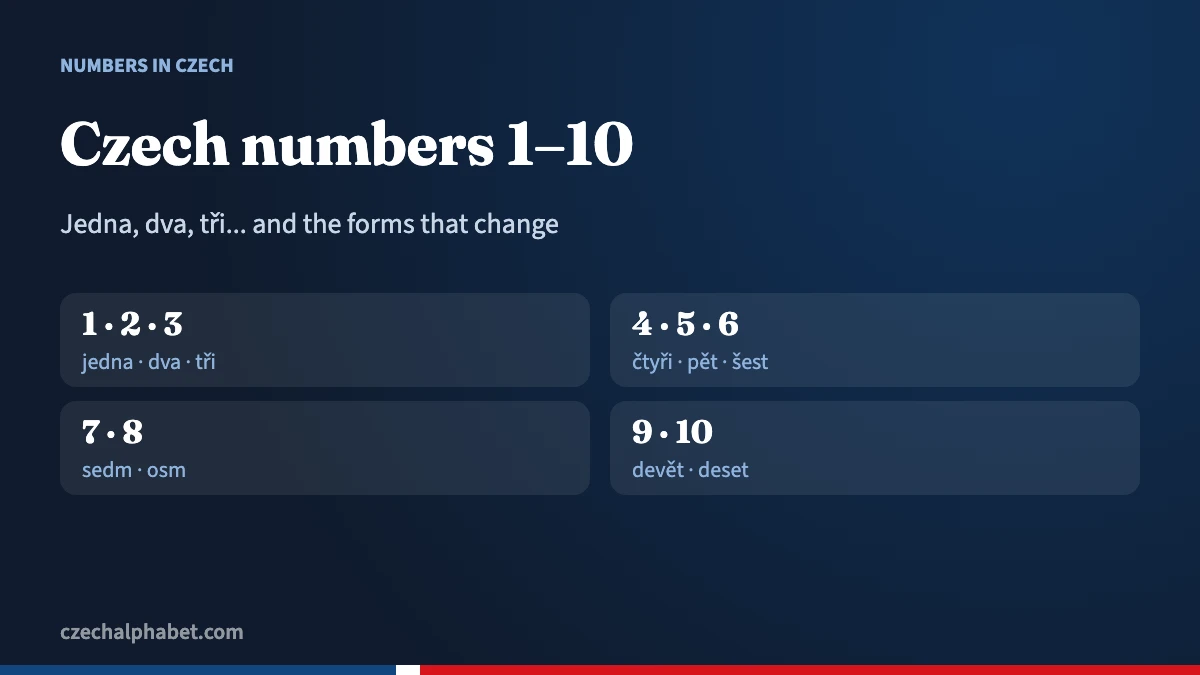
Czech numbers follow a regular pattern once you know the first twenty, the tens and a few rules for nouns. The number tool above turns any figure from 0 to 999,999 into words and reads it aloud. This guide explains what the tool does not: how one and two change with gender, why “five beers” uses a different form from “two beers,” and how Czechs say years and prices.
Czech numbers 0 to 20
| Number | Czech | Rough English respelling |
|---|---|---|
| 0 | nula | NU-la |
| 1 | jeden / jedna / jedno | YE-den / YED-na / YED-no |
| 2 | dva / dvě | dva / dvyeh |
| 3 | tři | trzhi |
| 4 | čtyři | CHTI-rzhi |
| 5 | pět | pyet |
| 6 | šest | shest |
| 7 | sedm | SE-dum |
| 8 | osm | O-sum |
| 9 | devět | DE-vyet |
| 10 | deset | DE-set |
| 11 | jedenáct | YE-de-naatst |
| 12 | dvanáct | DVA-naatst |
| 13 | třináct | TRZHI-naatst |
| 14 | čtrnáct | CHTR-naatst |
| 15 | patnáct | PAT-naatst |
| 16 | šestnáct | SHEST-naatst |
| 17 | sedmnáct | SE-dum-naatst |
| 18 | osmnáct | O-sum-naatst |
| 19 | devatenáct | DE-va-te-naatst |
| 20 | dvacet | DVA-tset |
The teens all end in -náct, which works like English “-teen.” Note the spelling shifts: pět becomes patnáct, čtyři shrinks to čtrnáct, and devět turns into devatenáct.
Three numbers trip up English speakers. Tři and čtyři contain ř, the famous Czech sound with no English equivalent; see how to pronounce the Czech Ř. Sedm and osm end in a syllabic m [sɛdm̩], so there is no written vowel, but the m carries its own beat. Čtrnáct uses a syllabic r the same way.
Czech numbers: tens, hundreds and thousands
| Number | Czech |
|---|---|
| 30 | třicet |
| 40 | čtyřicet |
| 50 | padesát |
| 60 | šedesát |
| 70 | sedmdesát |
| 80 | osmdesát |
| 90 | devadesát |
| 100 | sto |
| 200 | dvě stě |
| 300 | tři sta |
| 500 | pět set |
| 1,000 | tisíc |
| 2,000 | dva tisíce |
| 5,000 | pět tisíc |
| 1,000,000 | milion |
Notice that “hundred” and “thousand” change form. After 2 you say stě, after 3 and 4 sta, and from 5 up set. Thousands work the same way: tisíc, dva tisíce, pět tisíc. Bigger numbers are built from the top down with no “and”: 5,600 is pět tisíc šest set (Czech Online, cardinal numbers).
Two ways to say 21: dvacet jedna or jednadvacet
From 21 to 99, Czech has two word orders. The first matches English: dvacet jedna (“twenty-one”). The second puts the unit first and joins it with a, as in German: jednadvacet (“one-and-twenty”). Radio Prague notes that the reversed forms are more common in casual speech (Radio Prague International).
| Number | Order like English | Reversed order |
|---|---|---|
| 21 | dvacet jedna | jednadvacet |
| 25 | dvacet pět | pětadvacet |
| 48 | čtyřicet osm | osmačtyřicet |
| 22,000 | dvacet dva tisíc | dvaadvacet tisíc |
The tool above uses the English-style order, so it shows 21 as dvacet jedna and 22,000 as dvacet dva tisíc. Both orders are correct. You will also hear dvacet dva tisíce for 22,000, because some speakers let the last part, dva, decide the form of “thousand.” Pick one style and stay with it in a single sentence.
Note that a final 1 in a compound number is usually jedna: sto jedna (101), dvacet jedna. On its own, before a masculine noun, it is jeden.
Gender: one and two change their form
Czech nouns are masculine, feminine or neuter, and the numbers 1 and 2 agree with them.
| Gender | One | Two |
|---|---|---|
| masculine | jeden muž (one man) | dva muži (two men) |
| feminine | jedna žena (one woman) | dvě ženy (two women) |
| neuter | jedno pivo (one beer) | dvě piva (two beers) |
From 3 up, the number itself stays the same for every gender. The forms of jeden also change by case, which our page on Czech cases covers.
Counting things: 2 to 4 versus 5 and up
This is the rule that surprises learners most. After 2, 3 and 4 the noun goes in the normal plural. From 5 up it switches to the genitive plural, a form that roughly means “of.”
| Czech | English |
|---|---|
| jedno pivo | one beer |
| dvě piva | two beers |
| čtyři piva | four beers |
| pět piv | five beers |
| jedna koruna | one crown |
| tři koruny | three crowns |
| sto korun | a hundred crowns |
So a price tag of 5 Kč or more is read with korun: padesát korun, 50 crowns. The same genitive follows kolik (“how many”) and několik (“several”). For shopping lines that use this, see our Czech phrases list.
Czech ordinal numbers: first, second, third
Ordinals behave like adjectives and change their ending with gender. The masculine forms are první (first), druhý (second), třetí (third), čtvrtý (fourth), pátý (fifth) and desátý (tenth). In writing, Czech marks an ordinal with a period: 1. máj, 21. století (the 21st century).
Reading years, dates and phone numbers
For years up to 1999, Czechs usually split the year like English: 1989 is devatenáct set osmdesát devět, though tisíc devět set osmdesát devět is also correct. From 2000 on, they say the full number: 2026 is dva tisíce dvacet šest.
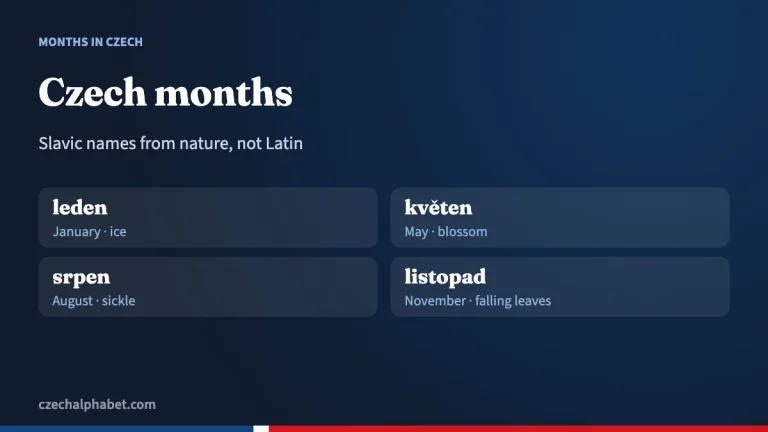
Dates use ordinal numbers in the genitive: “on 1 May” is prvního května. Our page on Czech months lists those forms. Phone numbers are usually read in groups of three digits, as in šest set dva, sto dvacet tři….
In writing, Czech separates thousands with a space and uses a decimal comma: 22 000 and 1,5 (one and a half).
Common mistakes
- Using dva with feminine nouns. It is dvě ženy, dvě koruny, not “dva ženy.”
- Keeping the plural after 5. Say pět piv, not “pět piva.”
- Saying “sto a jedna.” Czech has no “and” inside a number: sto jedna.
- Forgetting the háček. Pět (five) and “pet” are different words; the ě makes the “pye” sound. See the letter Ě.
- Adding a vowel to sedm. Do not write “sedum”; the m is syllabic.
- Reading 1,5 as fifteen hundred. In Czech the comma is a decimal point.
Frequently asked questions
How do you count to 10 in Czech?
Jedna, dva, tři, čtyři, pět, šest, sedm, osm, devět, deset. In plain counting Czechs say jedna for one.
Is 21 in Czech dvacet jedna or jednadvacet?
Both are correct. Dvacet jedna follows English order, while jednadvacet puts the unit first and is common in everyday speech.
Why do Czech numbers change after five?
From 5 up, the counted noun goes in the genitive plural: dvě piva but pět piv. Numbers 2 to 4 take the ordinary plural.
How do you say 100 and 1,000 in Czech?
100 is sto and 1,000 is tisíc. Their forms change after other numbers: dvě stě, pět set, dva tisíce, pět tisíc.
How do Czechs say years?
Before 2000 they usually say devatenáct set plus the rest (1989: devatenáct set osmdesát devět). From 2000 on they say dva tisíce plus the rest.
Sources
- Czech Online: Cardinal numbers (PDF)
- Radio Prague International: Czech by Numbers, Twenty
- Britannica: Czech language